वो खुद थी

दरवाज़े, जिनकी चाबी उसी के पास ही थी,
कुछ एक मेरे लफ्ज़, जो वो ही थी समझती,
समझ जाती थी ज़ुबान खामोशियों की भी,
सांसे उसके लिए जैसे सरगम किसी गाने की।

एक दिन ऐसा आया, वो बोली में चली जाउंगी,
तुम्हारी कुछ आदते हैं जो मैं कभी सह ना पाउंगी,
क्या पता उसको के सबसे बड़ी आदत वो खुद थी,
मेरे दरवाज़े की चाबी,
मेरे अनसुलझे लफ्ज़,
मेरी सांसे,
और मैं….

वो खुद थी…….

Yes, she was
हां, वो उसकी आदत थी ।। Yes, she was his habit

A Hindi poem, this one talks about the closeness and the “used to” kind of bond the lovers share, so much so that when the lady decides to leave citing few of the man’s habits that she can’t tolerate anymore, it turns out that the man considers her his biggest habit, as his key to happiness, as his unspoken words, even as his breath and he himself.

I have to admit that owing to time constraints and many ongoing projects, I am unable to give time to creative writing as much as I should. So, after a long time, here it is.

VERY IMPORTANT TO NOTE: Yes, you can share this work with proper attribution. But, please seek permission before using this work (not including the photo), partially or fully. YOU CAN NOT USE THE PHOTO. Believe me, asking is better than ending up in court or facing public shaming on social media. Thanks for understanding.

© Amrit Panigrahy. All rights reserved.

Genesis of Jagannath

The mythical King Indradyumna saw in his dream a manifestation of Lord Vishnu as Nila Madhava (the Blue Vishnu), in the form of an Indranil gem. He sent out his courtiers in all directions to find out more about his dream. Among the courtiers was Vidyapati, the younger brother of the royal priest. He travelled east from King Indradyumna’s capital city of Avanti (present day Ujjain, in Madhya Pradesh). On his way he came to know about the legends of Kitung, a Sabara (tribal) God, being worshipped by the Sabara chief Vishwabasu. Kitung’s description sounded very much similar to that of what King Indradyumna had seen in his dreams.

With lot of difficulties, Vidyapati reached the Sabara village near Brahmadri hills on the banks of a big river (present day Mahanadi, in Odisha), the place where Vishwabasu lived along with his daughter Lalita and his other subjects. Vishwabasu was very secretive about the location of his God, Kitung, because he was bound by a pre-condition by Him that the day any outsider came to know about His secret location, He would vanish. After living there for many months, Vidyapati was able to win Lalita’s heart and gain Vishwabasu’s confidence, after being one of them.

After Vishabasu agreed for the marriage, on Vidyapati’s request he also agreed to take him to Kitung, but put up a condition that Vidyapati must be blindfolded for the entire route. Vidyapati agreed to this condition, however, secretly kept a handful of mustard seeds under his waist belt. While walking behind Vishwabasu, blindfolded and holding his hand, Vidyapati kept sprinkling the mustard seeds all through the way. After reaching the cave of Kitung, he could confirm that Kitung was what his King was looking for. He was indeed Nila Madhava.

On pretext of calling his parents and other family members for his marriage, Vidyapati went to Avanti, and reported to King Indradyumna about the location of Lord Nila Madhava. The King having found his Lord, gathered everyone and marched east, towards Vishwabasu’s village. Upon reaching the village, Vidyapati easily identified the route because the mustard seeds he had sprinkled had grown into small trees, and their bloom marked the path with their yellow flowers. When King Indradyumna reached the cave, with Vidyapati, Vishwabasu, Lalita and everyone else in toe, it was empty. Vishwabasu’s Kitung had vanished, as per the condition with him.

Having not found Nila Madhava, King Indradyumna repented. That’s when the voice from the heavens directed him and others to go further east, to the sea, where the Lord would then manifest Himself in the form of a very large, fragrant, reddish log, and the signs of conch, disc, mace, and lotus can be found everywhere on it. They were instructed to take out log from the sea, and make four deities out of it and worship them.

The location they found the log at would be present day Puri, on the east coast. The four deities would be the siblings – Lord Jagannath, Lord Balabhadra, Goddess Subhadra, and Sudarshan. The descendants of Vidyapati and Lalita, and the people from Vishwabasu’s tribe still serve Lord Jagannath and His siblings in Puri. Vishwabasu’s village on the banks of Mahanadi is today known as Kantilo, in Nayagarh district in Odisha. A temple was built in later centuries and Lord Nila Madhava was consecreted at the same spot where Vishwabasu once worshipped Kitung.

What happened of King Indradyumna? Well, that’s a story for some other time!

I grew up listening to these as bed time stories, and at other times reading them from story books. The more I listened and read, I got fascinated by things of the past, legend or truth. I wonder if the later generations could ever relate to these.

Nila Madhava
A priest comes running down the stairs of the west gate of the Nila Madhava temple, in Kantilo, Nayagarh district, in Odisha.

In frame: A priest comes running down the stairs of the west gate of the Nila Madhava temple, in Kantilo, Nayagarh district, in Odisha. Kantilo is believed to be the place where Lord Jagannath was being worshipped in his earlier manifestation of Lord Nila Madhava or Kitung, by the Sabara chief Vishwabasu.

VERY IMPORTANT TO NOTE: Yes, you can share this work with proper attribution. But, please seek permission before using this work (not including the photo), partially or fully. YOU CAN NOT USE THE PHOTO. Believe me, asking is better than ending up in court or facing public shaming on social media. Thanks for understanding.

© Amrit Panigrahy. All rights reserved.

रूही

हर एक आशियाने पे जैसे वो चला देती थी अपनी जादू की छड़ी,
सुला के सबको, सपनों की रखवाली करती हुई रात भर रहती थी खड़ी |

सुबह की पहली रोशनी के साये में जैसे वो लड़खड़ाती हुई चल रही थी,
सपनों से भरी रात के नशे से लगभग बेहोश, अपने कदमों को संभालती।

उसकी अपनी कदमों की आहट जैसे उसी के जादू को थी तोड़ रही,
मुस्कुराती, और एक रूहानी रात का वादा करके चली गयी, रूही।

Daybreak
The setting moon over Hyderabad’s skyline, as seen from Moula Ali, in Hyderabad, India.

As if she ran her magic wand over all the dwellings during the night, and after having made everyone fall asleep,  she stood guard to their dreams. Under the shade of the first light of the morning (poetic expression), she unsteadily walked, still drunk on the dreams from the night, she tried keep herself steady. It was as if her own footsteps were undoing her magic spell, and with a smile on her face, Ruhi walked away promising another intriguing night.


It was magical indeed, my first ever photowalk, and first ever trip to Moula Ali, on the other side of Hyderabad. The moon was setting over the sleepy Hyderabadi skyline, and the dawn was breaking in the opposite direction.

These were my very early days in photography, when I was using a Sony HX100V (with a sensor that was 1/4th of what my current DSLR has). And I didn’t know RAW even existed (yes, perils of being self taught!), so bear with me for the resolution of the image.

In frame: The setting moon over Hyderabad’s skyline, as seen from Moula Ali, in Hyderabad, India. It was magical indeed, just being there at that moment, with the moon setting in front of me, and behind me, the dawn breaking.

VERY IMPORTANT TO NOTE: Yes, you can share this work with proper attribution. But, please seek permission before using this work (not including the photo), partially or fully. YOU CAN NOT USE THE PHOTO. Believe me, asking is better than ending up in court or facing public shaming on social media. Thanks for understanding.

© Amrit Panigrahy. All rights reserved.

ଘରବାହୁଡା

ସବୁ ସନ୍ଧ୍ୟାରେ ସଜବାଜ ହୁଏ ଗତକାଲିର ନିରାଶାକୁ ଭୁଲି,

ବାର ବର୍ଷ କାଳ ଅପେକ୍ଷାରେ ତୋର ହେଇଟି ଆସିବୁ ବୋଲି।

ମାଆ ମୋର କୁହେ, “ଝିଅ ଲୋ, ସେ ଆସିବନି ଆଉ ଫେରି”,

ହେଲେ ମୁଁ ଆସି ଠିଆ ହୁଏ ଦୁଆରେ ହେଲେ ଯେତେ ବି ଡେରି।

ଗାଁକୁ ଫେରନ୍ତି ସାଙ୍ଗ ସାଥି ହେଲେ ତୋର ସେତେ ସମୟ କାହିଁ,

ମନ୍ଦିର ତୋଳାରେ ବ୍ୟସ୍ତ ଅଛୁ ତୁ, ଆଉ କୋଉଠି ତୋ ଧ୍ୟାନ ନାହିଁ।

ତୋ ମୁକୁତା ହାର ଗଳାରେ ମୋର, ସିଏ ବି ଗଲାଣି ଥକି,

ସତେ ଯେମିତି ପଚାରେ ମୋତେ, “ସେ ଆଉ ଆସିବନି କି?”

ସବୁ ସନ୍ଧ୍ୟାରେ ଠିଆ ହୁଏ ବୋଲି ଗାଁ ଲୋକ କହିଲେଣି କେତେ କଥା,

କେହି ଡାକିଲାଣି ମୋତେ ଅଳସକନ୍ୟା ତ ଆଉ କିଏ ଡାକେ ଅଭିସାରିକା।

ବାର ବର୍ଷ ତଳେ ଯାଇଥିଲୁ ତୁ, କହିଲୁ ଫେରିବି କିଛି ଦିନରେ,
ମନ୍ଦିର ତୋଳା ତୋର ସରିନି ଆହୁରି, ଘରକୁ ଜଲଦି ଫେରେ।

Abhisarika
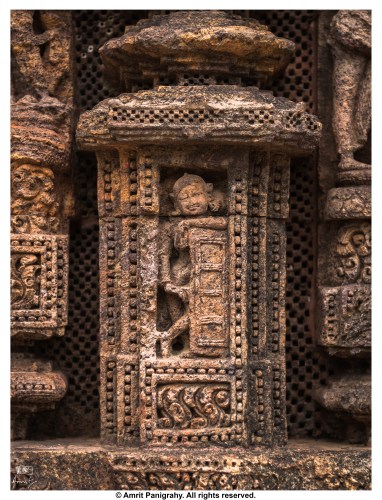
A sculpture of a lady waiting with half the door open, with a smile on her face. You can see this on the south side of Konark temple, in Odisha, India.

The Odia poem I wrote above is called “ଘରବାହୁଡା”, (pronounced as ghaw-raw-baa(as in baba)-hu(as in who)-da(as in dark), which means homecoming. A fiction based poem, the central character is a woman, who has been separated from his male consort or husband for twelve long years, because he is a sculptor by profession, and has been summoned by the King of the land, for construction of the Sun temple at Konark. She narrates how she dresses up every evening and stands near the door smiling, hoping against hope that he would come back, even though she had returned inside disappointed the previous evening. It has been twelve years and even her mom has now lost hope that he would ever return, but she stands and waits every evening, no matter how late. Even the pearl necklace that he had gifted her has become pale, as if tired of waiting for him and asking her whether he would ever return. Looking at her standing at the door every evening, people around her have starting thinking of her a dance girl, or a whore, in search of patrons. Then she goes on to urge him to come back home as soon as possible, regardless of the temple completion.

This sculpture, might be a figment of imagination of the sculptor, shows how his consort or wife might be waiting for him to return. By the time he must have finished this sculpture, he must have been away from home for twelve long years, or slightly more. Did you notice the smile on the figurine’s face? This was how the sculptor must have imagined to see her upon his return home, with a smile on her face.

1200 architects and sculptors took twelve years to build the Sun temple at Konark and it was finished in 1256 AD. King Narasimha Deva III spent 40cr gold coins to build this architectural marvel, the cost also included that of land reclamation from the sea (you heard that right!), as it is believed that the temple was built in the sea. There are many legends and stories associated with Konark, which I am saving for some other time, with your permission of course!

In frame: A sculpture of a lady waiting with half the door open, with a smile on her face. You can see this on the south side of Konark temple, in Odisha, India. Konark temple is full of sculptures which showcase every human emotion, and not only erotica as is popularly believed. In the words of Ravindranath Tagore, “Here the language of stone surpasses the language of human.”

VERY IMPORTANT TO NOTE: Yes, you can share this work with proper attribution. But, please seek permission before using this work (not including the photo), partially or fully. YOU CAN NOT USE THE PHOTO. Believe me, asking is better than ending up in court or facing public shaming on social media. Thanks for understanding.

© Amrit Panigrahy. All rights reserved.

Crimson Love

I had fallen back, to witness the drama that was unfolding in the sky.

My guide called out my name from a distance….

It was only minutes ago that he was here,
Telling me stories from the yesteryear,
Tales of opulence, generosity, valor and love,
For an open heart it was like a treasure trove.

Of all the stories, one was of interest in particular,
A King, his Queen, and love that was spectacular,
A poetess and a singer, she could bring words to life,
Smitten by her, the King convinced her to be his wife.

They were living happily ever after, or so they thought,
A big army attacked the kingdom, and a battle fought,
The King was killed in battle, was what the messenger told,
The Queen drank poison, and her lifeless body went cold.

The medieval fort, a witness to her love story,
Her eternal love for him that took her to glory,
Walking on that pavilion even I felt as a part it,
Kind of gloomy that in the end they couldn’t unite.

I glanced beyond the ramparts, as I walked back…

Crimson sun set over the horizon,
Leaving behind a familiar emotion.

And as it went…

The hues that it painted and the winter sky it tore,
Colors of desire and pain, that touches one’s core.

More than a year has gone since…

Crimson, is the color that I remember of that evening,
Of longing, the want of belonging and a love undying.

Crimson Love, ‘t was!

Drama in the sky
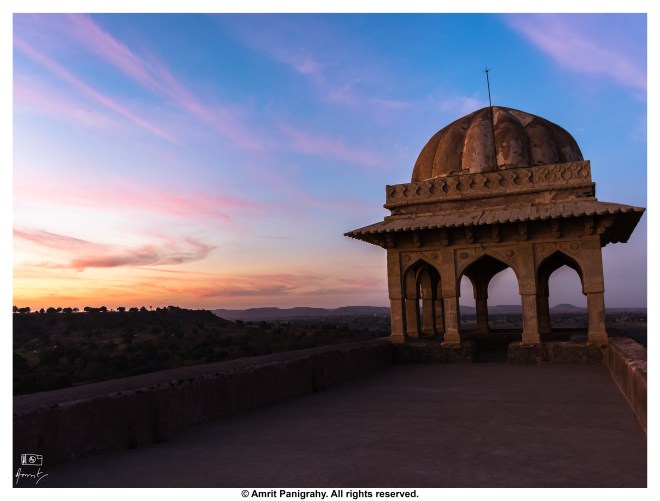
Brilliant hues of the winter sky just after the sunset, as seen from Roopmati pavilion in Mandu

I had earlier written a Hindi poem on Roopmati and called it “Jauhar”. You can read it here.

Mandu, or Mandav was capital of erstwhile kingdom of Malwa. Mandu is dotted with love tales of Sultan Baz Bahadur of Malwa, and his queen consort Roopmati.

Kingdom of Malwa used to be a vassal of the Mughals, and had declared indepedence taking advantage of the instability that ensued just after Akbar had taken control.

Akbar then sent his foster brother Adham Khan and a large contingent of the Mughal army to subdue Malwa. Adham Khan, who had by then heard of Roopmati’s enchanting beauty, had resolved to defeat Malwa and take her as a prized possession of his harem.

Baz Bahadur faced Adham Khan and the Mughals in Sarangpur with a small contingent. Baz Bahadur’s contingent was no match for the mighty Mughals and he escaped after being defeated.

Adham Khan then marched on to Mandav. Thinking that Baz Bahadur was slained in the battle, Roopmati poisoned herself, as she could not have seen another man in her life. Such was her love.

In due time, Adham Khan was executed by Akbar. Baz Bahadur surrendered to Akbar and was in return made the mansabdar of Malwa.

And for Roopmati, her love and loyalty for Baz Bahadur still fascinates imagination of the new generation of tourists to Mandu.

In frame: Brilliant hues of the winter sky just after the sunset, as seen from Roopmati pavilion in Mandu, Madhya Pradesh, India. Roopmati pavilion was built by Sultan Baz Bahadur for Roopmati, so that she could Narmada darshan everyday (one of her pre-conditions to her marriage with him). Narmada flows at a distance, in the plains.

VERY IMPORTANT TO NOTE: Yes, you can share this work with proper attribution. But, please seek permission before using this work (not including the photo), partially or fully. YOU CAN NOT USE THE PHOTO. Believe me, asking is better than ending up in court or facing public shaming on social media. Thanks for understanding.

© Amrit Panigrahy. All rights reserved.

Me too!

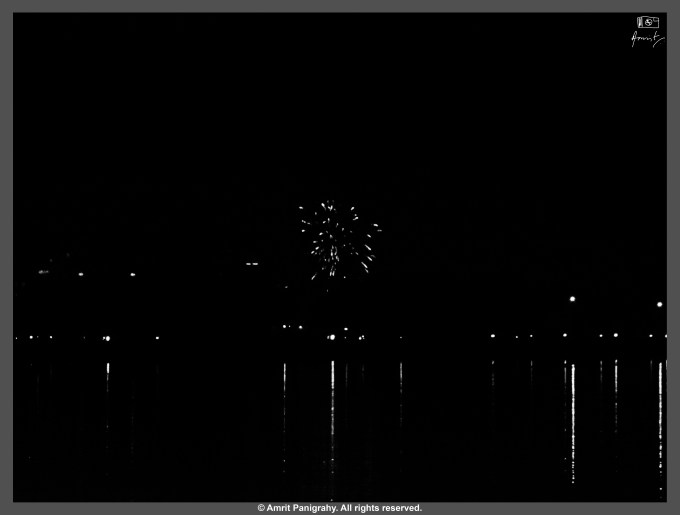
The sun had hidden behind the highrises for quite sometime now, and it was starting to get dark. The slum by the side of the polluted lake was getting ready for Diwali, in its own way.

“Kali, give Debu something to eat.”, said Kartik, Kali’s father. “He guided me home from the theka again today”, he said in a slurry voice, before falling on the ground, missing the soiled mattress by some distance. Kali was Kartik’s only child. Kartik, a widower, was a rickshaw puller in the city by the day and an alcoholic at sunset. After the days work, he would go to the theka on the periphery of their slum and spend almost all of his day’s earnings on country liqour. Kali had already seen more than her fair share of life, so her father’s alcoholism was something Kali was least concerned about.

Kali was married off at fourteen to Shambhu, a man twice her age. Shambhu was a migrant construction worker in the city. After the initial trauma of getting married at such a young age, her life was slowly turning for the better. She gave birth to Roshan, a son, when she was sixteen, a healthy child but for a medical condition which turned him blind at night. Two years back on the day of the Diwali, Kali was decorating their shanty with earthen diyas, when one of their neighbours came running and broke the news of Sambhu’s death in a road accident. Sambhu had gone to work on Diwali for the double bonus. Six months pregnant with her second child then, Kali was broken. She had no choice but to come and live with her father. Kartik was living alone after his wife had passed away, immediately after marrying Kali off. It was at her father’s place that Kali gave birth to her daughter, Chandini.

Kartik had taken to drinking after his wife died and was not in a position to take care of the recently widowed Kali and her children. So, Kali started working as a domestic help in nearby highrise,s to put food on her children’s plate and to give them an education.

Today was the day of Diwali, again. Debu, a middle-aged man, had started accompanying Kartik only about a month back. It was a bond of friendship made over alcohol, and would evaporate as does alcohol when left in open, or as it does in the hangover the next morning. When in his senses, Kartik wouldn’t strike a friendship with a man like Debu, a lecherous man. There were rumours about Debu having sexually assaulted many women. People said he wouldn’t even leave young girls alone. And Kali could sense that Debu had been eyeing her since the day he first accompanied Kartik.

Roshan was playing outside with other kids from the slum, he would return when the daylight is about to fade. Chandini was sleeping on the makeshift hammock made from one of Kali’s torn sarees, hanging from the celing. Kartik had passed out on the floor with an open mouth, after he returned that evening, his saliva starting to fall on the ground. Kartik won’t wake up before morning now. Debu, not as drunk as Kartik, sat there on the floor, staring at Kali’s back as she was getting him food. And Kali could feel Debu staring at her from behind.

As she put the plate down, Debu pushed the plate away and grabbed hold of Kali’s hand and pulled her towards him. Kali tried to resist but eventually fell on him. Before she could give out a cry for help, Debu was on top of her and had his left hand on her mouth, muffling whatever sound she could muster. With his right hand, Debu pulled Kali’s saree up until he bared her lower half. Kali was trying her best to push him away with both her hands, but Debu succeeded in forcing himself between her legs and started to unzip his pants. The stench was unbearable for Kali, the smell of country liqour mixed with that of Debu’s sweat, and the fact that he hadn’t taken bath probably in days, and his shirt hadn’t been washed in at least a month. Kali almost passed out.

Trying to get out of Debu’s evil clutch, Kali tried one last time and threw her arms up, trying to get hold of something with which she could hit him. Her hands moved frantically on the floor as Debu was unzipping his pants. Her right hand fell on a brick, which Roshan had brought from somewhere as he wanted her to make a doll’s house for him. While biting her teeth, with one swing of her right hand she picked up the brick and brought it on the back of Debu’s head with all the energy that was left. The motion of her right hand stopped with a muffled thud, and Debu’s grunts sounded more like a wounded swine, before his body turned cold and flaccid. A stream of thick warm blood from the back of Debu’s head started falling on Kali’s face. She wiped the blood with her left hand as her vision got blurry. Kali laid there for few minutes with Debu on top of her. All she could hear was bursting of crackers from outside. She couldn’t hear Debu’s breath even after trying to focus.

She pushed Debu’s body away and got up. She couldn’t see properly because of Debu’s blood in her eyes. All she could see were shapes and lights when they were bright enough. She stumbled her way out of the shanty to wash blood off her eyes. As soon as she stepped outside, she could hear Roshan. He was pointing at the bright fireworks on the other side of the lake.

“Maa, see fireworks! But I can’t see any colors.”, he said.

“Me too, beta!”, Kali replied, as she walked towards the bucket of water kept outside their shanty.
Diwali WM


This short story is my attempt to give voice to #metoo stories, incidents of sexual harassment from that section of the society which does not have a respectable living condition, let alone an internet connection.

DISCLAIMER: This is a work of fiction. Any resemblance to any person living or dead is purely coincidental.

In frame: Fireworks on the bank of Hussain Sagar in Hyderabad, Telangana, India.

VERY IMPORTANT TO NOTE: Yes, you can share this work with proper attribution. But, please seek permission before using this work (not including the photo), partially or fully. YOU CAN NOT USE THE PHOTO. Believe me, asking is better than ending up in court or facing public shaming on social media. Thanks for understanding.

© Amrit Panigrahy. All rights reserved.

As per the King’s order

“You are hereby commissioned, by the King’s order, to build the largest monolithic statue of our Lord, Shri Ganapati, from the large boulder that is marked by the royal flag, on top of the Hemakunta hill. On completion of this order, which can not exceed three years, you will receive a grant of five villages and the adjoining fertile land from the royal court.”, read the King’s messenger from the order signed by the King himself, as the master sculptor Narasimhulu listened in disbelief.

The messenger went on, “You can employ your own artisans for this order, and all such artisans will be on the payrolls of the royal court. Should you fail to execute this order, this same order will be passed on to your elder son, and you will be convicted of disobeying the King’s order and will be tried of high treason.” That was almost 3 years back, and he had gladly accepted the offer, not that he had too many choices at that time. In all these days, the statue of Lord Ganapati was only half done. With the King’s deadline expiring only a fortnight later, there was no way the order could be executed now. The King had already gotten a temple built around the half-finished statue. And Narasimhulu could not afford even a minute mistake, by increasing the pace of the work.

Knowing he could never complete the order in time, Narasimhulu asked all the artisans to leave. He locked himself inside the temple with the half finsihed statue and decided to starve himself to death.

He prayed to Lord Ganapati, asked for His forgiveness as he was leaving the statue unfinished. In a day or two he fell down in the corner, weakened by lack of food. He thought his end was near and he was hallucinating, as he saw a figure, much bigger than a normal human being, working on the unfinished statue with a chisel and a hammer. Other than his size, all Narasimhulu could notice was his larger than usual ears. He couldn’t see the face of the unknown sculptor, as he had his back to Narasimhulu at all times, and he was himself very weak to walk up and find out.

Meanwhile, in the outer world it was the day when the King’s deadline ended. The King came with all his courtesans and the royal family and found the temple doors locked from inside. He ordered the doors to be broken.

Narasimhulu, very weak from starvation for days, could faintly hear the sounds of heavy objects hitting the temple door from outside. When he heard the door open, he gathered all his energy and opened hi eyes. As light entered the temple, he could see the faces of the statue of Lord Ganapati.

Narasimhulu could see that the statue was complete, as per the King’s order.

Ganesha
Kadalekalu Ganesha, in Hampi, Karnataka, India.

DISCLAIMER: This is a work of fiction. Any resemblance to any person living or dead is purely coincidental.

In frame: Kadalekalu Ganesha, a 4.5 meters tall monolithic statue, located in a temple on the Hemakunta hill, in Hampi, Karnataka, India.

VERY IMPORTANT TO NOTE: Yes, you can share this work with proper attribution. But, please seek permission before using this work (not including the photo), partially or fully. YOU CAN NOT USE THE PHOTO. Believe me, asking is better than ending up in court or facing public shaming on social media. Thanks for understanding.

© Amrit Panigrahy. All rights reserved.


Arsalan’s last prayer

The instructions were very specific. The client wanted the knife to be extra sharp, and dipped in deadly poison. Just to be doubly sure. So that, even if the knife didn’t kill him, the poison definitely would. And it had to be on a Friday, a day Arsalan devoted completely to his God, a day he didn’t touch his weapon and wore no armor.

Arsalan, a warrior of Persian decent and a Muslim, was a general in the Vijayanagara army, Vijayanagara’s chief military strategist and commander of its famed artillery and cavalry units. A middle-aged battle hardened man, he had won many battles for Vijayanagara, with his unquestionable loyalty to the King, his valor and strategies.

He was born in Persia to an unmarried woman and was left to his own fate after his mother died. While fending for himself in the streets of Isfahan, he had heard tales of a place called Hindustan. After having saved enough, he traveled to Hindustan at the age of thirteen, and was hired by a Turkish noble as a help. Few months later, his master had taken him in a hunting expedition. This is when a Lion sneaked in to the camp on one night. He killed the lion with nothing but a knife, and he was just fourteen. This is from where he got his name – Arsalan, Turkish for lion. And he never looked back from that day on.

A man without any family, Arsalan used to be a hired hand till few years back, a commander of a group of merceneries with their loyalty only to the highest bidder. He fought many battles on the side of the highest bidder, saw many atrocities being committed in the name of religion, and God.

During his last assignment as a hired hand, he was to join the forces of the Sultan of Berar, who was mounting an expedition on an empire of infidels to the south, the Vijayanagara empire. It was on a Friday that the battle was fought. Arsalan, had never in his entire life seen such brave soldiers, the soldiers of Vijayanagara. Arsalan killed hundreds of them and they still kept coming. At the end, the army of the Sultan of Berar was defeated, and every single one of Arsalan’s merceneries were killed and he himself was grieviously wounded. Left for being dead, he was rescued by the soldiers of Vijayanagara and was taken to the capital Hampi for better treatment of his wounds. He was impressed by the fact that the Vijayanagara had citizens from all faiths, including Muslims – and was not an empire of infidels, as was being portrayed.

When he recovered, grew stronger and was ready to leave, the King requested his presence in the court. The King, who himself was impressed by Arsalan’s military tactics earlier, asked him to join the Vijayanagara army as a general, and promised him religious freedom, among other things. Arsalan couldn’t deny the offer being made by his savior. Arsalan also took a vow that he will not pick up his weapon on Fridays, as a mark of respect to the brave soldiers of Vijayanagara he had slayed on the same day, in the earlier battle.

His presence in Vijayanagara army meant that Sultan of Berar couldn’t win even an inch of land to the south. So, the Sultan had hired an assassin to get rid of him.

On that fateful Friday, while coming back from the mosque, the assassin in the guise of his bodyguard, stabbed him in the neck. Even before he could know what had happened, Arsalan was on the ground. He could see the mosque at a distance, the mosque which his infidel King had ordered to be built for him.

Slowly, the voices around him faded and he slipped into darkness…

That was the last prayer Arsalan ever offered!

4. The last prayer of Arsalan Pathan 17 Mar Final

DISCLAIMER: This is a work of fiction. Any resemblance to any person living or dead is purely coincidental.

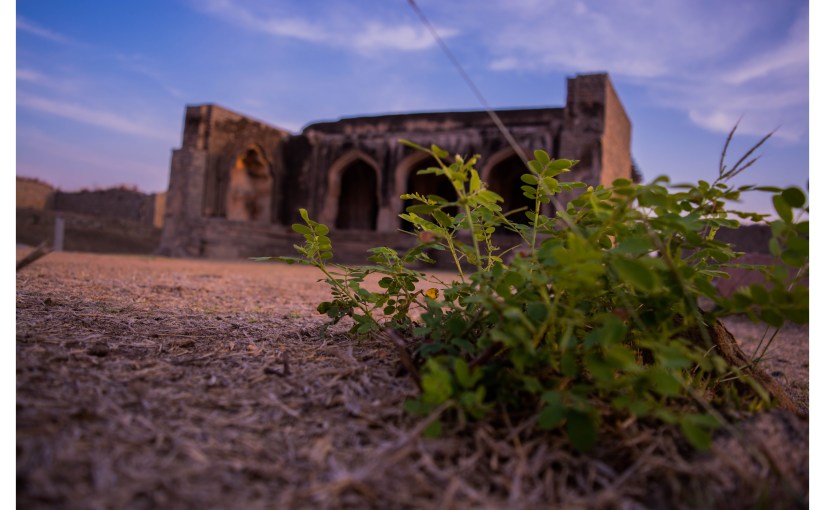
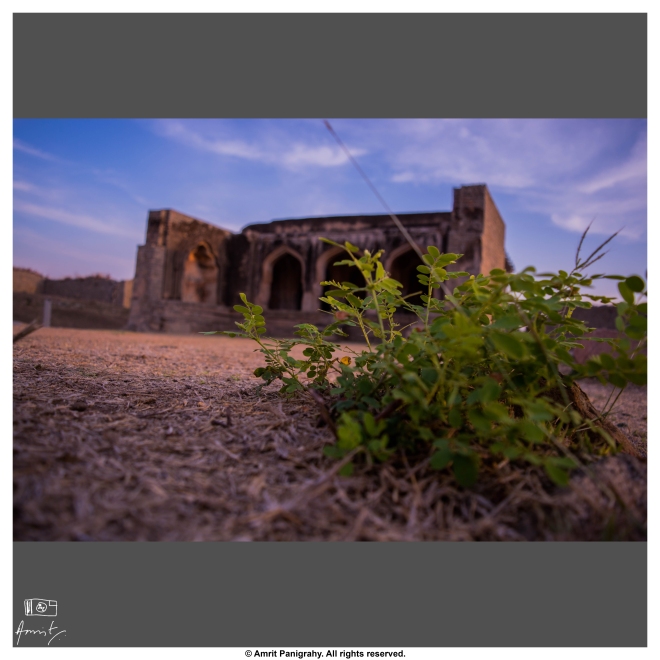
In frame: A low angle of the mosque inside the palace complex, in Hampi, Karnataka, India.

VERY IMPORTANT TO NOTE: Yes, you can share this work with proper attribution. But, please seek permission before using this work (not including the photo), partially or fully. YOU CAN NOT USE THE PHOTO. Believe me, asking is better than ending up in court or facing public shaming on social media. Thanks for understanding.

© Amrit Panigrahy. All rights reserved.

I was there…. Waiting for you!

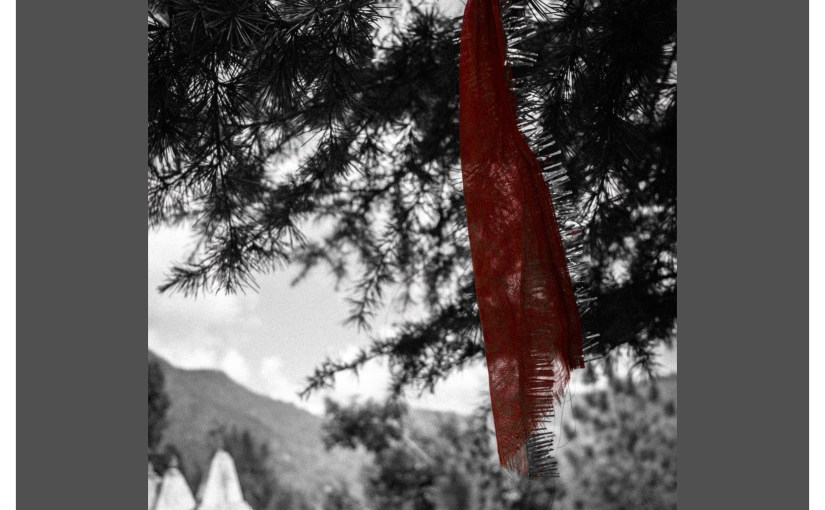
I waited there, under our pine tree,
And I went there for many more days,
Hoping you would come one day.

It was futile, I was told,
And that you would never be back.
But, I wanted to give it a try.

I wanted to give it a try,
Just so when my time comes,
I won’t feel that I did not wait enough.

And when I realized many springs later,
That you would never come,
I left there the scarf you had given me.

The scarf, my only piece of memory of you,
For it had your scent, as fresh as dew,
It was the only thing that I had of you.

As I wanted to let you know,
Just in case you showed up..
….That…

I was there…. Waiting for you!

————————————————

DISCLAIMER: Penned by yours truly, this poem is a work of fiction. Any resemblance to any person living or dead is purely coincidental.

In frame: A ritualistic scarf tied to a pine tree in the Himalayas, on the way from Naitala to Guptakashi, in Uttarakhand, India. I found small temples dedicated to local Gods as well as such ritualistic things, common place in the Himalayas.

VERY IMPORTANT TO NOTE: Yes, you can share this work with proper attribution. But, please seek permission before using this work (not including the photo), partially or fully. YOU CAN NOT USE THE PHOTO. Believe me, asking is better than ending up in court or facing public shaming on social media. Thanks for understanding.

© Amrit Panigrahy. All rights reserved.

The Ascend

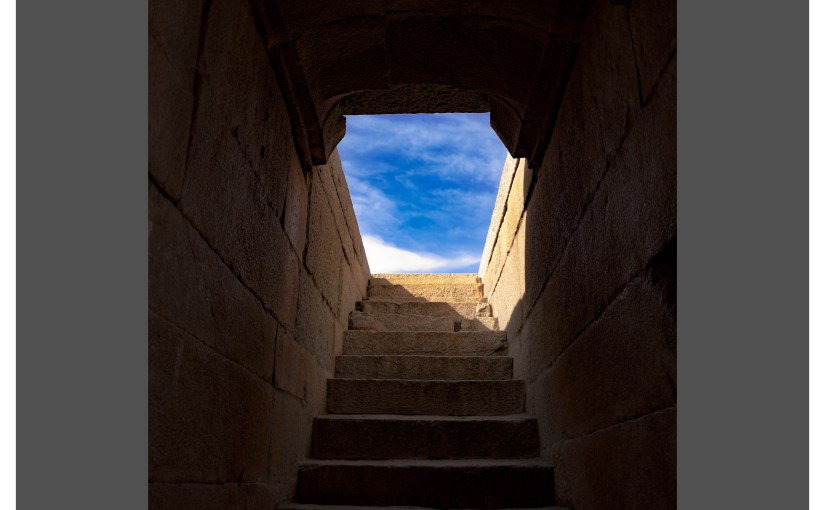
The wheels of the royal ceremonial gold chariot screeched to a halt on the gravel road behind the Mahanavami Dibba. A well-built dark skinned man, in his mid-twenties, climbed down from the chariot.

A masculine face with neatly trimmed moustache, but the cut on his left cheek which ran almost the full length from just below the eye, looked fresh – a parting gift from a beloved enemy, perhaps. Laden in gold jewellery that were studded with precious stones of all sizes and colors, he wore a bright pink angavastram made of silk and a white silk dhoti. He wore a turban made of yellow silk, and attached to it was the royal pin, which had the largest diamond of all. In his right hand he was holding a precious stone studded gold scabbard, and inside was the sword that whole of the subcontinent bowed down to – the Sword of Vijayanagara.

Standing below the flight of stairs inside the royal entrance at the back of the Dibba, the new King looked up to the portion of the blue sky that was visible. The royal trumpeters on top of the Dibba blew the trumpets, announcing the arrival of the new King of Vijayanagara. The chatter among the crowd stopped. Then the drummers started beating the big drums across the palace complex, in a rhythm. And the crowd started cheering – “Long live the King! Long live the King….”

“Doesn’t anyone remember what happened in last one month leading up to today?”, the new King asked himself.

The new King was the eldest son and heir apparent to the throne of Vijayanagara, and was the most capable. He had been groomed to be the King, right from the day he started walking. He was trained to be the best in sword fight, archery and hand to hand combats in the whole of Vijayanagara empire. And he was well conversant in the Vedas, Upanishads, Gita and Chanakya’s Arthashastra. For the last two years, he had been fighting the Moslems in the north, and had subjugated two Bahmani Sultanates. It was in last one month that everything changed, for better or for worse. The old King took ill suddenly, and was killed in his sleep by one of his younger sons, the new King’s half-brother.

This is when the new King had to ride back to the capital city of Hampi, to confront his half-brother, and to claim the throne that was rightfully his. The situation had changed completely while he was away. Most of the old royal staff had been replaced with loyalists of his half-brother. He knew that his half-brother wouldn’t dare to touch him in broad day light. He confronted him in the palace courtyard, with a handful of his father’s loyalists.

This is when the confrontation turned physical. His half-brother took out a dagger and took a wild swing. He leaned back, but couldn’t move completely away from the dagger’s path, and it sliced him on the left cheek and the wound ran almost the full length from just below the eye. In one continous motion, he took his dagger out, pushed it deep in to his half-brother’s throat, killing him instantly.

Then began the clean-up act. For next two weeks, all the loyalists of his half-brother were either killed or jailed, eliminated systematically. He didn’t stop until everyone of them who had helped his half-brother had been punished. That was the last one month.

As the new King stood below the flight of stairs pondering, the Rajguru touched his shoulder and signalled politely that he should ascend and show himself to the world, to show the world that everything was in control. The King nodded his head and agreement and thought, “Doesn’t anyone really remember?”

DISCLAIMER: This is a work of fiction. Any resemblance to any person living or dead is purely coincidental.

In frame: The sky from below the flight of stairs, inside the back entrance of Mahanavami Dibba, inside the palace complex in Hampi, Karnataka, India. Mahanavami Dibba was used as a platform by the royals of Vijayanagara to watch the Dussehra celebrations, as well as on special royal ceremonies.

VERY IMPORTANT TO NOTE: Yes, you can share this work with proper attribution. But, please seek permission before using this work (not including the photo), partially or fully. YOU CAN NOT USE THE PHOTO. Believe me, asking is better than ending up in court or facing public shaming on social media. Thanks for understanding.

© Amrit Panigrahy. All rights reserved.