She’s the only one I got

Ours is a unique “love” story, as one-sided as it gets. She is so good, all she has ever known is giving. And she gives without expecting anything in return. She gives without asking. She gives more than what I need. She gives more than what I deserve. She gives even if I hurt her, beat her up, or bruise her. She gives in joy. She gives in pain. She gives me whatever she has. She loves me!

Having used her mindlessly for all these years, having bruised her in unimaginable ways, having hurt her in worse ways than worst of my nightmares, I still found her by my side. And then, I realized that she is very very special. And… She’s the only one I got!

She’s the only one you got. And, she’s the only one we got.

Earth, yours, mine and each one of ours. Our “love” for her has been so cruel, we have done unimaginable things to her. We have always taken from her, more than our fair share, and without ever giving anything back, or giving back too little. In simple terms, we have raped her in every worst way possible.

There is no “humane” way of destroying our beloved little blue marble. Other lives on this once beautiful planet are suffering the repercussions of our actions. Ever imagined why we are acting the way we are? Because, we humans have a very wrong notion of “Oh, we are so entitled”. Because, we believe everything that exists on this planet belongs to us, and it exists to serve us. We can do anything we want to anything that exists on this planet.

We were capable of learning, we were capable of improvising. We learned, and we improvised. We also CHEATED! As intended, we did not use our learning and improvisation for betterment of other lives and that of our planet. Instead, we used them to take advantage of other lives, and to screw up our planet. And with time we have become so greedy, we do everything in excess. We eat more than needed, we use more than required and naturally, we waste more than we can have.

Do you remember those Hollywood sci-fi movies, in which an alien species invades Earth because it has exhausted the “resources” on its own planet? Do you like those aliens? No? Well, those alien characters are based on our greed! Having almost screwed up our planet successfully, we are now looking at other planets in the solar system and beyond, to implement our scheme of things and screw them up too.

All those cyclones, floods, unseasonal rains, droughts, rising temperatures and missing seasons of the recent times are a grim reminder that though she loves us unconditionally, our Earth can fall sick too. And when she does, all hell breaks lose! So, hoping that it is not too late, let’s do our bit to prevent her from falling sick. However small it may seem, but let’s start for once. Be it closing that tap, or switching off the engine at the traffic signal, or not using polythene, or reusing/recycling, or planting that one tree sapling. Let’s us do how much ever we can do. And let it not be restricted to mere symbolism.

As far as I am concerned, I do not use the AC in my car when I am travelling alone, not even in this hot summer. I had turned a vegetarian for some other reason, but I intend to stay a vegetarian for the rest of my life, because recently I came to know that animal agriculture for meat production generates more harmful greenhouse gases than all cars put together (read here). And with time, I intend to do more. Pitch in with my small little efforts, even if it sometimes results in discomfort for me.

Why am I doing this? For everything that I have put her through, I have realized that I can not live without her, quite literally! And I have fallen in love with her. Because, she’s the only one I got. She’s the only one you got. She’s the only one we got.

For her! Happy Earth Day, my love..

In frame: Sun rise at Naitala village, in Uttarakhand, India. This was the first morning I woke up in the laps of the Himalayas. The river in the bottom of the frame is Bhagirathi, “who” is called Ganga after Dev Prayag (Use of “who” is deliberate, because Ganga is now legally a living person. Read more about it here). All this serenity and tranquility in my mind were shattered, when I imagined the havoc floods of 2013 must have caused, scars of which were visible throughout my journey in the Himalayas.

VERY IMPORTANT TO NOTE: Yes, you can share this work with proper attribution. But, please seek permission before using this work (not including the photo), partially or fully. YOU CAN NOT USE THE PHOTO. Believe me, asking is better than ending up in court or facing public shaming on social media. Thanks for understanding.

© Amrit Panigrahy. All rights reserved.

Could you repeat that, Mr Capa?

“If your pictures are not good enough, you are not close enough.” – Robert Capa

Well, that’s what Robert Capa said. But, who was Mr Capa?

Robert Capa was the “greatest combat and adventure photographer” in history. If you are not in the photography business or have got nothing to do with cameras, you would probably not know him. An accidental photographer like many of us, he becamse a legend because of the way he dealt with his profession – dedication and commitment.

The said quote was in the context of war photography. Robert Capa lived and died during an age when there were no fancy photographic equipment. And in that age, more often than not, one had to walk in to the thick of action to get that appealing frame. We are talking about bombs going off all around, bullets whizzing past ears. That thick of an action! And it was this “getting close” part which helped Capa in capturing some of the most dramatic photographs of the wars that he covered.

How is the quote relevant for me in this age, when we have all the fancy equipment we can think of: super-zoom telephoto lenses, the best sensors, and what not? How is it relevant for me when I have not seen a live combat in my entire life? Combat as in when people are trying to kill each other! And most importantly, how is it relevant in my life? Read on for the revelation!

Capa’s quote in the context of photography:

On a scale of one to telephoto lenses, how lazy are you? That’s a weird scale, isn’t it? Not when we are discussing photography.

First, let’s all agree that photography is all about interactions with subjects. Alright? The goodness of the photograph is directly proportional to how well the photographer has interacted with the subjects. If the broad genre is people, then it becomes interaction with people, and if the broad genre is wildlife and/or nature, then it becomes interaction with the nature (insects, trees, birds and animals included). Simply put, the photographer needs to get involved with her/his subjects. And one cannot get involved with the subjects without getting closer, can (s)he?

For me, capturing people was always difficult. I was shy by nature. I was not comfortable talking to strangers. For this reason, most of the times I came across as arrogant. When I say capturing people, I do not mean staying in my comfort zone, taking out that telephoto lens and start capturing people from far off. And then, out of those thousands of photos chose one that is reasonably good and call it “candid”. Well, nothing wrong in that! Nothing wrong other than the fact that I would be bull-shitting, if I say “I capture people”. So, to challenge myself, I took up making portraits.

The photographs where the subjects look right at the viewer, I find these photographs as most intriguing. I feel these are the photographs which connect with the viewer instantly. And to capture those, the subject must be aware, and one needs to abandon all the inhibitions and ask for permission from a total stranger. That is the thrill part!

And that is the level of involvement (“getting close” in Capa’s words) one needs, irrespective of the genre of photography. All or nothing, I tell you!

With time, as I develop my skills of making a portrait, I am also developing my people skills. Now, I do not mind approaching a total stranger and ask for permission to make a portrait. If it is a “yes”, you can see the result in the portrait above. And if is a “no”, I take it in the stride and keep working on my smile.

While making portraits, how do I know how close is close enough? Well, definitely not so annoyingly close that I am encroaching my subject’s personal space. But close enough to capture the right emotions.

Below is yours truly in action, while making the portrait above. That close is close enough, I think.

IMG_3305

I have never been caught in action, except for this one time, all thanks to my good friend Amit Kumar Singh.

Capa’s quote in the context of life:

I am going to tweak that original quote slightly.

“If your life is not interesting enough, then you are not living it from close enough.”

Well, you are alive, aren’t you? And what part of “being alive” do you find not interesting?

More about Robert Capa:

Capa lived and died in an age when there were no fancy photography equipment, in an age when photographers had to “make” photographs. Yes, he died at a young age of 40 back in 1954, when he stepped on a landmine while covering the French Indochina war. He had a love story too! He was engaged to Gerda Taro, another combat photographer, who was killed in the Spanish civil war in 1937. Capa contributed primarily to Life magazine. He clicked some of his most famous photos when he accompanied Allied troops during D-day invasion, in World War II. He was the co-founder of Magnum Photos. For all his association with war and death, here is his second most famous quote:

I hope to stay unemployed as a war photographer till the end of my life.” – Robert Capa

In frame: A flower seller in Gudimalkapur flower market, Hyderabad, Telangana, India. I initiated the talk by asking if I could take pictures of the marigold flowers she was selling, and she agreed. After the photographing the marigolds, I asked if I could make her portrait, and she agreed but said it is going to cost me. So, we bargained and settled for a “nominal” amount. So much for people skills.

Also, I have used a 3-step Brenizer technique here, for the first time. These are three photographs from top to bottom merged in to one.

VERY IMPORTANT TO NOTE: Yes, you can share this work with proper attribution. But, please seek permission before using this work (not including the photo), partially or fully. YOU CAN NOT USE THE PHOTO. Believe me, asking is better than ending up in court or facing public shaming on social media. Thanks for understanding.

© Amrit Panigrahy. All rights reserved.

A promise to my witness!

The “Me” that descended from the Himalayas was completely different from the “Me” that had ascended about a week earlier.

My ego and beliefs were questioned at every turn of the switchbacks, while climbing up and down the Himalayas. And there are like a million switchbacks in the entire route. So the questioning was a million times over.

I thought I was better off the way I was when I started climbing! But, as time progressed I could sense that a change had been set in motion. It was the “Why” part that I was not able to comprehend! Why was I being put through the change, when life seemed so perfect? The “Why” was so overwhelming for my mind, that my emotions could not cope with it.

On my last day, I stood on the banks of Ganga, with tears swelling in my eyes. And I asked her “Why?”. All I could hear was her roar. I asked her repeatedly. Ganga did not answer.

But Ganga was a witness. She was there all along, in the form of Ganga herself, or Bhagirathi, or Alaknanda, or Mandakini, throughout my journey. And she had witnessed the beginning of my change. So, I promised Ganga, my witness, that I might not find an answer to the “Why” that I had asked her, but the change will continue. And when I return to see her again, I would return a better man.

Me being me, I still do not understand how much better is good enough. So, I am thriving to make myself better, in whatever way possible. Probably, there lies the answer to the “Why”!

In frame: Ganga Arati, Triveni Ghat in Rishikesh, Uttarakhand, India. This is a tribute to my witness, Ganga, who stayed by my side throughout my journey in the Himalayas.

VERY IMPORTANT TO NOTE: Yes, you can share this work with proper attribution. But, please seek permission before using this work (not including the photo), partially or fully. YOU CAN NOT USE THE PHOTO. Believe me, asking is better than ending up in court or facing public shaming on social media. Thanks for understanding.

© Amrit Panigrahy. All rights reserved.

In pursuit of immortality

“What is the price that you are willing to pay for immortality, Sultan?”, asked the Fakir.

“Whatever it takes, Oh Learned One! I have everything I need, except immortality. And immortality it is that I want”, replied the Sultan.

“Why do you want immortality, Sultan?”, asked the Fakir.

“Because one life time is not enough to spend all the wealth I have. And, because I want to enjoy all the good things that the world has to offer.”, replied the Sultan.

“What will you do once you have spent all your wealth and enjoyed all the good things that the world has to offer, dear Sultan? Because, it will be you who will be an immortal! Everything else comes with an expiry date. What will you do?”, asked the Fakir.

There was silence in the room…

The Fakir broke the silence and said, “But, I have a way to make you an immortal. You may die, but you will live on, through your deeds. You have so much wealth, utilise it to help the people in need. And as the head of the state, make sure that justice prevails. Be a peoples’ King, Sultan! That way, you may die, but you will live on in the heart of your subjects.”

It was a summer afternoon, and as the Fakir walked out, cool breeze entered the room. It was a sign of changing times. The Sultan had finally found a way to become an immortal.

DISCLAIMER: This is a work of fiction. Any resemblance to any person living or dead is purely coincidental.

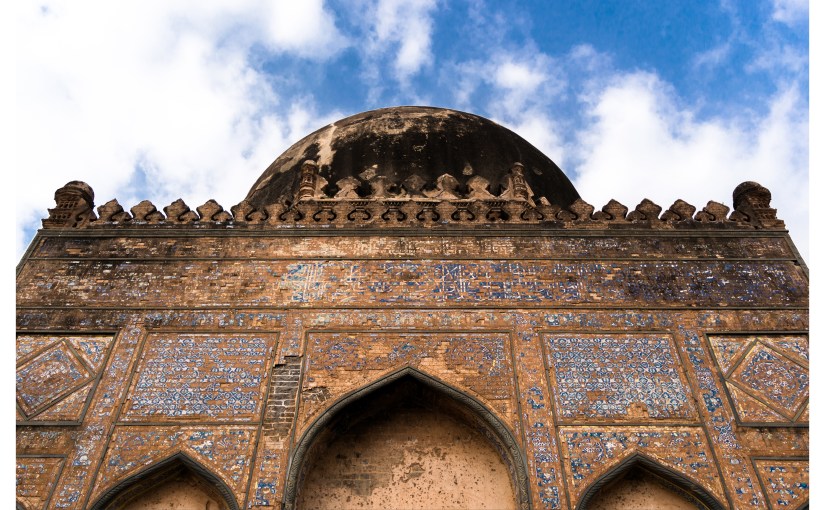
In frame: The tomb of Sultana Ahmed, wife of Bahmani Sultan Ahmad Shah-Al-Wali in Ashtur village, near Bidar, Karnataka, India. The Persian blue tiles on the upper reaches of the tomb are very well preserved, having stood the test of time for close to six centuries.

VERY IMPORTANT TO NOTE: Yes, you can share this work with proper attribution. But, please seek permission before using this work (not including the photo), partially or fully. YOU CAN NOT USE THE PHOTO. Believe me, asking is better than ending up in court or facing public shaming on social media. Thanks for understanding.

© Amrit Panigrahy. All rights reserved.
Gratitude and humility? Who the hell cares?

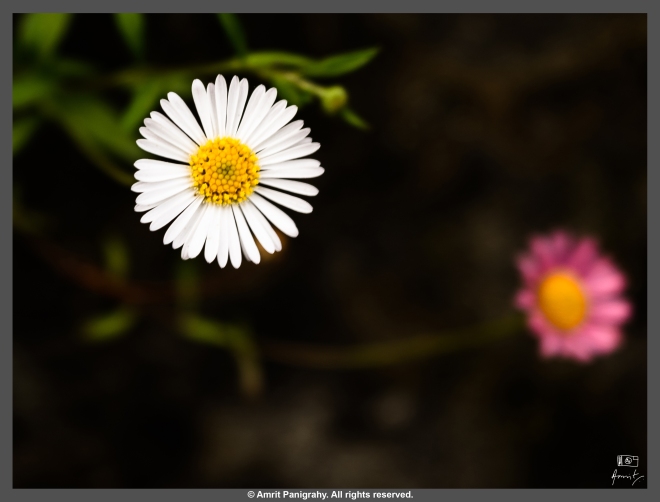
Can a brilliant looking flower be a brilliant looking flower, on its own? The stem plays an important role in how the flower turns out to be. It is the stem that connects the flower to the plant, supplies all its nutrients, and helps it stay fresh. And it is the same stem that keeps the flower above all the muck and mud below. The moment the flower gets carried away by its own persona, leaves behind the stem, and detaches itself from the roots, it will not have many moments of beauty left in it, and will end up being part of the same muck that it was once so distinguished from. Gratitude and humility play a vital role in a person’s life, the same role that the stem plays in case of the flower.

Swaying Himalayan Aster
Flower of the Swaying Himalayan Aster (Botanical name – Aster Molliusculus), a perennial herb found in the Himalayas, at altitudes of 1,800-3,000m above mean sea level. This one was on the banks of Bhagirathi (river Ganga as she is known before reaching Dev Prayag), on the way back from Gangotri, Uttarakhand, India.

I admit, I used to be a thankless person, and was not a humble soul for sure. Not because I had something against showing gratitude or humility, but because I felt I was entitled to things, people, or feelings. Hence, I never felt the need to show my gratitude, and be humble while doing so. I took tremendous pride in all the things I knew, in all the things I had achieved and in all of my capabilities. That’s the way I was! Until that day…

That day, the majestic mountains taught me humility. And when I was stranded on top of those mountains due to bad weather, I learnt my lesson on gratitude. I threw away my “red book of grudges” in those mountains, for good.

The learning process is a long way from being over, though. But, I feel I am making progress in the right direction. Over the months, I have realised that being humble is the best way to unlearn and learn life. And being grateful creates more space inside me for everything good that the world has to offer. Both of these together, they help me stay content, connect me to the world in a much better way and negate my ego. I must say, I have come a long long way from the day I was stranded on top of that mountain.

Now, the best part about us humans is, we do not necessarily have to experience something to learn. We can learn from others’ experiences as well, thus saving us precious time. So, here is my experience for you, in one sentence –

Be grateful for everything you have (even for having your annoyingly critical friend), be humble in front of everyone (even an illiterate or someone who comes from way below your social stratum), and you will find happiness!

In frame: Flower of the Swaying Himalayan Aster (Botanical name – Aster Molliusculus), a perennial herb found in the Himalayas, at altitudes of 1,800-3,000m above mean sea level. I framed this one on the banks of Bhagirathi (river Ganga as she is known before reaching Dev Prayag), on my way back from Gangotri, Uttarakhand, India.

VERY IMPORTANT TO NOTE: Yes, you can share this work with proper attribution. But, please seek permission before using this work (not including the photo), partially or fully. YOU CAN NOT USE THE PHOTO. Believe me, asking is better than ending up in court or facing public shaming on social media. Thanks for understanding.

© Amrit Panigrahy. All rights reserved.