ଘରବାହୁଡା

ସବୁ ସନ୍ଧ୍ୟାରେ ସଜବାଜ ହୁଏ ଗତକାଲିର ନିରାଶାକୁ ଭୁଲି,

ବାର ବର୍ଷ କାଳ ଅପେକ୍ଷାରେ ତୋର ହେଇଟି ଆସିବୁ ବୋଲି।

ମାଆ ମୋର କୁହେ, “ଝିଅ ଲୋ, ସେ ଆସିବନି ଆଉ ଫେରି”,

ହେଲେ ମୁଁ ଆସି ଠିଆ ହୁଏ ଦୁଆରେ ହେଲେ ଯେତେ ବି ଡେରି।

ଗାଁକୁ ଫେରନ୍ତି ସାଙ୍ଗ ସାଥି ହେଲେ ତୋର ସେତେ ସମୟ କାହିଁ,

ମନ୍ଦିର ତୋଳାରେ ବ୍ୟସ୍ତ ଅଛୁ ତୁ, ଆଉ କୋଉଠି ତୋ ଧ୍ୟାନ ନାହିଁ।

ତୋ ମୁକୁତା ହାର ଗଳାରେ ମୋର, ସିଏ ବି ଗଲାଣି ଥକି,

ସତେ ଯେମିତି ପଚାରେ ମୋତେ, “ସେ ଆଉ ଆସିବନି କି?”

ସବୁ ସନ୍ଧ୍ୟାରେ ଠିଆ ହୁଏ ବୋଲି ଗାଁ ଲୋକ କହିଲେଣି କେତେ କଥା,

କେହି ଡାକିଲାଣି ମୋତେ ଅଳସକନ୍ୟା ତ ଆଉ କିଏ ଡାକେ ଅଭିସାରିକା।

ବାର ବର୍ଷ ତଳେ ଯାଇଥିଲୁ ତୁ, କହିଲୁ ଫେରିବି କିଛି ଦିନରେ,
ମନ୍ଦିର ତୋଳା ତୋର ସରିନି ଆହୁରି, ଘରକୁ ଜଲଦି ଫେରେ।
Abhisarika
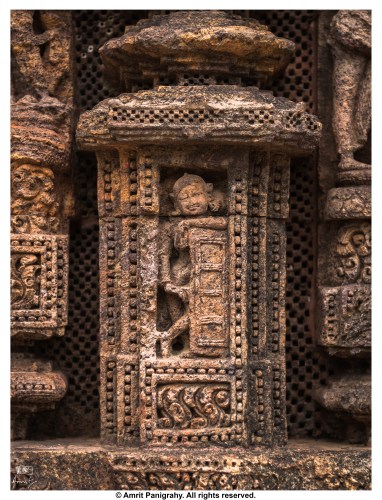
A sculpture of a lady waiting with half the door open, with a smile on her face. You can see this on the south side of Konark temple, in Odisha, India.

The Odia poem I wrote above is called “ଘରବାହୁଡା”, (pronounced as ghaw-raw-baa(as in baba)-hu(as in who)-da(as in dark), which means homecoming. A fiction based poem, the central character is a woman, who has been separated from his male consort or husband for twelve long years, because he is a sculptor by profession, and has been summoned by the King of the land, for construction of the Sun temple at Konark. She narrates how she dresses up every evening and stands near the door smiling, hoping against hope that he would come back, even though she had returned inside disappointed the previous evening. It has been twelve years and even her mom has now lost hope that he would ever return, but she stands and waits every evening, no matter how late. Even the pearl necklace that he had gifted her has become pale, as if tired of waiting for him and asking her whether he would ever return. Looking at her standing at the door every evening, people around her have starting thinking of her a dance girl, or a whore, in search of patrons. Then she goes on to urge him to come back home as soon as possible, regardless of the temple completion.

This sculpture, might be a figment of imagination of the sculptor, shows how his consort or wife might be waiting for him to return. By the time he must have finished this sculpture, he must have been away from home for twelve long years, or slightly more. Did you notice the smile on the figurine’s face? This was how the sculptor must have imagined to see her upon his return home, with a smile on her face.

1200 architects and sculptors took twelve years to build the Sun temple at Konark and it was finished in 1256 AD. King Narasimha Deva III spent 40cr gold coins to build this architectural marvel, the cost also included that of land reclamation from the sea (you heard that right!), as it is believed that the temple was built in the sea. There are many legends and stories associated with Konark, which I am saving for some other time, with your permission of course!

In frame: A sculpture of a lady waiting with half the door open, with a smile on her face. You can see this on the south side of Konark temple, in Odisha, India. Konark temple is full of sculptures which showcase every human emotion, and not only erotica as is popularly believed. In the words of Ravindranath Tagore, “Here the language of stone surpasses the language of human.”

VERY IMPORTANT TO NOTE: Yes, you can share this work with proper attribution. But, please seek permission before using this work (not including the photo), partially or fully. YOU CAN NOT USE THE PHOTO. Believe me, asking is better than ending up in court or facing public shaming on social media. Thanks for understanding.

© Amrit Panigrahy. All rights reserved.

Crimson Love

I had fallen back, to witness the drama that was unfolding in the sky.

My guide called out my name from a distance….

It was only minutes ago that he was here,
Telling me stories from the yesteryear,
Tales of opulence, generosity, valor and love,
For an open heart it was like a treasure trove.

Of all the stories, one was of interest in particular,
A King, his Queen, and love that was spectacular,
A poetess and a singer, she could bring words to life,
Smitten by her, the King convinced her to be his wife.

They were living happily ever after, or so they thought,
A big army attacked the kingdom, and a battle fought,
The King was killed in battle, was what the messenger told,
The Queen drank poison, and her lifeless body went cold.

The medieval fort, a witness to her love story,
Her eternal love for him that took her to glory,
Walking on that pavilion even I felt as a part it,
Kind of gloomy that in the end they couldn’t unite.

I glanced beyond the ramparts, as I walked back…

Crimson sun set over the horizon,
Leaving behind a familiar emotion.

And as it went…

The hues that it painted and the winter sky it tore,
Colors of desire and pain, that touches one’s core.

More than a year has gone since…

Crimson, is the color that I remember of that evening,
Of longing, the want of belonging and a love undying.

Crimson Love, ‘t was!

Drama in the sky
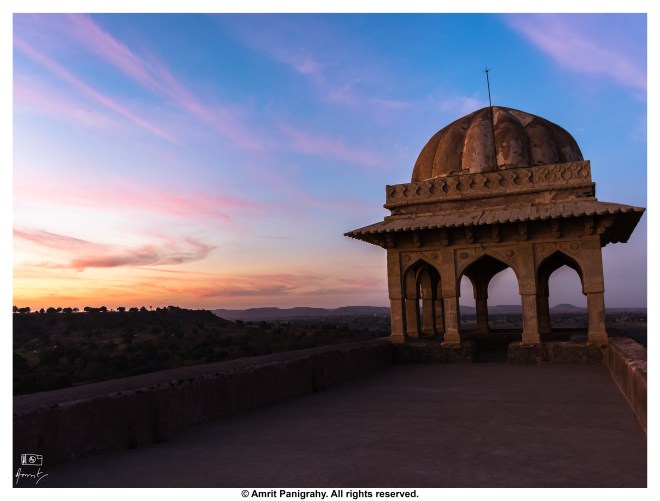
Brilliant hues of the winter sky just after the sunset, as seen from Roopmati pavilion in Mandu

I had earlier written a Hindi poem on Roopmati and called it “Jauhar”. You can read it here.

Mandu, or Mandav was capital of erstwhile kingdom of Malwa. Mandu is dotted with love tales of Sultan Baz Bahadur of Malwa, and his queen consort Roopmati.

Kingdom of Malwa used to be a vassal of the Mughals, and had declared indepedence taking advantage of the instability that ensued just after Akbar had taken control.

Akbar then sent his foster brother Adham Khan and a large contingent of the Mughal army to subdue Malwa. Adham Khan, who had by then heard of Roopmati’s enchanting beauty, had resolved to defeat Malwa and take her as a prized possession of his harem.

Baz Bahadur faced Adham Khan and the Mughals in Sarangpur with a small contingent. Baz Bahadur’s contingent was no match for the mighty Mughals and he escaped after being defeated.

Adham Khan then marched on to Mandav. Thinking that Baz Bahadur was slained in the battle, Roopmati poisoned herself, as she could not have seen another man in her life. Such was her love.

In due time, Adham Khan was executed by Akbar. Baz Bahadur surrendered to Akbar and was in return made the mansabdar of Malwa.

And for Roopmati, her love and loyalty for Baz Bahadur still fascinates imagination of the new generation of tourists to Mandu.

In frame: Brilliant hues of the winter sky just after the sunset, as seen from Roopmati pavilion in Mandu, Madhya Pradesh, India. Roopmati pavilion was built by Sultan Baz Bahadur for Roopmati, so that she could Narmada darshan everyday (one of her pre-conditions to her marriage with him). Narmada flows at a distance, in the plains.

VERY IMPORTANT TO NOTE: Yes, you can share this work with proper attribution. But, please seek permission before using this work (not including the photo), partially or fully. YOU CAN NOT USE THE PHOTO. Believe me, asking is better than ending up in court or facing public shaming on social media. Thanks for understanding.

© Amrit Panigrahy. All rights reserved.
In search of “Nothingness”

Bira (pronounced as Bee-raw, meaning brave in Odia) was born into a Brahmin family, in a Brahman Sasan. In Odisha, a Brahman Sasan is a village where every family is Brahmin. He grew up witnessing the monster called Brahmin supremacy and the twisted, distorted Hindu Sanatan religion. Tired of it, he and few of his friends went to Joranda and embraced Mahima Dharma. That was seven decades ago.

The allegation that was levelled against Bira was that he had converted and was no more a Hindu, so he and his family need to pay a fine to continue to stay in the village, to which Bira sternly refused. As a result, his family was banished from their ancestral village. One of main reasons was, even after being a Brahmin himself, Bira had challenged their supremacy. All other families of the village were asked to not keep any kind transaction with his family.

In the meantime, a letter was written to the high seat of Hindus in Jagannath temple, in Puri, asking them to advise a future course of action in Bira’s case. To which, they replied that it was settled long back and Mahima Dharma was very much a part of the Sanatan Hindu fold. After the ban on Bira’s family was lifted, having his point proven he chose to stay back in his ancestral village fighting further religious atrocities and intolerance, till he left for a city close by for his children’s education few decades later.

Bira Panigrahy was my grandfather. Of the group of people who embraced Mahima Dharma on that day, more than seven decades ago, only my grandfather continued to be a follower till his death. Any history of my association with Mahima Dharma would be incomplete without mentioning the brave man who was much ahead of his time. As I sat down to write this post, devotional songs written by the blind poet Bhim Bhoi and sang by Mahima devotees rang in the background. The devotees, even though having full time professions, accompany the monks  wherever they go. They were at our home as we were conducting something known as a “Balyaleela”, a yagna of sorts. The occasion this time was my grandfather’s death anniversary.

As per the teachings of Mahima Swamy (as the Master of Mahima Dharma is called), a human doesn’t need any intermediaries to reach the Supreme. All humans are born equals despite caste, creed, color, race, gender and religion. That there is only one God, the Supreme, who is shapeless and colorless, the nothingness in other words. The Supreme resides in every living and non-living being and everything resides in the Supreme. Mahima Dharma is a form of Vishisht Advaita, where every living being is respected equally. Followers of Mahima Dharma worship the nature and the universe, the nothingness within and without, and pray for well being of every living being of the universe.

The Offering
A Mahima monk accepting a coconut being offered by a follower of Mahima Dharma at “Dhuni Mandir”, the temple of fire in Mahimagadi, at Joranda, Dhenkanal, Odisha. The offered coconut will be burned in the holy fire.

The monks of Mahima Dharma as directed by Mahima Swamy himself follow an extremely ascetic lifestyle. For example, when they visit the houses of devotees, they not allowed to stay for more than a night, and are not supposed to go inside the house. They eat under the open skies, and are not allowed to sleep on beds for the rest of their lives. Giving up basically everything that would even remotely qualify as modern comfort. They have only one task at hand, spread the message of the Master, and in the process move ahead in their spiritual journey.

When I was on a road trip with parents in Odisha few months back, something strange had happened. After having spent few minutes in the Indralath temple, in Ranipur-Jharial, we came out and were getting ready to get inside the car. A drunk shepherd approached my father from nowhere, and told him “A Mahima monk had come here many many years ago when I was a kid. And he hosted a “Balyaleela” (a ritual done on special occasions), and there were lakhs of people.” There were no identifications either on my father or on our car which suggested that any of us were a follower of Mahima Dharma. The followers of Mahima Dharma are a very very small fraction of the total population.

Before that, when I had gone to see Puri during Rathyatra last year, I received a call from an unknown number. On the other side was a Mahima monk who visits our family very often. “Have you become a Jagannath devotee?”, he asked me, when on being asked I told him that I was in Puri. Worshiping deities, shapes or  forms is forbidden in Mahima Dharma.That the monk had called me for the first time ever, when I had come to see Lord Jagannath had to mean something; also, what the drunk shepherd was mumbling in front of the Indralath temple.

The celestial message was clear to me. I had to go visit the Mahimagadi, the seat of Mahima Dharma at Joranda, in Dhenkanal, Odisha. And what better time than the annual Maghmela, on the full moon day in the Hindu month of Magh.

On 31 January, 2018, Joranda was a mission accomplished!


VERY IMPORTANT TO NOTE: Yes, you can share this work with proper attribution. But, please seek permission before using this work (not including the photo), partially or fully. YOU CAN NOT USE THE PHOTO. Believe me, asking is better than ending up in court or facing public shaming on social media. Thanks for understanding.

© Amrit Panigrahy. All rights reserved.

The year song


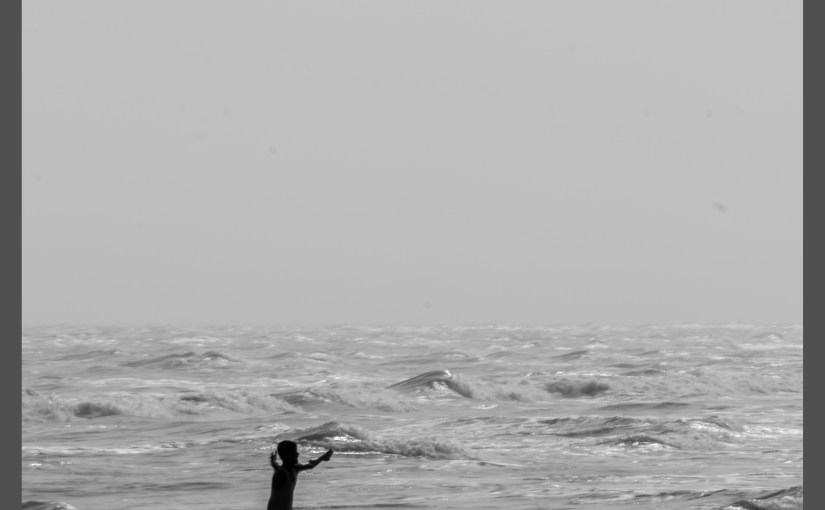
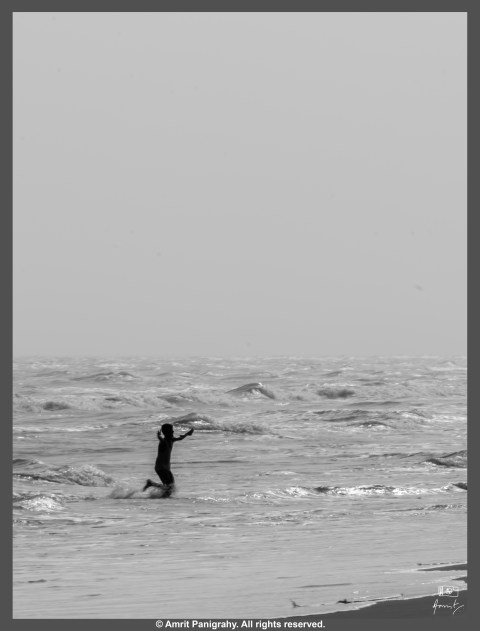
Riding the waves
A young man running back to the shore from the sea

A song for the year, I had promised to write,
Taking time out in the middle of the night,
Thoughts rusty, and not organised so well,
But an year it was and many tales to tell.

So, here it is!

Before the year started, in hindsight it was like…

Retreating waves pulled me back to the sea,
Like vices in whose vice like grip I was in,
Vices I left behind on my way to the coast,
And to those no one would raise a toast.

With questions and no answers I started my year,
A start with much less joy and surely a lot of fear,
As if I stepped into the unknown blindfolded,
Fear of an uncertain future, and what lay ahead.

It was the best one ever. To sum it up…

I travelled ten thousand kilomeres on road,
To new places about which I had never heard,
Met people I would never see in my life again,
But memories of a lifetime, of joy and of pain.

I let go of the hands that I never thought I would,
Stopped missing people I never imagined I could,
Worked on myself and learned to be with me,
Had I felt bored with myself, I was in bad company.

Started to see every living being for what they were,
My lack of compassion, and it was totally unfair,
Biggest lesson was on empathy and to be able to relate,
Thank my stars I learned in time, and it wasn’t too late.

The universe has been very kind to me in return,
A lot of gifts and people with best intentions,
Gifts that will stay with me for my entire life,
People who will stay and will help me thrive.

When the waves pulled me, I came back riding them,
Stronger, wiser, calmer, compassionate and brave.

Now with 2017 behind me, here is my 2018 wish for you….

May you have my 2017, if not better than that,
I wish this for you from the bottom of my heart.

Call it a rhyme or a poem, this is my year song,
A song, I won’t mind humming whole life long.


2017 was a life changing year for me, with a lot a of changes for good. This is how good a year it was, in my own words, as a poem.

In frame: A young man running back to the shore from the sea, near Baruva, in Andhra Pradesh, India.

VERY IMPORTANT TO NOTE: Yes, you can share this work with proper attribution. But, please seek permission before using this work (not including the photo), partially or fully. YOU CAN NOT USE THE PHOTO. Believe me, asking is better than ending up in court or facing public shaming on social media. Thanks for understanding.

© Amrit Panigrahy. All rights reserved.

64 Yoginis – And a message to my father

The 64 Yogini Temple:

Ranipur Jharial was the first stop on the recent road-trip I did with my parents in Odisha. We reached here after a gruelling 6 hours drive from my home town. The 64 Yogini temple of Ranipur Jharial in Bolangir district in Odisha, is one of the only 4 such temples dedicated to 64 Yoginis that exist in the whole country. Two of them are in Odisha – the other one in Hirapur, near Bhubaneswar.

The 64 Yogini temple is located atop small hill, which is a single rock spread over many acres. On that rock there are also many small temples dedicated mainly to Lord Shiva. What would catch your eye however is the peculiar structure of the 64 Yogini temple.

64 Yogini Temple
The 64 Yogini Temple under the sun on a cloudy day, in Ranipur Jharial, Bolangir, Odisha, India.

It is a circular hypaethral temple. The deities of 64 Yoginis adorn the inner side of the circular temple. The centre of the temple is adorned by an image of three faced Lord Shiva, Adi Yogi himself, embracing his wife Goddess Parvati. This temple is believed to have been built by Somavamshi Keshari kings in 9th-10th century AD. All the deities are made of sandstone.

Lord Shiva
Three faced Lord Shiva at the center of 64 Yogini Temple, in Ranipur Jharial, Bolangir, Odisha, India. I shot this frame using my 35mm Canon FTb QL manual film SLR on an Ilford HP5 Plus 400.

The temple is designed in such a way that energy from all the 64 Yoginis would stay within the circular wall of the temple, and the yogis and sadhaks who did their sadhana here would benefit immensely from the concentrated energy from all Yoginis. The 64 Yoginis also represent 64 types of Siddhis a human can achieve.

The Indralath Temple:

Indralath Temple
The elevation of Indralath Temple from up close, in Ranipur Jharial, Bolangir, Odisha, India.

Another attraction in Ranipur Jharial is the 60ft tall Indralath temple, the oldest and tallest brick temple in Odisha. Also built during 9th/10th century AD by Somavamshi Keshari kings, it is believed that this temple was probably dedicated to Lord Shiva or Lord Vishnu. Interestingly however, the designs and statues on the outer wall of the temple suggest Buddhist influence on the architecture. The statues on the outer wall are made of clay and mud and are burnt to give them longevity, as it was done for the bricks.

The Experience:

Before I started the journey, I was told that it is not advisable and safe to go on top of the hill during the month of Ashadh, or the first month of monsoon, because of the numerous lightning strikes that have happened in the past. We were well past Ashadh, so that was a relief.

64 Yogini Temple
The 64 Yogini Temple, in Ranipur Jharial, Bolangir, Odisha, India. I shot this frame using my 35mm Canon FTb QL manual film SLR on an Ilford HP5 Plus 400.

When I went on top of the rock, near the temple, the first thing I noticed about the place was the calmness, even if it was windy. However, the calmness was only on the surface. The place was full of some mystic energy, as if all the yogis and sadhaks who did their sadhana here left their legacy behind for the later generations to experience. Although there were many things running through my mind, when I closed my eyes, it was as if I got teleported instantaneously into another realm. What happened with my father however, was interesting! And I was a witness.

My father, as were both my paternal grand parents, is a follower of Satya Mahima Dharma, and he has been practising meditation for many years now. One of the youngest sects of Hinduism, quite interestingly, this sect also had 64 Siddh Purush (64 men with Siddhis). Numbering just a tiny fraction of Odisha’s population the followers of this sect do not worship any deity. Very much a part of Hinduism, they believe that to reach the Supreme you do not need any mediums. One of my next projects is to highlight this sect to the mainstream, so look out for that.

Being himself, my father decided to check how it feels to sit in meditation near the 64 Yogini temple. So, he removed his shoes, sat on the platform and closed his eyes and went into a meditative state. And I got busy taking photos. Few minutes later, I got back to him, and by that time he was done. I asked him how was it, and he told me that he could feel some kind of energy. After that we decided to visit the nearby Indralath temple nearby, and it was all fine till then.

It got weird when after having spent few minutes in the Indralath temple, we came out and were getting ready to get inside the car. A drunk shepherd approached my father from nowhere, and said “A Mahima sadhu (a preacher of the sect of which my father is a follower) had come here many many years ago when I was a kid. And he hosted a Balyaleela (a ritual done only special occasions), and there were lakhs of people.”

There were no identifications either on my father or on our car which suggested that any of us were a follower of that particular sect. The practitioners of this sect are very very small fraction of  the total population. To give you all an idea, there are only 2/3 families of this sect in my hometown which a population of at least one lakh. Too much of a coincidence, right?

The only thing that could possibly explain this incident was probably the fact that there are strong energies still existent in the 64 Yogini temple and nearby, and after father meditated there, he “was sent a message” that the path he had chosen for himself (that of Satya Mahima Dharma) is right for him, and he does not need to divert now. We reached at this conclusion after discussing on this incident for some time.

And then we decided to move ahead with our journey, a 2,000km road-trip across Odisha, which turned out to be quite eventful in its own right. More on that later!

VERY IMPORTANT TO NOTE: Yes, you can share this work with proper attribution. But, please seek permission before using this work (not including the photo), partially or fully. YOU CAN NOT USE THE PHOTO. Believe me, asking is better than ending up in court or facing public shaming on social media. Thanks for understanding.

© Amrit Panigrahy. All rights reserved.


Me too!

The sun had hidden behind the highrises for quite sometime now, and it was starting to get dark. The slum by the side of the polluted lake was getting ready for Diwali, in its own way.

“Kali, give Debu something to eat.”, said Kartik, Kali’s father. “He guided me home from the theka again today”, he said in a slurry voice, before falling on the ground, missing the soiled mattress by some distance. Kali was Kartik’s only child. Kartik, a widower, was a rickshaw puller in the city by the day and an alcoholic at sunset. After the days work, he would go to the theka on the periphery of their slum and spend almost all of his day’s earnings on country liqour. Kali had already seen more than her fair share of life, so her father’s alcoholism was something Kali was least concerned about.

Kali was married off at fourteen to Shambhu, a man twice her age. Shambhu was a migrant construction worker in the city. After the initial trauma of getting married at such a young age, her life was slowly turning for the better. She gave birth to Roshan, a son, when she was sixteen, a healthy child but for a medical condition which turned him blind at night. Two years back on the day of the Diwali, Kali was decorating their shanty with earthen diyas, when one of their neighbours came running and broke the news of Sambhu’s death in a road accident. Sambhu had gone to work on Diwali for the double bonus. Six months pregnant with her second child then, Kali was broken. She had no choice but to come and live with her father. Kartik was living alone after his wife had passed away, immediately after marrying Kali off. It was at her father’s place that Kali gave birth to her daughter, Chandini.

Kartik had taken to drinking after his wife died and was not in a position to take care of the recently widowed Kali and her children. So, Kali started working as a domestic help in nearby highrise,s to put food on her children’s plate and to give them an education.

Today was the day of Diwali, again. Debu, a middle-aged man, had started accompanying Kartik only about a month back. It was a bond of friendship made over alcohol, and would evaporate as does alcohol when left in open, or as it does in the hangover the next morning. When in his senses, Kartik wouldn’t strike a friendship with a man like Debu, a lecherous man. There were rumours about Debu having sexually assaulted many women. People said he wouldn’t even leave young girls alone. And Kali could sense that Debu had been eyeing her since the day he first accompanied Kartik.

Roshan was playing outside with other kids from the slum, he would return when the daylight is about to fade. Chandini was sleeping on the makeshift hammock made from one of Kali’s torn sarees, hanging from the celing. Kartik had passed out on the floor with an open mouth, after he returned that evening, his saliva starting to fall on the ground. Kartik won’t wake up before morning now. Debu, not as drunk as Kartik, sat there on the floor, staring at Kali’s back as she was getting him food. And Kali could feel Debu staring at her from behind.

As she put the plate down, Debu pushed the plate away and grabbed hold of Kali’s hand and pulled her towards him. Kali tried to resist but eventually fell on him. Before she could give out a cry for help, Debu was on top of her and had his left hand on her mouth, muffling whatever sound she could muster. With his right hand, Debu pulled Kali’s saree up until he bared her lower half. Kali was trying her best to push him away with both her hands, but Debu succeeded in forcing himself between her legs and started to unzip his pants. The stench was unbearable for Kali, the smell of country liqour mixed with that of Debu’s sweat, and the fact that he hadn’t taken bath probably in days, and his shirt hadn’t been washed in at least a month. Kali almost passed out.

Trying to get out of Debu’s evil clutch, Kali tried one last time and threw her arms up, trying to get hold of something with which she could hit him. Her hands moved frantically on the floor as Debu was unzipping his pants. Her right hand fell on a brick, which Roshan had brought from somewhere as he wanted her to make a doll’s house for him. While biting her teeth, with one swing of her right hand she picked up the brick and brought it on the back of Debu’s head with all the energy that was left. The motion of her right hand stopped with a muffled thud, and Debu’s grunts sounded more like a wounded swine, before his body turned cold and flaccid. A stream of thick warm blood from the back of Debu’s head started falling on Kali’s face. She wiped the blood with her left hand as her vision got blurry. Kali laid there for few minutes with Debu on top of her. All she could hear was bursting of crackers from outside. She couldn’t hear Debu’s breath even after trying to focus.

She pushed Debu’s body away and got up. She couldn’t see properly because of Debu’s blood in her eyes. All she could see were shapes and lights when they were bright enough. She stumbled her way out of the shanty to wash blood off her eyes. As soon as she stepped outside, she could hear Roshan. He was pointing at the bright fireworks on the other side of the lake.

“Maa, see fireworks! But I can’t see any colors.”, he said.

“Me too, beta!”, Kali replied, as she walked towards the bucket of water kept outside their shanty.

Diwali WM


This short story is my attempt to give voice to #metoo stories, incidents of sexual harassment from that section of the society which does not have a respectable living condition, let alone an internet connection.

DISCLAIMER: This is a work of fiction. Any resemblance to any person living or dead is purely coincidental.

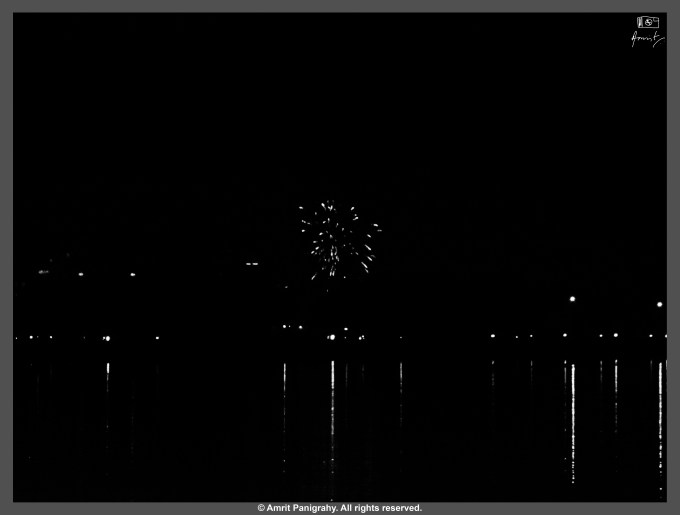
In frame: Fireworks on the bank of Hussain Sagar in Hyderabad, Telangana, India.

VERY IMPORTANT TO NOTE: Yes, you can share this work with proper attribution. But, please seek permission before using this work (not including the photo), partially or fully. YOU CAN NOT USE THE PHOTO. Believe me, asking is better than ending up in court or facing public shaming on social media. Thanks for understanding.

© Amrit Panigrahy. All rights reserved.
Nine parts of One

Goddess Durga
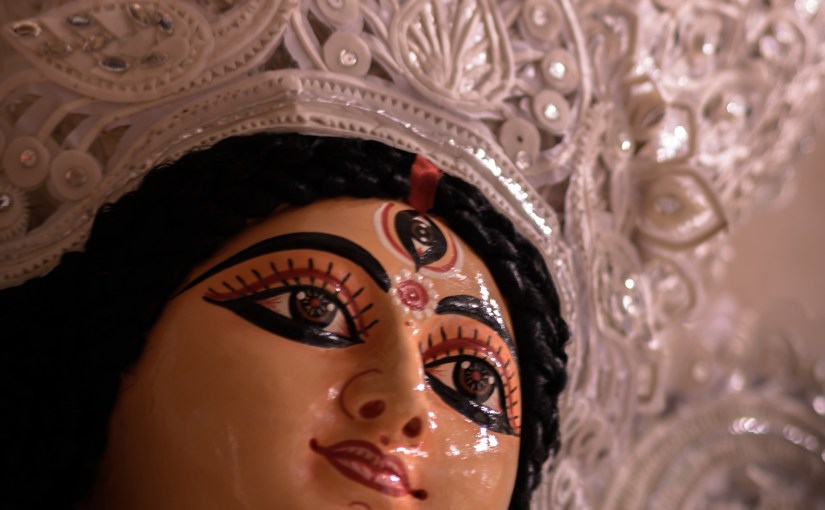
Goddess Durga during Durga Puja of 2017 at Hyderabad Bengali Samiti, Hyderabad, Telangana

So big and black a void it was, you could lose everything,
Even the most significant, would seem like nothing.

Into the emptiness of the universe she was summoned,
To lay a strong foundation, we know today as the creation.

The universe that you know as it is today,
She created it in a past far far away.

She then resided in the sun and in the stars,
Emanating light that could wipe out scars.

To marry Shiva, She would be born to a mighty King,
As austerity, from the world She would be abstaining.

As the daughter of the mountain She would be born again,
She would be so fair, not just superficially as others feign.

Married to Shiva again, the half moon would adorn Her head,
Mother to a child, armies of the Gods who eventually led.

Summoned to defeat the dark forces when everything else would fail,
She came as the deadly dark night without leaving behind a trail.

One last demon was left before goodness prevailed,
The demon of disguise who She finally had killed.

She is the saviour, since the days of the time immemorial,
Even by Gods she has been invoked to help good to prevail.

Goddess Durga
Goddess Durga from another angle during Durga Puja of 2017 at Hyderabad Bengali Samiti, Hyderabad, Telangana

This poem is my tribute to the nine forms of Adi Parashakti or, as we know her today, Shakti, worshipped during the nine days of Navaratri. The nine forms of Shakti who are worshipped during Navaratri, are: 1. Shailaputri, 2. Brahmacharini, 3. Chandraghanta, 4. Kushmanda, 5. Skandamata, 6. Katyayani, 7. Kaalratri, 8. Mahagauri, 9. Siddhidatri. Together they are also called Navadurga. The image of Shakti worshipped during the Navaratri/Durga Puja is actually that of Katyayani. To read more about the Navadurga please here.


In frame: Goddess Durga during Durga Puja 2017 at Hyderabad Bengali Samiti, Hyderabad, Telangana.

VERY IMPORTANT TO NOTE: Yes, you can share this work with proper attribution. But, please seek permission before using this work (not including the photo), partially or fully. YOU CAN NOT USE THE PHOTO. Believe me, asking is better than ending up in court or facing public shaming on social media. Thanks for understanding.

© Amrit Panigrahy. All rights reserved.


Caro(m)kshetra

Caro(m)kshetra
The Striker and the pieces on a carom board

They are family, kin and friends, how could one kill,
Void they would leave behind, who would be able to fill.

The ones that he grew up playing with, and the ones who taught,
Unable to take on them, was there a way the battle won’t be fought.

The battlefield lay in front of him, and the warriors gave battle cries,
He was unable to pick up his weapon, even after a million tries.

He was given a code to live by, and million reasons to kill,
Told they were his enemies, whose void he need not fill.

He was shaken violently, when he hesitated and refused to fight,
To see things clearly, like he would in the morning after a dark night.

He was chosen for this task because he was mighty and just,
Unlike mightier warriors filled with jealousy and blood-lust.

The ones in front of him were dead the day they joined the wrong,
With justice and morality on his side, he felt ever so strong.

Understanding his duty and worth, he started killing with rage,
Without seeing who was in front of him, or what was their age.

He killed for many days, and many of his beloved ones were taken away,
Rule of justice finally established when he stopped, and was there to stay.


This poem and the accompanying photograph are my attempt to draw an analogy between the Kurukshetra war and our day to day life, even something as uneventful as playing carom.

I try to portray one of the most important teachings of Bhagvad Gita, that attachments make us lose sense of right and wrong, just and injustice, moral and immorality. To uphold and do what is right, one must rise above every form of attachment, and look at things objectively. And when the time comes to do one’s duty, it has to be done no matter what.

In frame: The striker and the pieces on a carom board, clicked on manual mode using my Oneplus 3 phone during the carom tournament at office. This photo was edited using Google Snapseed.

VERY IMPORTANT TO NOTE: Yes, you can share this work with proper attribution. But, please seek permission before using this work (not including the photo), partially or fully. YOU CAN NOT USE THE PHOTO. Believe me, asking is better than ending up in court or facing public shaming on social media. Thanks for understanding.

© Amrit Panigrahy. All rights reserved.

Mountain Song

I was unsure and had many questions when I started,
Unable to understand whether to hold on to those who departed.

I tried and any attempt to touch my past was futile,
As from behind the veil it waved at me with a “smile”.

In a failed attempt, I fought with my past in present,
An act that I would never consider to be decent.

I cried as I saw the past slip away, to which I was so attached,
It was a healing process and I thought I was being attacked.

I decided to quit the things that I was doing,
With tears in my eyes I tried a new beginning.

There was one more thing that I had still to let go,
The sense of I, me and mine, which they call the ego.

As I looked at the winding road up the hill,
Towards a destination I hadn’t started still.

It looked like I was a long long way away from my goal,
I decided to climb nonetheless and it started taking a toll.

Shivering while climbing as cold touched my bones,
On the roads I found freshly fallen pine cones.

The pine cones reminded something that I had chosen to forget,
That even those high up also fall and eventually turn to dust.

When hungry, I found fresh apples from a road side garden,
Tastier I am sure than the one had by Eve and Adam.

When I was thirsty I drank from a mountain spring,
A respite that only pure mountain water could bring.

It was the Almighty telling me to relax and not to worry,
And that I would be provided for and I need not be sorry.

The mountains and highlands that people called divine,
When I reached there, I was sure I would be fine.

The mountains were so big, and the snow so white,
And I told myself that the teachers were always right.

Mountains told me to accept that I was puny and the outcome I can’t influence,
I am not even a speck of dust, when it comes to the whole vast universe.

The snows told me that everything here is inherently pure,
And we pollute everything looking for useless cure.

When I came down from the mountains, I was not like when I went,
Left there many things I was attached to, for which I was sent.

I was questioned for the decisions I took and things I left behind,
I told them as long as this did good to me, I really didn’t mind.

Been a year since I came back from the mountains,
And the memory still as fresh as last night’s rains.

Looking back at last year, it all makes sense now,
The answers to my why, what, when and how.

In human terms, this journey has lasted only a year long,
Ode to the mountains and my evolution, this mountain song.

Mountain song
A temple by the mountain road, high in the Himalayas

The poem was penned by me, where I have tried to put in to words my evolution from what I was a year back when I went to the Himalayas.

In frame: A temple by the mountain road high in the Himalayas, on the way from Naitala to Guptakashi, in Uttarakhand, India. I found these small temples dedicated to local Gods as well as such ritualistic things, common place in the Himalayas.

VERY IMPORTANT TO NOTE: Yes, you can share this work with proper attribution. But, please seek permission before using this work (not including the photo), partially or fully. YOU CAN NOT USE THE PHOTO. Believe me, asking is better than ending up in court or facing public shaming on social media. Thanks for understanding.

© Amrit Panigrahy. All rights reserved.

Advertisements

Love story 1 – Act I: Of bad tea, and good coffee!

He made his cup of morning tea, and sat down to work on his blog. “I make awesome tea”, he thought after taking the first sip, taking pride in his tea making capabilities. He wasn’t yet done basking in his pride, he heard her voice, like every time.

Moon2 WM Final

And like every time, this time too her voice said, “You make horrible tea!” Lest she knew, that whenever she was around, all his attention was focused on her, and not on the tea, that he was making. And he would eventually end up spoiling the tea, every single time.

But, he had his moment of glory. It was a long two months wait for him, since she had changed her job and moved cities. When she was with him, she was a part of everything he did, every plan he made, knowingly or unknowingly. Though he had been preparing for her move, it was still painful. And after two months, he paid her a visit.

“You make good coffee!”, she said as she sipped from her cup. “Why the tea you made was atrocious every single time, when I came down to your place”. He had taken special care not to screw up the coffee this time. Giving it all the attention, even her share of his attention. And received an appreciation for it, from her, one person he valued the most. They just sat there, sipping coffee, the coffee he made. He was going back, with promises of returning soon.

That was a year back! One long year. It is strange how things normalise or seem so, over one year. Memories are in black and white they say. The only colour he could remember was that of the stain of her red lipstick on the cup.

Moon2-6 WM Final

And, only if he had known that he was seeing her for the last time, he would have screwed up the coffee too.

**END OF PART I**


Wondering what happened to her? All in good time, my friends! You got to wait for the next part, right?

Let’s call it “A tough call!”…..

/Disclaimer: A work of fiction. Any resemblance to any character living or dead is purely “coincidental”./

In frame: Moonmoon Sharma, a good friend and a talented model.

VERY IMPORTANT TO NOTE: Yes, you can share this work with proper attribution. But, please seek permission before using this work (not including the photo), partially or fully. YOU CAN NOT USE THE PHOTO. Believe me, asking is better than ending up in court or facing public shaming on social media. Thanks for understanding.

© Amrit Panigrahy. All rights reserved.