A promise to my witness!

The “Me” that descended from the Himalayas was completely different from the “Me” that had ascended about a week earlier.

My ego and beliefs were questioned at every turn of the switchbacks, while climbing up and down the Himalayas. And there are like a million switchbacks in the entire route. So the questioning was a million times over.

I thought I was better off the way I was when I started climbing! But, as time progressed I could sense that a change had been set in motion. It was the “Why” part that I was not able to comprehend! Why was I being put through the change, when life seemed so perfect? The “Why” was so overwhelming for my mind, that my emotions could not cope with it.

On my last day, I stood on the banks of Ganga, with tears swelling in my eyes. And I asked her “Why?”. All I could hear was her roar. I asked her repeatedly. Ganga did not answer.

But Ganga was a witness. She was there all along, in the form of Ganga herself, or Bhagirathi, or Alaknanda, or Mandakini, throughout my journey. And she had witnessed the beginning of my change. So, I promised Ganga, my witness, that I might not find an answer to the “Why” that I had asked her, but the change will continue. And when I return to see her again, I would return a better man.

Me being me, I still do not understand how much better is good enough. So, I am thriving to make myself better, in whatever way possible. Probably, there lies the answer to the “Why”!

In frame: Ganga Arati, Triveni Ghat in Rishikesh, Uttarakhand, India. This is a tribute to my witness, Ganga, who stayed by my side throughout my journey in the Himalayas.

VERY IMPORTANT TO NOTE: Yes, you can share this work with proper attribution. But, please seek permission before using this work (not including the photo), partially or fully. YOU CAN NOT USE THE PHOTO. Believe me, asking is better than ending up in court or facing public shaming on social media. Thanks for understanding.

© Amrit Panigrahy. All rights reserved.

FRIGHT

“It is not advisable to stay here after dark. Please wrap up fast.” The guide said in the courtyard of the old palace as he collected his fees, and started walking towards the gate.

Being a photographer, she did not have any business staying there after dark. Photography is a tale by light, after all. But this time, it was different. This one was her first major complete wedding shoot, and the couple she was shooting could help her get more clients. She had just this one day for the pre-wedding, before the bride and groom got busy with the rituals from their respective sides. Without enough resources to hire a help at such a nascent stage of her career, she was doing everything on her own. And whatever help she had in the form of the guide, she didn’t have anymore, as the guide’s shift had ended.

As the sun reached for the horizon, she got some amazing frames of the couple during the golden hour. Within no time, the sun had set and the light was fading fast. Happy with the results, she called it a day and asked the would-be husband and wife to wait in the car outside, while she packed all the equipment and props. She thought the couple would enjoy some quiet time together, which was very hard to find just before the marriage. And meanwhile, she could put her thoughts together on how she would cover the wedding, while packing up in silence.

The conversation between the couple gradually turned into a murmur and then into a whisper, as they walked out of the gate in the front. That’s when the eerie silence of the old palace started to grow on her. The silence was intermittently being broken by the flutter of the pigeons’ wings as they settled for the night, and also by the shrill sound of the bats as they prepared for the night’s feast ahead.

She was almost done packing as she had her back to the closed door on the other side of the courtyard. Suddenly, she heard running footsteps from behind the door and the pigeons and the bats fell silent. And it turned so quiet that she could hear her blood rush through her veins. Unable to understand what was happening, she quickly packed rest of her stuff and was getting up when she heard heavy footsteps approaching her from the door behind, the same door she saw was closed few moments ago. She froze, stood there and the footsteps got heavier with each step, as they approached her from the back.

She had almost all her blood drained out, when the would-be groom walked in to the courtyard from the gate in front of her. Apparently, she had forgotten to give the couple the car keys!

DISCLAIMER: This is a work of fiction. Any resemblance to any person living or dead is purely coincidental.

In frame: A door on the left side of the open space behind Bibi ka Maqbara, in Aurangabad, Maharashtra, India. Bibi ka Maqbara is the mausoleum of Dilras Banu Begum, first wife of Aurangzeb. She was buried under the posthumous title of Rabia-ud-Daurani”. A low angle, the monsoon clouds and the fading light all added to the drama of this frame.

VERY IMPORTANT TO NOTE: Yes, you can share this work with proper attribution. But, please seek permission before using this work (not including the photo), partially or fully. YOU CAN NOT USE THE PHOTO. Believe me, asking is better than ending up in court or facing public shaming on social media. Thanks for understanding.

© Amrit Panigrahy. All rights reserved.

In pursuit of immortality

“What is the price that you are willing to pay for immortality, Sultan?”, asked the Fakir.

“Whatever it takes, Oh Learned One! I have everything I need, except immortality. And immortality it is that I want”, replied the Sultan.

“Why do you want immortality, Sultan?”, asked the Fakir.

“Because one life time is not enough to spend all the wealth I have. And, because I want to enjoy all the good things that the world has to offer.”, replied the Sultan.

“What will you do once you have spent all your wealth and enjoyed all the good things that the world has to offer, dear Sultan? Because, it will be you who will be an immortal! Everything else comes with an expiry date. What will you do?”, asked the Fakir.

There was silence in the room…

The Fakir broke the silence and said, “But, I have a way to make you an immortal. You may die, but you will live on, through your deeds. You have so much wealth, utilise it to help the people in need. And as the head of the state, make sure that justice prevails. Be a peoples’ King, Sultan! That way, you may die, but you will live on in the heart of your subjects.”

It was a summer afternoon, and as the Fakir walked out, cool breeze entered the room. It was a sign of changing times. The Sultan had finally found a way to become an immortal.

DISCLAIMER: This is a work of fiction. Any resemblance to any person living or dead is purely coincidental.

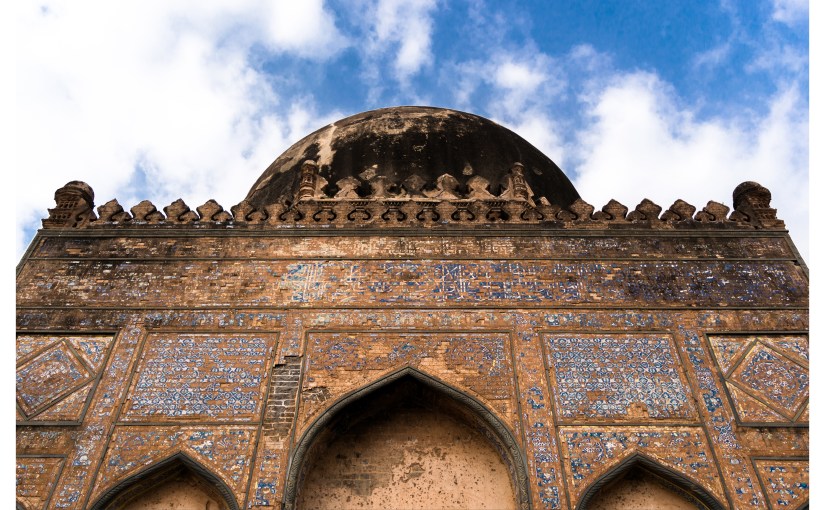
In frame: The tomb of Sultana Ahmed, wife of Bahmani Sultan Ahmad Shah-Al-Wali in Ashtur village, near Bidar, Karnataka, India. The Persian blue tiles on the upper reaches of the tomb are very well preserved, having stood the test of time for close to six centuries.

VERY IMPORTANT TO NOTE: Yes, you can share this work with proper attribution. But, please seek permission before using this work (not including the photo), partially or fully. YOU CAN NOT USE THE PHOTO. Believe me, asking is better than ending up in court or facing public shaming on social media. Thanks for understanding.

© Amrit Panigrahy. All rights reserved.
Gratitude and humility? Who the hell cares?

Can a brilliant looking flower be a brilliant looking flower, on its own? The stem plays an important role in how the flower turns out to be. It is the stem that connects the flower to the plant, supplies all its nutrients, and helps it stay fresh. And it is the same stem that keeps the flower above all the muck and mud below. The moment the flower gets carried away by its own persona, leaves behind the stem, and detaches itself from the roots, it will not have many moments of beauty left in it, and will end up being part of the same muck that it was once so distinguished from. Gratitude and humility play a vital role in a person’s life, the same role that the stem plays in case of the flower.

Swaying Himalayan Aster
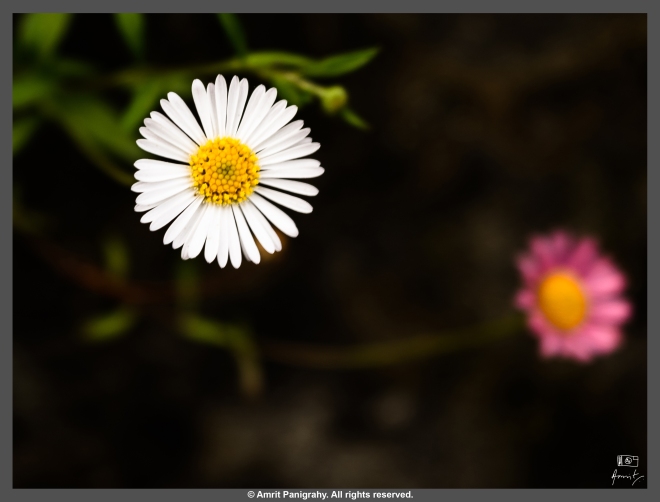
Flower of the Swaying Himalayan Aster (Botanical name – Aster Molliusculus), a perennial herb found in the Himalayas, at altitudes of 1,800-3,000m above mean sea level. This one was on the banks of Bhagirathi (river Ganga as she is known before reaching Dev Prayag), on the way back from Gangotri, Uttarakhand, India.

I admit, I used to be a thankless person, and was not a humble soul for sure. Not because I had something against showing gratitude or humility, but because I felt I was entitled to things, people, or feelings. Hence, I never felt the need to show my gratitude, and be humble while doing so. I took tremendous pride in all the things I knew, in all the things I had achieved and in all of my capabilities. That’s the way I was! Until that day…

That day, the majestic mountains taught me humility. And when I was stranded on top of those mountains due to bad weather, I learnt my lesson on gratitude. I threw away my “red book of grudges” in those mountains, for good.

The learning process is a long way from being over, though. But, I feel I am making progress in the right direction. Over the months, I have realised that being humble is the best way to unlearn and learn life. And being grateful creates more space inside me for everything good that the world has to offer. Both of these together, they help me stay content, connect me to the world in a much better way and negate my ego. I must say, I have come a long long way from the day I was stranded on top of that mountain.

Now, the best part about us humans is, we do not necessarily have to experience something to learn. We can learn from others’ experiences as well, thus saving us precious time. So, here is my experience for you, in one sentence –

Be grateful for everything you have (even for having your annoyingly critical friend), be humble in front of everyone (even an illiterate or someone who comes from way below your social stratum), and you will find happiness!

In frame: Flower of the Swaying Himalayan Aster (Botanical name – Aster Molliusculus), a perennial herb found in the Himalayas, at altitudes of 1,800-3,000m above mean sea level. I framed this one on the banks of Bhagirathi (river Ganga as she is known before reaching Dev Prayag), on my way back from Gangotri, Uttarakhand, India.

VERY IMPORTANT TO NOTE: Yes, you can share this work with proper attribution. But, please seek permission before using this work (not including the photo), partially or fully. YOU CAN NOT USE THE PHOTO. Believe me, asking is better than ending up in court or facing public shaming on social media. Thanks for understanding.

© Amrit Panigrahy. All rights reserved.

Drawing Parallels

I tend to start reading about people, places or things as soon as I develop a small interest in them, and then the interest tends to grow on me. It is as if I feel hungry, until a point where I realise that I have devoured every piece of information, or trivia that existed on the said topic – Bhimbetka was earlier this week (you can read here), and Amrapali the week before (you can read here).

However, the case of Hampi is completely different. I was on my second visit to Hampi within a year. And I did not understand the pull that Hampi exerted on me. Hampi was the capital of the mighty Vijayanagara empire. Having read megabytes about Hampi, to the point of obsession, the said pull never subsided. And no, it has got nothing to do with the other side of Hampi. And yes, recently, I cracked the curious case of the pull, the constant tugging that Hampi exerts on my mind, which I promise to reveal later in this post.

Ah, history books!

As a general practice, when reading about kingdoms, I tend to check what was happening in the Indian sub-continent, if not around the world, during the same time, hoping to chance upon a significant event, that might have mysteriously failed to appear in our history chapters. The more I read, the more I realise that we contemporary Indians have been made an ignorant lot. We, when focusing on any event in history, tend to ignore the events of a parallel time line, however significant those are. So do our history text books, conveniently.

The beginning of 16th century was a time of tremendous churning in North India. The Lodi Sultanate of Delhi was routed by a mere 12,000 strong Mughal army of Babur in 1526 AD, and Babur laid foundation of the Mughal empire in India, by defeating Rana Sanga of Mewar.

We all have read in our history books about Sultanates of Delhi and how Mughal empire was established, correct? What we haven’t read in our history books is this!

While Babur was ravaging North India, the lands to the south of Narmada were relatively peaceful. One man had subjugated the Sultans of Deccan, the Portugese on the west coast, the Reddys of Kondavidu, the Velamas of Bhuvanagiri and even the Gajapatis of Kalinga to the east. Though questionable, it is believed that Babur did not dare cross Narmada, fearing that one man and close to a million strong army the man commanded. May be, Babur preferred a buffer of sovereign states between his realm, and that of the man who could have easily become his nemesis. Krishnadevaraya was his name, most prominent Emperor of Vijayanagara, and the third one from Tuluva dynasty. He reigned for 20 years (1509-1529 AD), which is considered as the golden period of Vijayanagara, as well as southern India.

At a time when religious persecutions were common place elsewhere in the Indian subcontinent, mainly in the north, Krishnadevaraya ensured equal rights for every subject of his empire irrespective of the religion they practised. For a sovereign to prosper, its borders must be secured. He achieved this through his unmatched military acumen and diplomacy. He implemented many reforms that economically benefited all his subjects.

That’s not all! He was an accomplished poet, well versed in Telugu, Tamil, Kannada and Sanskrit. Art flourished in his reign, examples of which exist even today, either in the form of poetry composed by Krishnadevaraya himself or one of the many prominent poets who graced his court (Tenali Rama being most prominent of them), or in the form of exquisite sculptures that grace the temple ruins across Hampi. Vijayanagara emerged as the centre of intellect during Krishnadevaraya’s rule.

Vijayanagara empire ceased to exist after the battle of Talikota, in 1565 AD, when combined forces of Deccan Sultans defeated its army. The victorious armies plundered and pillaged Hampi for six long months.

There! A significant chunk of our own legacy that most of us are not aware of. I never read about the glorious Vijayanagara empire in my history books. And I bet, neither did most of you!

Finally, the promise kept!

Didn’t I promise in the beginning, to reveal the curious case of the pull, the constant tugging that Hampi exerts on my mind? Here it is!

Krishnadevaraya was the third from the Tuluva dynasty which ruled Vijayanagara empire from 1491 AD till its end. I recently discovered that rulers of Tuluva dynasty, were ancestors of the people that we know today as Tulus, primarily from the Udupi-Mangalore-Kasargod region of the Konkan coast. And my mother is a Tulu, that too from the warrior clan!

The pull or the constant tugging I was experiencing, was in fact of the people from the land of my mother!

In frame: A tourist exploring the ruins, in one of the many ancient gates of Vijaya Vittala temple, Hampi, Karnataka.

VERY IMPORTANT TO NOTE: Yes, you can share this work with proper attribution. But, please seek permission before using this work (not including the photo), partially or fully. YOU CAN NOT USE THE PHOTO. Believe me, asking is better than ending up in court or facing public shaming on social media. Thanks for understanding.

© Amrit Panigrahy. All rights reserved.
Anatomy of a photographer’s mind

“The whole point of taking pictures is so that you don’t have to explain things with words.” – Elliott Erwitt.

Why do we take photographs? To document? To record? To cherish a memory, or as a key to the past… time travel, you see? And in worst case as evidence or proof. Right? For those of us who have difficulty with words (and even for those who have a way with words), it is easier and far less cumbersome to explain events through photographs. Ever heard of Instagram?

What would have we done if we had lived in an era where there was no Instagram or even cameras? Answer would be painting, yes? In most cases, we wouldn’t have painted those ourselves. Rather, we would have hired a painter. If we take out the elements of imagination and creativity, the primitive instinct which drives this behaviour is our propensity to record the events around us.

That, my friend, is the primary motive behind visual art! That’s where it all started.

Wait! How old is visual art?

Hold your breath!

The oldest existing painting is at least 40,800 years old (El Castillo, northern Spain). The oldest surviving examples of paintings in the Indian sub-continent are at least 30,000 years old, in the Rock Shelters of Bhimbetka, a UNESCO World Heritage Site, located in the Vindhya range in Madhya Pradesh, India. These rock shelters are believed to have been continuously inhabited right up to the medieval period. And the same primitive instinct which I mentioned earlier, was the driving force behind the paintings of Bhimbetka, for close to 30 millennia.

The procession (see photo) was one such event of ancient India, which the dwellers of Bhimbetka recorded. The painting is that of a royal procession, with possibly a very important figure seated on the decorated horse at the front. Some say, it is the royal procession of Emperor Ashoka, himself. Even I believe so, for three reasons. First, for the dwellers of Bhimbetka to depict something, it had to be an extremely important event. Second, Ashoka was the governor of Vidisha during the reign of his father, Bindusara, Emperor of Magadh. Vidisha lies about 90 kms north of Bhimbetka. And third, this painting dates back to the classical period which starts sometime around 3rd century BC, about the same time as Ashoka.

Now, go back up and the read the quote by Elliott Erwitt, while looking at the painting in the photo. Do you understand why we take photographs?

I got to confess, if not a photographer and a storyteller, I would love to be a historian. But wait, in a way aren’t historians storytellers too?

In frame: The Royal Procession, Rock shelter no. 8, Rock Shelters of Bhimbetka, Madhya Pradesh, India

You can read more about Elliott Erwitt here.

VERY IMPORTANT TO NOTE: Yes, you can share this work with proper attribution. But, please seek permission before using this work (not including the photo), partially or fully. YOU CAN NOT USE THE PHOTO. Believe me, asking is better than ending up in court or facing public shaming on social media. Thanks for understanding.

© Amrit Panigrahy. All rights reserved.

My tribute to the womankind!

My first post on my own domain!

And what better way to start it than paying a tribute to the womankind – the creators, beautifiers and managers of life around us.

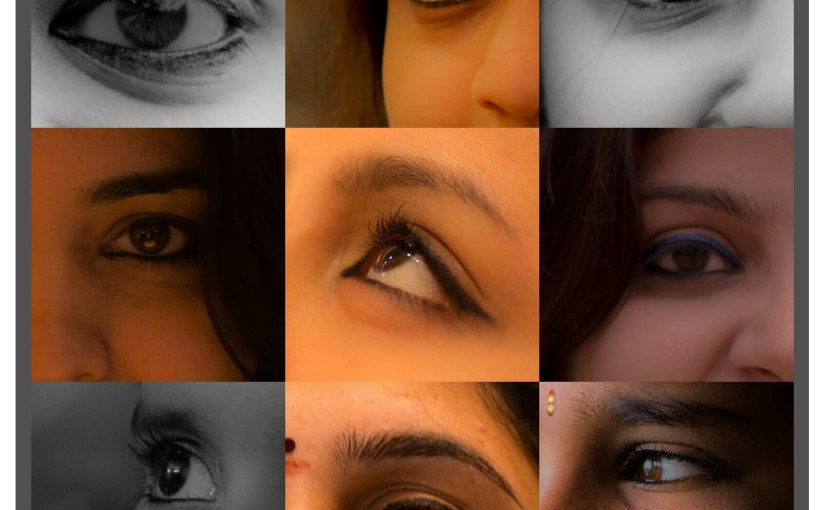
The featured photograph is a collage of the whole series I did on the occasion of “International Women’s Day”. The feature was named “Her point of view”, and the idea was to capture eyes of women, signifying their point of view, which I believe is ignored by many of us.

“Her point of view” series was an amazing experience. This idea came to me in February and I approached complete strangers, colleagues and friends with this idea and saw a fair bit of rejections too. The rejections were mainly by strangers, owing primarily to their scepticism that resulted from a stranger with a camera approaching them for a portrait shot.

There were some rescheduling too – and this project being for women, the least I could have done was manage my time according to the availability of my amazing models.

On the other hand, this project helped me in gaining valuable insight in to woman psychology. I will not be wrong if I claim that I understand women better today, than I did a few month’s ago.

Special thanks to the girls!