Autumn Resilience

Those were the Autumn days, about two decades back,
Was out and about with family, had festivities to make.

Was on my way back home, when the warning was issued,
The Cyclone was approaching, we tried to rush all we could.

Efforts were not enough, and we got stuck in a bad traffic jam,
With huge trucks around us, ours was a tiny car in the open.

The hours passed, a veil of darkness descended upon us,
We heard big roars, as if the devil’s lung was about to burst.

The Cyclone went about its business for the whole night long,
Destroying vehicles, houses, as if licked with its thorny tongue.

Twisted trees and power poles alike with all its might,
Wiping out years of mankind and civility in just one night.

We stayed in that car for the whole time, huddled and scared,
The winds tried to toss us, and we thought we won’t be spared.

That was one scary Autumn night, like none I had seen before,
With everything else destroyed, as if we were left to tell the lore.

It was long before, when cyclones were without any names,
Less powerful, and may be a slightly less in fearsomeness.

Rising temperatures have made them more common than ever,
Autumn is synonymous with cyclones now, and will be in future.

When the world prepares for festivities at the arrival of Autumn.
My tribe is either preparing for a cyclone or is recovering from one.

As mankind “progresses” towards a better “future” elsewhere,
There will be people here who pay more than their fair share.

Not paying for the “progresses” they haven’t made, not a choice,
Autumn and its cyclones are now a story of my tribe’s resilience.

Having stood steadfast in the face of the cyclone of this year,
They pick up pieces, preparing for the next without any fear.

Autumn Resilience
An old man looks at the restless sea under black clouds as he prays using prayer beads, at Puri in Odisha, India.

My first encounter with a cyclone was way back in 1999, when me and my family were caught unawares while coming back from a roadtrip during Dussehra. We spent a night inside the car, stuck in a traffic jam on the then infamous Andhra-Odisha border. The storm raged on outside, and tried hard to toss and turn our car as the eye of the storm passed right over us. When the storm passed and dawn broke, almost everything around us was destroyed. The super cyclone of 1999 followed it, and became one of the worst natural disasters of the Indian subcontinent.

Over the years we moved to naming cyclones in the Indian ocean region, but the cyclones didn’t relent. On the east coast, Odisha became their primary target, and they came back every year during Autumn, the festive season in India. As global temperatures have risen, Odisha has been gearing up for cyclones, every year since, that is, after facing its annual bout of floods.

And for the people of coastal Odisha and the adjoining hills inland, they don’t understand what on Earth is worth the price they pay for every Autumn, year after year. The industrialisation that doesn’t exist in their backyard, the infrastructure that is just beginning to show up, the vehicles that don’t ply on their roads, or the over-consumption of resources that they are not party to? Or is it that they pay the price for someone else’s luxury?

VERY IMPORTANT TO NOTE: Yes, you can share this work with proper attribution. But, please seek permission before using this work (not including the photo), partially or fully. YOU CAN NOT USE THE PHOTO. Believe me, asking is better than ending up in court or facing public shaming on social media. Thanks for understanding.

© Amrit Panigrahy. All rights reserved.

वो खुद थी

दरवाज़े, जिनकी चाबी उसी के पास ही थी,
कुछ एक मेरे लफ्ज़, जो वो ही थी समझती,
समझ जाती थी ज़ुबान खामोशियों की भी,
सांसे उसके लिए जैसे सरगम किसी गाने की।

एक दिन ऐसा आया, वो बोली में चली जाउंगी,
तुम्हारी कुछ आदते हैं जो मैं कभी सह ना पाउंगी,
क्या पता उसको के सबसे बड़ी आदत वो खुद थी,
मेरे दरवाज़े की चाबी,
मेरे अनसुलझे लफ्ज़,
मेरी सांसे,
और मैं….

वो खुद थी…….

Yes, she was
हां, वो उसकी आदत थी ।। Yes, she was his habit

A Hindi poem, this one talks about the closeness and the “used to” kind of bond the lovers share, so much so that when the lady decides to leave citing few of the man’s habits that she can’t tolerate anymore, it turns out that the man considers her his biggest habit, as his key to happiness, as his unspoken words, even as his breath and he himself.

I have to admit that owing to time constraints and many ongoing projects, I am unable to give time to creative writing as much as I should. So, after a long time, here it is.

VERY IMPORTANT TO NOTE: Yes, you can share this work with proper attribution. But, please seek permission before using this work (not including the photo), partially or fully. YOU CAN NOT USE THE PHOTO. Believe me, asking is better than ending up in court or facing public shaming on social media. Thanks for understanding.

© Amrit Panigrahy. All rights reserved.

Danda Jatra – The Festival of Punishment

ହେ ଋଷିପୁତ୍ରେ!
ଆଇଲେ ହର, ଦେଇଗଲେ ବର,
ଅନ୍ୟ ସେବା ଛାଡି ଏ ସେବା କର।

ଏ ସେବା କଲେ କି ଫଳ ପାଏ,
ଉଷୁନା ଧାନ ଗଜା ହୁଏ,
ଶୁଖିଲା କାଠ କଞ୍ଚା ହୁଏ,
ଭଜାମୁଗ ଗଜା ହୁଏ,
ଅପୁତ୍ରିକ ପୁତ୍ର ଦାନ ପାଏ,
ଅନ୍ଧ ଚକ୍ଷୁଦାନ ପାଏ,
ଜରାରୋଗ ଭଲ ହୁଏ।

“Dear Sons of the Sages! Lord Shiva has come and granted you boons. Give up everything else and do this service. If you do this service, you can make the impossible possible, parboiled rice and fried green gram will sprout, dried wood becomes a living tree, childless mothers bear children, blinds get vision and old people become young again.”


It was the Hindu month of Chaitra and I was driving by a village in southern Odisha. While passing, by I heard the sound of the drums and the grave tune was potent enough to teleport you into another dimension. It had to be, for it was meant to please the fiercest forms of Shakti and Shiva – Goddess Dandakaali and Lord Rudra, respectively. As I grew curious and stopped the car, my father told me it was Danda Jatra, pronounced as thuh (as in “the”)-wn-daw zaat-ra, literally meaning the festival of punishment.

Drummers
Drummers beating a very grave tone, announcing the arrival of Danduas to villages from far off.

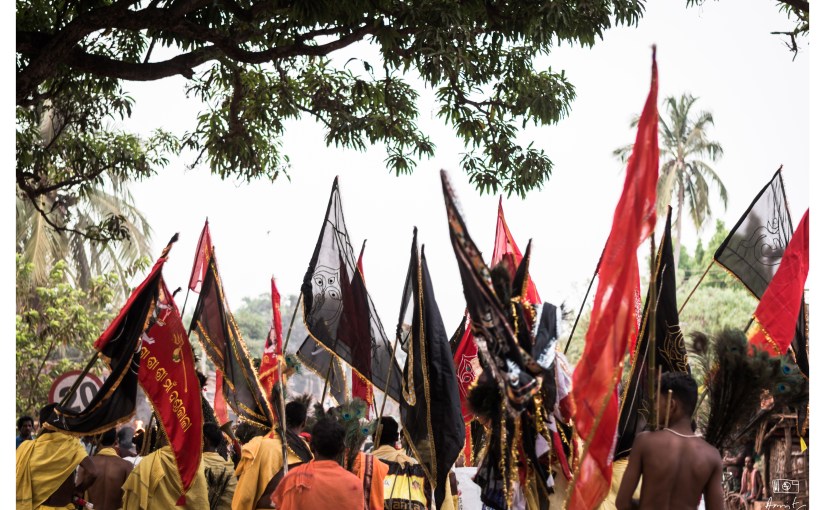
Danda Jatra traces back its origins to more than a millennium ago, when it found importance in the Tantrik practices of a predominantly Shakta (worshippers of Shakti) Kalinga of 10th century AD, or thereabouts. Danda Jatra is by the farming community and for the farming community, cutting across all castes, and revolves around the daily life of a farmer. In simple words, the practice revolves around the age old tradition of “barter”, wherein in this case the Dandua (as the people who take part in this festival are called) asks for a few wishes to be fulfilled by Goddess Dandakaali and Lord Rudra and in return promises to spend 13, 18 or 21 days in penance and abstinence (the punishment), spreading the message of Shiva and Shakti.

Danda Jatra
Danduas walking past a village in a procession holding these flags, to the beat of drums, and spreading the message of Shiva and Shakti.

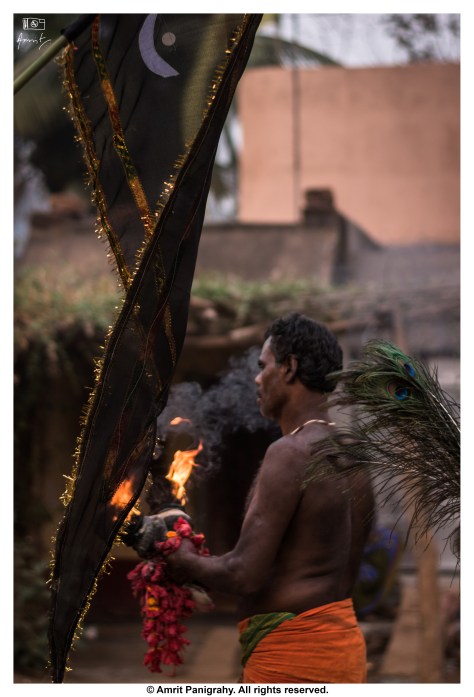
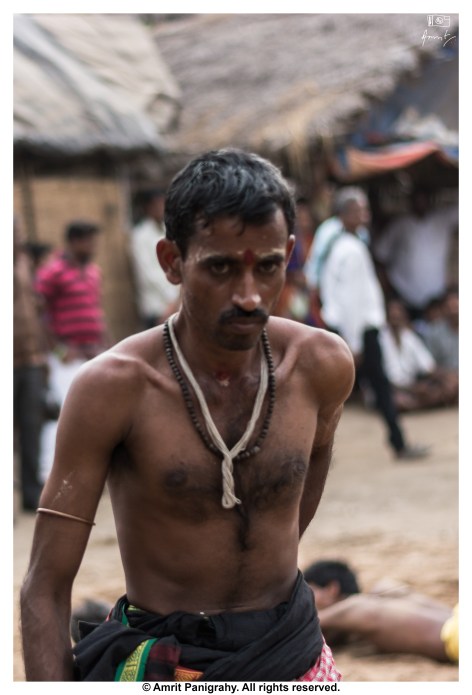
Every team comprises of 13 Danduas and there are more than 300 teams in existence today. From the start, for 21 days the Danduas abstain from any kind of indulgence like meat (of all kinds), liqour and physical intimacy with their partners. On the strike of midnight of the first day, they take bath in the village pond, wear saffron colored clothes and congregate near the village temple. After a few rituals Hara-Gouri (basically Shiva and Shakti) are consecrated as two holy sticks (also called Danda in Odia). Then they light the holy fire by (you guessed it right!) rubbing two bamboo sticks against each other, and this holy fire remains lit till the end of the festival. I saw them roaming around in villages with the holy fire and the consecrated sticks, and blessing households and shops as the walked along.

Danda Jatra
A Dandua carrying the holy fire around the village, to bless the households and shops. The holy fire is kept lit for whole 21 days.

They go around giving performances in villages upon invitation, and through the use of comedy and light-heartedness (sometimes vulgar), they spread serious messages from the scriptures, about ways of life and righeousness. When they perform on the dirt, it is called Dhuli Danda (Dhuli in Odia means dust), and when it is in the water, it is called Pani Danda (Pani in Odia means water). And then there is something known as Danda Suanga, which usually starts around midnight and continues well into the morning next day.

I had heard about it as a kid and had seen it a couple of times when I went to the villages with my father. I had the opportunity of watching Dhuli Danda this time. The Danduas had made square shaped farmlands on the ground, by lying down on the dirt, and one of them acted as a farmer, who used two of them as oxen to cultivate the farmland and then planted seeds. And so the daily life of a farmer continued.

Dhuli Danda
The Danduas on the dirt are mimicking farmlands, and two running towards the camera are acting like oxen cultivating the farmlands. The Dandua behind them acting as the farmer.

Danda Jatra is one of the toughest festivals to take part in for the Danduas, high summer temperatures, lack of sleep, off-schedule and mainly midnight rituals, and just one full meal take a toll even on the most seasoned of them. The meal that is prepared is neither grinded nor boiled, and is offered to Goddess Dandakaali and Lord Rudra first. The Danduas have the food after that in the dead of the night, outside the village and amidst the deafening sound of the drums. They are not supposed to hear any sound while eating, not even that of a bird chirping. If they hear any such sound, or find any impurity in their food, they won’t take that food and stay hungry that night.

Exhausted
A Dandua sitting on the road exhausted. High summer temperatures, lack of sleep, off-schedule and mainly midnight rituals, and just one full meal take a toll even on the most seasoned of them.

On the day of Vishubh Sankrati (the day when Sun crosses the equator and moves into the northern hemisphere), also the last day of the Danda Jatra, the Pata (Paa-taw) Dandua, the leader of the team who wears only black, plays an important role. It is said that Goddess Dandakaali herself possesses him, and then he is tied upside down with holy fire lit right below his head. Sal tree resin (locally called Jhuna) is thrown into the fire repeatedly and it creates a lot of smoke. Amidst loud chantings, it is repeated till the Pata Dandua bleeds from the nose and exactly three drops of blood fall in the holy fire right below. This signifies Goddess Dandakaali having accepted the offerings, and the Danda Jatra culminates.

Pata Dandua
The Pata Dandua plays a very important role in the Danda Jatra, and acts as the medium of communication between Goddess Dandakaali, the Danduas and the villagers.

Danda Jatra is a religio-spiritual practice, and is held with reverence and much fanfare in rural southern Odisha, even after a millennium since it started. Modernity has influenced it in many ways. And, my quest for knowing the practices around Danda Jatra more intimately, and bringing them out to the larger audience, remains a medium-term project.

Jai Dandakaali!


VERY IMPORTANT TO NOTE: Yes, you can share this work with proper attribution. But, please seek permission before using this work (not including the photo), partially or fully. YOU CAN NOT USE THE PHOTO. Believe me, asking is better than ending up in court or facing public shaming on social media. Thanks for understanding.

© Amrit Panigrahy. All rights reserved.
Bhakta Salabega

“ଆହେ ନୀଳ ଶୈଳ ପ୍ରବଳ ମତ୍ତ ବାରଣ,
ମୋ ଆରତ ନଳିନୀ ବନକୁ କର ଦଳନ।”
– ଭକ୍ତ ସାଲବେଗ

Dear Lord of the blue mountain, trample and subjugate my restless mind, like a mighty elephant destroys a lotus pond. Thus save me!
– Bhakta Salabega


Salabega (pronounced Saa-law-be-gaw), one of the greatest devotee of Lord Jagannath was a Muslim by birth. He wrote very beautiful devotional songs dedicated to the Lord. Bhakta Salbeg’s era dates back to about half a century after Kalapahad (yes, I will tell his story too, but that’s for a different time!) had wreaked havoc on Odias, in the early 1600s. Odisha was reeling under Mughal rule. Lalbeg was the Mughal subedar of the Odisha province at that time.

While returning from a conquest, Lalbeg fell for the beauty of a bathing Brahmin widow near a place called Dandamukundapur (which is near present day Sakhigopal between Bhubaneshwar and Puri). Lalbeg forcefully took away the Brahmin widow to his harem and married her. Bhakta Salabega born in 1607/08 AD was their only child. After growing up, Salabega accompanied his father to many military conquests. In one such battles Salabega was grievously injured.

On his death bed, Salabega listened to his mother who was still a Jagannath devotee and started praying to the Lord. By the grace of the Lord and under his mother’s care Salabega had a miraculous recovery and became Lord’s devotee for life. After recovery from his injuries Salabega went to Puri for Lord’s darshan but was turned away from the temple for his religion of birth. Heartbroken Salabega left for Vrindavan hoping that he would have the Lord’s darshan around a year later during Rathyatra.

When Salabega was returning to Puri during Rathyatra a year later, he fell ill midway. He was very disappointed, as now he would have to wait for another year to be able to see Lord Jagannath. So he started praying, and Lord Jagannath being how He is, obliged and His chariot Nandighosh didn’t move even an inch from where it was, till Salabega didn’t reach Puri, and was able to see Him in his own eyes.

After his death, Salabega was cremated at the same spot on Puri Badadand (grand road) where Nandighosh had stopped. His samadhi still stands there, and it is customary for Nandighosh, Lord’s chariot to stop in front of Salabega’s samadhi during Rathayatra.

Bhakta Salabega wrote many beautiful devotional songs dedicated to Lord Jagannath, each of those equally expressive of a devotee’s devotion and His greatness. “Ahe nila shaila”, pronounced “Aa-he nee-law shai-law” (the same one from where the opening lines of this post are taken) is the most well known. You can watch a much shorter and slightly modernised version of the original here.

For those of you interested in the original lyrics of “Ahe nila shaila”, below are the stanzas in Odia and their English translation.


Devotion
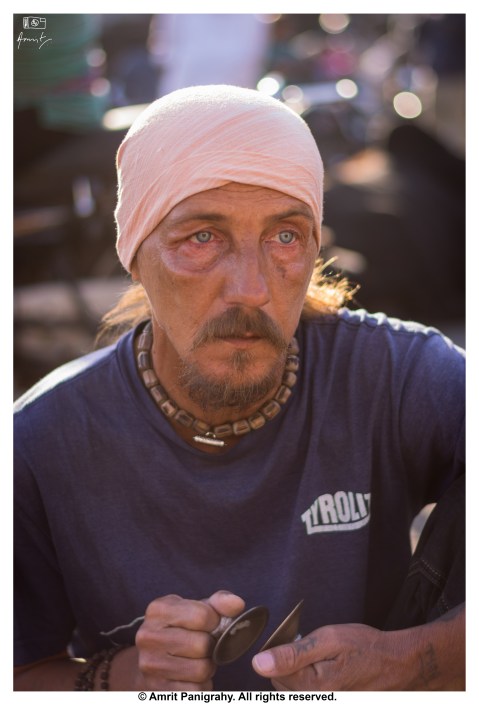
A Russian devotee of Lord Jagannath singing His praise right outside the Singhadwar (Lion gate) of the temple in Puri, Odisha.

“ଆହେ ନୀଳ ଶୈଳ”

ଆହେ ନୀଳ ଶୈଳ ପ୍ରବଳ ମତ୍ତ ବାରଣ,
ମୋ ଆରତ ନଳିନୀ ବନକୁ କର ଦଳନ।
“Dear Lord of the blue mountain, trample and subjugate my restless mind, like a mighty elephant destroys a lotus pond. Thus save me!”

ଗଜରାଜ ଡାକ ଦେଲା ଥାଇ ଘୋର ଜଳେଣ,
ଚକ୍ର ପେଶି ନକ୍ର ନାଶି କୃପା କଲ ଆପଣ।
“When the King of elephants cried out your name in pain when his foot was caught by a crocodile, you sent your disc to kill the crocodile and rescue the elephant. Thus save me!”

କୁରୁସଭା ସ୍ଥଳେ ଶୁଣି ଦ୍ରୌପଦୀର ଜଣାଣ,
କୋଟି ବସ୍ତ୍ର ଦେଇ ହେଳେ ଲଜ୍ଜା କଲ ବାରଣ।
“After hearing Draupadi’s cries for help from the Kuru court, you saved her from being ashamed in front of the court full of men by providing her with a million yards of clothes. Thus save me!”

ଘୋର ବନେ ମୃଗୁଣିକୁ ପଡିଥିଲା କଷଣ,
କେତେ ବଡ଼ ବିପତ୍ତିରୁ କରି ଅଛ ତାରଣ।
“When the deer was in excruciating pain in the dense forest, you saved her from a grave danger. Thus save me!”

ରାବଣର ଭାଇ ବିଭୀଷଣ ଗଲା ଶରଣ,
ଶରଣ ସମ୍ଭାଳି ତାଙ୍କୁ ଲଙ୍କେ କଲ ରାଜନ।
“When the Raavan’s younger brother Vibhishan came to take refuge under you, you gave him refuge and made him the King of Lanka. Thus save me!”

ଅଜାମିଳ ଡାକ ଦେଲା ଜୀବ ଯିବା ବେଳେଣ,
ତେଡ଼େ ବଡ଼ ପାପୀ ଗଲା ବଇକୁଣ୍ଠ ଭୁବନ।
“When a grave sinner like Brahmin Ajamik called out your name while dying, you liberated him. Thus save me!”

ପ୍ରହଲ୍ଲାଦ ପିତା ସେ ଯେ ବଡ଼ ଦୁଷ୍ଟ ଦାରୁଣ,
ସ୍ତମ୍ଭରୁ ବାହାରି ତାକୁ ବିଦାରିଲ ତକ୍ଷଣ।
“Prahalad’s father (a demon named Hiranyakashipu) was terrible and atrocious, and you came out of the pillar to tear him apart. Thus save me!”

ନୀଳାଚଳେ ବିଜେ କରି ବୌଦ୍ଧ ଅଵତାରେଣ,
ବେନି ଭୁଜ ଟେକି ପ୍ରଭୁ ଯାଚୁଅଛ ଶରଣ।
“You have chosen Neelachal (another name of Puri) as your abode, residing there as the Buddha incarnation of Lord Vishnu, and are offering shelter to everyone by lifting your hands.”

କହେ ସାଲବେଗ ହୀନ ଜାତିରେ ମୁଁ ଯବନ,
ଶ୍ରୀରଙ୍ଗା ଚରଣ ତଳେ କରୁଛି ମୁଁ ଜଣାଣ।
“Thus speaks the insignificant Salabega, who is a Muslim by birth, and I am appealing under your lotus feet, please save me!”


In frame: A Russian devotee of Lord Jagannath singing His praise right outside the Singhadwar (Lion gate) of the temple in Puri, Odisha. As was for Bhakta Salbeg, it is forbidden for this devotee also to enter the temple, because of his religion of birth and foreign origin.

VERY IMPORTANT TO NOTE: Yes, you can share this work with proper attribution. But, please seek permission before using this work (not including the photo), partially or fully. YOU CAN NOT USE THE PHOTO. Believe me, asking is better than ending up in court or facing public shaming on social media. Thanks for understanding.

© Amrit Panigrahy. All rights reserved.

The Day I Died

The roar of the river, and so close,
Drowned everything including sound,
Couldn’t even hear my mind’s prose,
Beneath, the slippery shaky ground.

The whirlpool right in front of me,
Couldn’t fathom how deep it could go,
To be locked in it, and lose the key,
Forever, with no more despair to grow.

My mind’s whirlpool was getting bigger,
Consuming everything, from inside out,
Event that led to this, and the rigour,
Everything that I thought I knew about.

Stood there thinking, on the bank of the river,
Cold wind touched my skin and I began to shiver.

Lot of rejections, a failed life I thought,
People who once “adored” had started to hate,
This agony and pain, on myself I had brought,
There won’t be any if they left at this rate.

The image of a life I had in my mind,
Things that I had started to believe,
In last few days all of it came unwind,
It started to question my love to live.

It was the river I had followed,
All the way up, and on way back,
And saw everything it had mowed,
The mountains it made to crack.

I walked a few steps on the bank, and now closer,
Thought it was okay if the world called me a loser.

Everything started to become hazy,
Was getting ready to make the jump,
Thoughts in my head were going crazy,
Clearly heard my heart’s frantic pump.

Everything fell silent all around, including the river’s roar.
I clearly heard but turned to find no one, and it shook my core.

I had clearly heard my Mom’s calling,
But I couldn’t see her anywhere near,
Didn’t know what kept me from falling,
And the whole event too much to bear.

More than a year later, when I think of it,
Perilously close I actually was to commit.

Cannot thank enough the divine intervention,
A blunder it would have been, for any reason.

All these days, this past in me had dormantly lied,
Nothing remained same, that was the day “I” died.

The “I” that was meek, and fragile..
The “I” that was weak and easily broke….


Lot of things were unfolding in my life during that time, and the mountains had turned my life upside down. People had changed, definitions had changed, and outlook had changed, or so I thought. I was finding it really hard to cope with all of it at once. And it is that moment of weakness I have portrayed in my poem above. Depression is a killer. You might not be as lucky as I am to have a divine intervention. So, please talk it out.

Remember, suicide is a crime against your loved ones!

Ganga
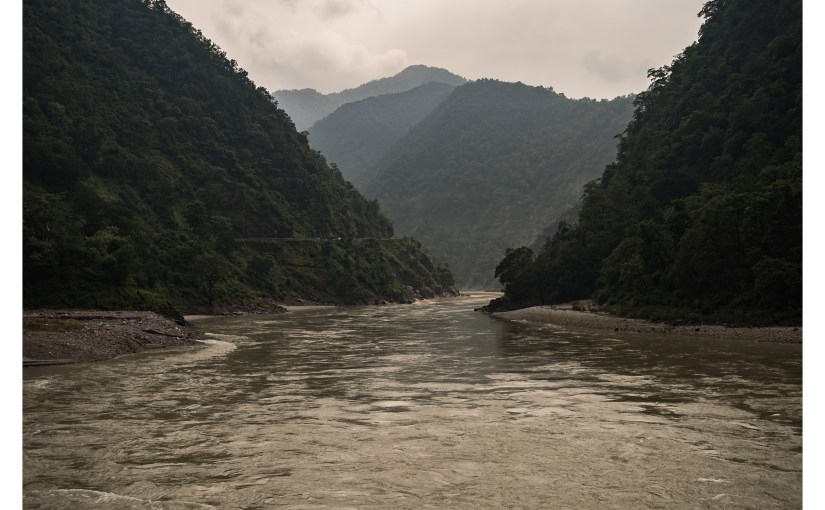
River Ganga flowing through a valley, under an overcast sky, downhill from Devprayag, in Uttarakhand, India.

In frame: River Ganga flowing through a valley, under an overcast sky, downhill from Devprayag, in Uttarakhand, India. It was here we had stopped for lunch on our last day in the mountains more than a year ago.

VERY IMPORTANT TO NOTE: Yes, you can share this work with proper attribution. But, please seek permission before using this work (not including the photo), partially or fully. YOU CAN NOT USE THE PHOTO. Believe me, asking is better than ending up in court or facing public shaming on social media. Thanks for understanding.

© Amrit Panigrahy. All rights reserved.
रूही

हर एक आशियाने पे जैसे वो चला देती थी अपनी जादू की छड़ी,
सुला के सबको, सपनों की रखवाली करती हुई रात भर रहती थी खड़ी |

सुबह की पहली रोशनी के साये में जैसे वो लड़खड़ाती हुई चल रही थी,
सपनों से भरी रात के नशे से लगभग बेहोश, अपने कदमों को संभालती।

उसकी अपनी कदमों की आहट जैसे उसी के जादू को थी तोड़ रही,
मुस्कुराती, और एक रूहानी रात का वादा करके चली गयी, रूही।

Daybreak
The setting moon over Hyderabad’s skyline, as seen from Moula Ali, in Hyderabad, India.

As if she ran her magic wand over all the dwellings during the night, and after having made everyone fall asleep,  she stood guard to their dreams. Under the shade of the first light of the morning (poetic expression), she unsteadily walked, still drunk on the dreams from the night, she tried keep herself steady. It was as if her own footsteps were undoing her magic spell, and with a smile on her face, Ruhi walked away promising another intriguing night.


It was magical indeed, my first ever photowalk, and first ever trip to Moula Ali, on the other side of Hyderabad. The moon was setting over the sleepy Hyderabadi skyline, and the dawn was breaking in the opposite direction.

These were my very early days in photography, when I was using a Sony HX100V (with a sensor that was 1/4th of what my current DSLR has). And I didn’t know RAW even existed (yes, perils of being self taught!), so bear with me for the resolution of the image.

In frame: The setting moon over Hyderabad’s skyline, as seen from Moula Ali, in Hyderabad, India. It was magical indeed, just being there at that moment, with the moon setting in front of me, and behind me, the dawn breaking.

VERY IMPORTANT TO NOTE: Yes, you can share this work with proper attribution. But, please seek permission before using this work (not including the photo), partially or fully. YOU CAN NOT USE THE PHOTO. Believe me, asking is better than ending up in court or facing public shaming on social media. Thanks for understanding.

© Amrit Panigrahy. All rights reserved.
Crimson Love

I had fallen back, to witness the drama that was unfolding in the sky.

My guide called out my name from a distance….

It was only minutes ago that he was here,
Telling me stories from the yesteryear,
Tales of opulence, generosity, valor and love,
For an open heart it was like a treasure trove.

Of all the stories, one was of interest in particular,
A King, his Queen, and love that was spectacular,
A poetess and a singer, she could bring words to life,
Smitten by her, the King convinced her to be his wife.

They were living happily ever after, or so they thought,
A big army attacked the kingdom, and a battle fought,
The King was killed in battle, was what the messenger told,
The Queen drank poison, and her lifeless body went cold.

The medieval fort, a witness to her love story,
Her eternal love for him that took her to glory,
Walking on that pavilion even I felt as a part it,
Kind of gloomy that in the end they couldn’t unite.

I glanced beyond the ramparts, as I walked back…

Crimson sun set over the horizon,
Leaving behind a familiar emotion.

And as it went…

The hues that it painted and the winter sky it tore,
Colors of desire and pain, that touches one’s core.

More than a year has gone since…

Crimson, is the color that I remember of that evening,
Of longing, the want of belonging and a love undying.

Crimson Love, ‘t was!

Drama in the sky
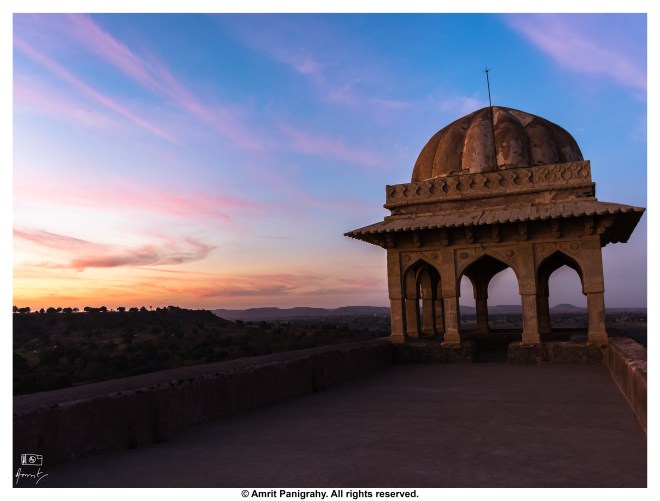
Brilliant hues of the winter sky just after the sunset, as seen from Roopmati pavilion in Mandu

I had earlier written a Hindi poem on Roopmati and called it “Jauhar”. You can read it here.

Mandu, or Mandav was capital of erstwhile kingdom of Malwa. Mandu is dotted with love tales of Sultan Baz Bahadur of Malwa, and his queen consort Roopmati.

Kingdom of Malwa used to be a vassal of the Mughals, and had declared indepedence taking advantage of the instability that ensued just after Akbar had taken control.

Akbar then sent his foster brother Adham Khan and a large contingent of the Mughal army to subdue Malwa. Adham Khan, who had by then heard of Roopmati’s enchanting beauty, had resolved to defeat Malwa and take her as a prized possession of his harem.

Baz Bahadur faced Adham Khan and the Mughals in Sarangpur with a small contingent. Baz Bahadur’s contingent was no match for the mighty Mughals and he escaped after being defeated.

Adham Khan then marched on to Mandav. Thinking that Baz Bahadur was slained in the battle, Roopmati poisoned herself, as she could not have seen another man in her life. Such was her love.

In due time, Adham Khan was executed by Akbar. Baz Bahadur surrendered to Akbar and was in return made the mansabdar of Malwa.

And for Roopmati, her love and loyalty for Baz Bahadur still fascinates imagination of the new generation of tourists to Mandu.

In frame: Brilliant hues of the winter sky just after the sunset, as seen from Roopmati pavilion in Mandu, Madhya Pradesh, India. Roopmati pavilion was built by Sultan Baz Bahadur for Roopmati, so that she could Narmada darshan everyday (one of her pre-conditions to her marriage with him). Narmada flows at a distance, in the plains.

VERY IMPORTANT TO NOTE: Yes, you can share this work with proper attribution. But, please seek permission before using this work (not including the photo), partially or fully. YOU CAN NOT USE THE PHOTO. Believe me, asking is better than ending up in court or facing public shaming on social media. Thanks for understanding.

© Amrit Panigrahy. All rights reserved.

One toe!

“इति श्रीरावण-कृतम्
शिव-ताण्डव-स्तोत्रम्
सम्पूर्णम्”

“Thus ends the Shiva Tandava Stotram, written by Sri Raavan.”

You subjugate all nine planets (navaghrah), all three worlds – heaven, earth and underworld, and all living beings. You are master of such knowledge that even your worst enemies would seek your presence to consecrate yagyas and offer prayers on their behalf. Things like all the wealth of the world is yours for the taking (albeit by force from your half-blood brother). When you are the strongest, the most knowledgeable and the most intelligent being alive, you would have some pride, wouldn’t you? Raavan did.

Was anything impossible for Raavan? Virtually no! Apparently, Naarad once told him that if could impress Lord Shiva somehow, He would grant Raavan boons that would make him invincible. As nothing was impossible for Raavan, he marched to Mount Kailash the adobe of Lord Shiva. Upon reaching, he did penance for many years but Lord Shiva was unimpressed. Angry with ignorance, Raavan sat down on one knee and picked up Mount Kailash on his shoulders, Mount Kailash with Lord Shiva and His family on it.

When He felt the tremors, Lord Shiva understood what was happening. To teach Raavan a lesson, while sitting on top of Mount Kailash He pushed it down with one toe. Raavan, the strongest, the most knowledgeable and the most intelligent being alive, was pinned down, and cried out loud in pain (and hence Lord Shiva gave him the name Raavan, from its Sanskrit root word “Ru”, which means to cry, bewail, roar, scream).

Lord Shiva was unmoved by Raavan’s cries. Raavan’s pain was compounded by the agony of not being able to impress Him, so he decided to do the unthinkable. Still pinned down under Mount Kailash, he ripped apart one of his heads (he had ten!) and one of his hands, took out his intestines and used them as strings to make a makeshift Veena, and started singing praises of Lord Shiva, which would go on to become known as Shiva Tandava Stotram (click here), which is still sung by devotees of Lord Shiva.

Raavan, the strongest, the most knowledgeable and the most intelligent being to have ever lived – fixed with one toe!


In the mortal world, nothing comes closer to depiction of Mount Kailash and the many stories associated with, than Kailash Temple in Ellora, Maharashtra, India. A World Heritage Site and commissioned by the Rashtrakutas, built in 8th century AD, Kailash (also known as cave no. 16) measuring 82m X 46m, is a megalith, i.e. built from one single rock. Unbelievable, isn’t it?

Kailash Temple
Kailash Temple is a World Heritage Site and was dedicated to Lord Shiva.

Kailash Temple was built top down (unlike other temples which are built bottom up) from a single rock mountain. It is estimated that in the process of building this temple, 400,000 tonnes of rock must have been scooped out, yet there is no large deposit of excavated rock to be seen nearby.

The temple is filled with depictions of many stories from the mythologies, and also includes full depiction of Ramayana and Mahabharata. The elephants carved at the base of the main temple give an impression as if they are holding the temple aloft. The ground floor of the main temple is solid rock, and takes the weight of the huge Shivling in the sanctum on the first floor. If looked closely, one can also see a painting on the ceiling in the first floor, and the painting has stayed intact more than a millenium.

The courtyard is surrounded by an arcade three stories high and depicting stories related mainly to Lord Shiva and Lord Vishnu through lively sculptures, complete with even facial expressions.

All of it, from one freakin’ rock, which was freakin’ ‘uge!


In frame: Front view of the Kailash Temple, in Ellora, Maharashtra, India. A World Heritage Site, Kailash Temple was dedicated to Lord Shiva and built in 8th century AD. It is a megalith i.e. built top down from a single rock mountain.

VERY IMPORTANT TO NOTE: Yes, you can share this work with proper attribution. But, please seek permission before using this work (not including the photo), partially or fully. YOU CAN NOT USE THE PHOTO. Believe me, asking is better than ending up in court or facing public shaming on social media. Thanks for understanding.

© Amrit Panigrahy. All rights reserved.


The year song


Riding the waves
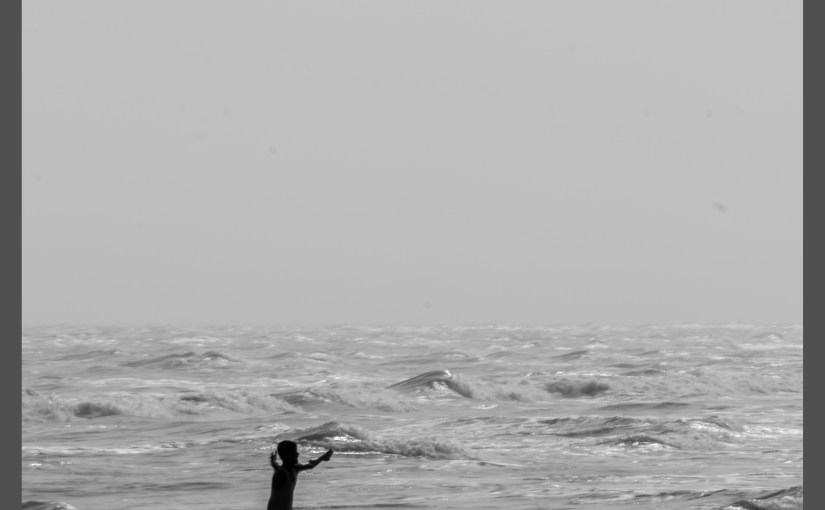
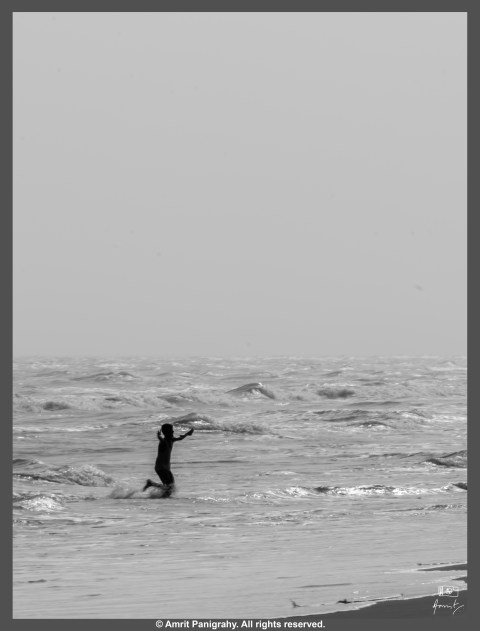
A young man running back to the shore from the sea

A song for the year, I had promised to write,
Taking time out in the middle of the night,
Thoughts rusty, and not organised so well,
But an year it was and many tales to tell.

So, here it is!

Before the year started, in hindsight it was like…

Retreating waves pulled me back to the sea,
Like vices in whose vice like grip I was in,
Vices I left behind on my way to the coast,
And to those no one would raise a toast.

With questions and no answers I started my year,
A start with much less joy and surely a lot of fear,
As if I stepped into the unknown blindfolded,
Fear of an uncertain future, and what lay ahead.

It was the best one ever. To sum it up…

I travelled ten thousand kilomeres on road,
To new places about which I had never heard,
Met people I would never see in my life again,
But memories of a lifetime, of joy and of pain.

I let go of the hands that I never thought I would,
Stopped missing people I never imagined I could,
Worked on myself and learned to be with me,
Had I felt bored with myself, I was in bad company.

Started to see every living being for what they were,
My lack of compassion, and it was totally unfair,
Biggest lesson was on empathy and to be able to relate,
Thank my stars I learned in time, and it wasn’t too late.

The universe has been very kind to me in return,
A lot of gifts and people with best intentions,
Gifts that will stay with me for my entire life,
People who will stay and will help me thrive.

When the waves pulled me, I came back riding them,
Stronger, wiser, calmer, compassionate and brave.

Now with 2017 behind me, here is my 2018 wish for you….

May you have my 2017, if not better than that,
I wish this for you from the bottom of my heart.

Call it a rhyme or a poem, this is my year song,
A song, I won’t mind humming whole life long.


2017 was a life changing year for me, with a lot a of changes for good. This is how good a year it was, in my own words, as a poem.

In frame: A young man running back to the shore from the sea, near Baruva, in Andhra Pradesh, India.

VERY IMPORTANT TO NOTE: Yes, you can share this work with proper attribution. But, please seek permission before using this work (not including the photo), partially or fully. YOU CAN NOT USE THE PHOTO. Believe me, asking is better than ending up in court or facing public shaming on social media. Thanks for understanding.

© Amrit Panigrahy. All rights reserved.
Caro(m)kshetra

Caro(m)kshetra
The Striker and the pieces on a carom board

They are family, kin and friends, how could one kill,
Void they would leave behind, who would be able to fill.

The ones that he grew up playing with, and the ones who taught,
Unable to take on them, was there a way the battle won’t be fought.

The battlefield lay in front of him, and the warriors gave battle cries,
He was unable to pick up his weapon, even after a million tries.

He was given a code to live by, and million reasons to kill,
Told they were his enemies, whose void he need not fill.

He was shaken violently, when he hesitated and refused to fight,
To see things clearly, like he would in the morning after a dark night.

He was chosen for this task because he was mighty and just,
Unlike mightier warriors filled with jealousy and blood-lust.

The ones in front of him were dead the day they joined the wrong,
With justice and morality on his side, he felt ever so strong.

Understanding his duty and worth, he started killing with rage,
Without seeing who was in front of him, or what was their age.

He killed for many days, and many of his beloved ones were taken away,
Rule of justice finally established when he stopped, and was there to stay.


This poem and the accompanying photograph are my attempt to draw an analogy between the Kurukshetra war and our day to day life, even something as uneventful as playing carom.

I try to portray one of the most important teachings of Bhagvad Gita, that attachments make us lose sense of right and wrong, just and injustice, moral and immorality. To uphold and do what is right, one must rise above every form of attachment, and look at things objectively. And when the time comes to do one’s duty, it has to be done no matter what.

In frame: The striker and the pieces on a carom board, clicked on manual mode using my Oneplus 3 phone during the carom tournament at office. This photo was edited using Google Snapseed.

VERY IMPORTANT TO NOTE: Yes, you can share this work with proper attribution. But, please seek permission before using this work (not including the photo), partially or fully. YOU CAN NOT USE THE PHOTO. Believe me, asking is better than ending up in court or facing public shaming on social media. Thanks for understanding.

© Amrit Panigrahy. All rights reserved.