धरोहर

कहानियां बीते सदियों की जब हालात कुछ और हुआ करते,
इनसानों के बीच फुट कम, और पुल बहुत सारे थे जुड़ते।

सदी, जब ना था किसीका कोई भगवान, और ना कोई धर्म,
गोरा या काला, इनसान का रंग ना पैदा करता था कोई भ्रम।

जब मानसिकता नहीं थी भ्रष्ट, और ना था सोच में कोई पक्षपात,
सृष्टि का भला होता था एकमात्र धर्म, बस एक ही थी इनसानियत।

वैसी एक धरोहर हमरा हक था,
विरासत में मिला केवल विवाद,
फुट इतनी गहरी, और घाव इतने,
के पूरा समाज होने चला है बर्बाद।

क्या ऐसी एक धरोहर पर हक है हमारे बाद कि पीढ़ियों का?
क्या ये हमारा फ़र्ज़ नहीं के हम उनके लिए छोड़ जाएं कुछ अच्छा?

The stories of a different time altogether, when bridges between men outnumbered the differences.

A time when there was no God and no religion, and color of the skin did not create any confusions.

A time when the mentality was not corrupt and thoughts were not prejudiced, and everyone’s well-being was the only religion, and was the only humanity.

We deserved such a heritage. Instead, we inherited only differences, the fault-lines so deep and wounds so many, that the society is headed for destruction.

Do generations yet to come deserve such a heritage, a legacy of differences? Isn’t it our duty to leave something better for them?


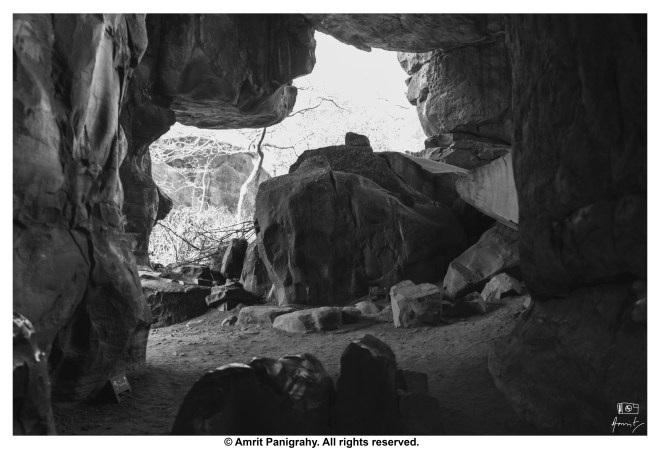
Assembly Hall
The Assembly Hall, as this cave in the Bhimbetka rock shelters is called. It is open on both sides and held a very important place among the inhabitants. This cave was used for community meetings, with the boulder at the center believed to be the seat of the Chief.

Rock shelters of Bhimbetka were continuously inhabited from at least a hundred thousand years ago to as recently as the medieval period. These rock shelters look over the alluvial plains of the Betwa river (a tributary of Yamuna to the north), the plains which extend right up to the foothills of the mighty Himalayas.

Bhimbetka gets its name from Bhim Baithak (sitting place of Bhim of Mahabharat). The rock shelters find themselves mouth of the Deccan traps, along the Dakshinapath, the ancient important trade route that connected the southern India, which lied beyond the Satpura-Vindhya range, with northern India. The location makes the then inhabitants of these rock shelters prime witnesses to India’s unfolding history – Lord Ram’s exile and subsequent southern campaigns, the exile of the Pandavs, civilizational shift from Indus plains to Gangetic plains, Emperor Ashoka’s ascend, rise of the Satavahans and Islamic invasion of southern India. It was as if destiny had reserved the best seats of an epic called “India”, for the “primitive” inhabitants of these rock shelters.

They first find mention in modern times in 1888, by British India officer W. Kincaid in his scholarly paper, the rock shelters were physically discovered only in 1957 by V. S. Wakankar. Though thought to have been lost, their proximity to Bhojpur, the ancient capital of Raja Bhoj, and to the Dakshinapath means there have been exchanges between the inhabitants of Bhimbetka and other human encampments/civilizations.

What make these rock shelters special and earn them the badge of a “World Heritage Site”, are the paintings on the rock faces, created by the inhabitants. The oldest painting here is believed to be at lease 30,000 years old (oldest existing painting in the world is at least 40,800 years old and is in El Castillo, northern Spain). And then there are the cup marks on few rocks, believed to be as old as the habitation itself in Bhimbetka, and would be earliest evidene of human creativity, and so make Bhimbetka one of the earliest cradles of cognitive human evolution in the entire world.

Rockshelters of Bhimbetka, is entire mankind’s heritage indeed!

Note: As I keep digging my storage device for photos from Bhimbetka, I will update this blog post.

VERY IMPORTANT TO NOTE: Yes, you can share this work with proper attribution. But, please seek permission before using this work (not including the photo), partially or fully. YOU CAN NOT USE THE PHOTO. Believe me, asking is better than ending up in court or facing public shaming on social media. Thanks for understanding.

© Amrit Panigrahy. All rights reserved.

Danda Jatra – The Festival of Punishment

ହେ ଋଷିପୁତ୍ରେ!
ଆଇଲେ ହର, ଦେଇଗଲେ ବର,
ଅନ୍ୟ ସେବା ଛାଡି ଏ ସେବା କର।

ଏ ସେବା କଲେ କି ଫଳ ପାଏ,
ଉଷୁନା ଧାନ ଗଜା ହୁଏ,
ଶୁଖିଲା କାଠ କଞ୍ଚା ହୁଏ,
ଭଜାମୁଗ ଗଜା ହୁଏ,
ଅପୁତ୍ରିକ ପୁତ୍ର ଦାନ ପାଏ,
ଅନ୍ଧ ଚକ୍ଷୁଦାନ ପାଏ,
ଜରାରୋଗ ଭଲ ହୁଏ।

“Dear Sons of the Sages! Lord Shiva has come and granted you boons. Give up everything else and do this service. If you do this service, you can make the impossible possible, parboiled rice and fried green gram will sprout, dried wood becomes a living tree, childless mothers bear children, blinds get vision and old people become young again.”


It was the Hindu month of Chaitra and I was driving by a village in southern Odisha. While passing, by I heard the sound of the drums and the grave tune was potent enough to teleport you into another dimension. It had to be, for it was meant to please the fiercest forms of Shakti and Shiva – Goddess Dandakaali and Lord Rudra, respectively. As I grew curious and stopped the car, my father told me it was Danda Jatra, pronounced as thuh (as in “the”)-wn-daw zaat-ra, literally meaning the festival of punishment.

Drummers
Drummers beating a very grave tone, announcing the arrival of Danduas to villages from far off.

Danda Jatra traces back its origins to more than a millennium ago, when it found importance in the Tantrik practices of a predominantly Shakta (worshippers of Shakti) Kalinga of 10th century AD, or thereabouts. Danda Jatra is by the farming community and for the farming community, cutting across all castes, and revolves around the daily life of a farmer. In simple words, the practice revolves around the age old tradition of “barter”, wherein in this case the Dandua (as the people who take part in this festival are called) asks for a few wishes to be fulfilled by Goddess Dandakaali and Lord Rudra and in return promises to spend 13, 18 or 21 days in penance and abstinence (the punishment), spreading the message of Shiva and Shakti.

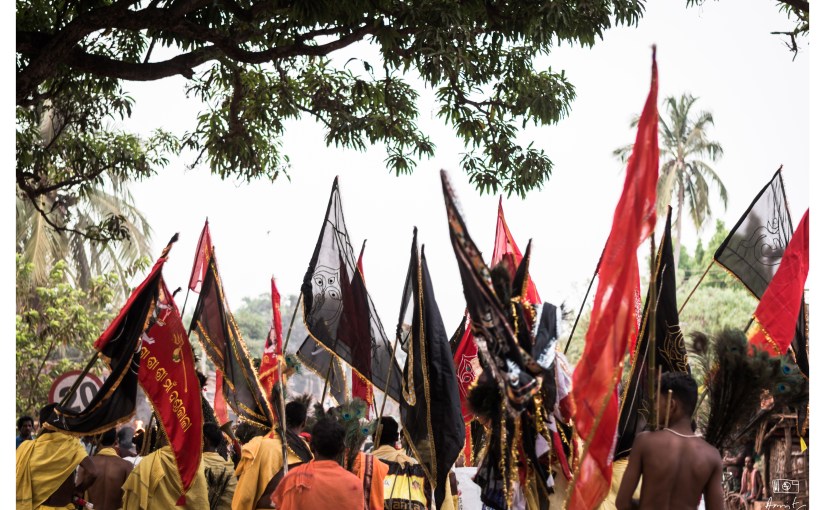
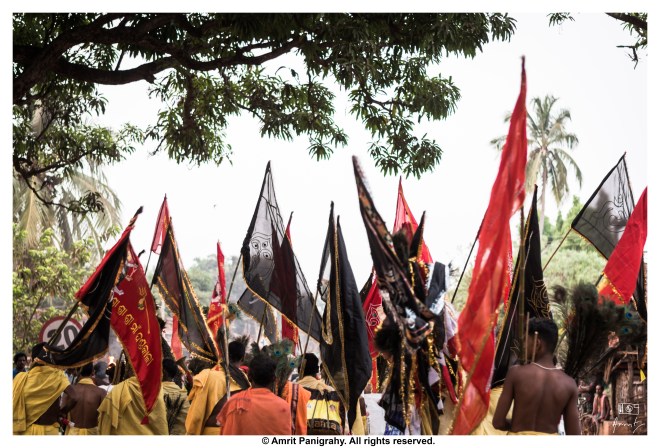
Danda Jatra
Danduas walking past a village in a procession holding these flags, to the beat of drums, and spreading the message of Shiva and Shakti.

Every team comprises of 13 Danduas and there are more than 300 teams in existence today. From the start, for 21 days the Danduas abstain from any kind of indulgence like meat (of all kinds), liqour and physical intimacy with their partners. On the strike of midnight of the first day, they take bath in the village pond, wear saffron colored clothes and congregate near the village temple. After a few rituals Hara-Gouri (basically Shiva and Shakti) are consecrated as two holy sticks (also called Danda in Odia). Then they light the holy fire by (you guessed it right!) rubbing two bamboo sticks against each other, and this holy fire remains lit till the end of the festival. I saw them roaming around in villages with the holy fire and the consecrated sticks, and blessing households and shops as the walked along.

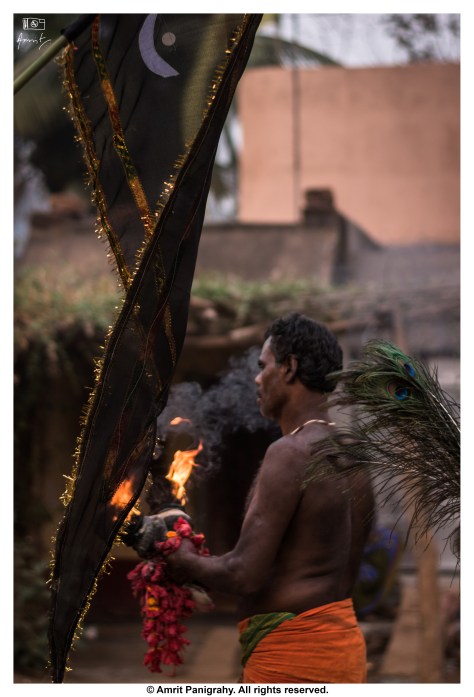
Danda Jatra
A Dandua carrying the holy fire around the village, to bless the households and shops. The holy fire is kept lit for whole 21 days.

They go around giving performances in villages upon invitation, and through the use of comedy and light-heartedness (sometimes vulgar), they spread serious messages from the scriptures, about ways of life and righeousness. When they perform on the dirt, it is called Dhuli Danda (Dhuli in Odia means dust), and when it is in the water, it is called Pani Danda (Pani in Odia means water). And then there is something known as Danda Suanga, which usually starts around midnight and continues well into the morning next day.

I had heard about it as a kid and had seen it a couple of times when I went to the villages with my father. I had the opportunity of watching Dhuli Danda this time. The Danduas had made square shaped farmlands on the ground, by lying down on the dirt, and one of them acted as a farmer, who used two of them as oxen to cultivate the farmland and then planted seeds. And so the daily life of a farmer continued.

Dhuli Danda
The Danduas on the dirt are mimicking farmlands, and two running towards the camera are acting like oxen cultivating the farmlands. The Dandua behind them acting as the farmer.

Danda Jatra is one of the toughest festivals to take part in for the Danduas, high summer temperatures, lack of sleep, off-schedule and mainly midnight rituals, and just one full meal take a toll even on the most seasoned of them. The meal that is prepared is neither grinded nor boiled, and is offered to Goddess Dandakaali and Lord Rudra first. The Danduas have the food after that in the dead of the night, outside the village and amidst the deafening sound of the drums. They are not supposed to hear any sound while eating, not even that of a bird chirping. If they hear any such sound, or find any impurity in their food, they won’t take that food and stay hungry that night.

Exhausted
A Dandua sitting on the road exhausted. High summer temperatures, lack of sleep, off-schedule and mainly midnight rituals, and just one full meal take a toll even on the most seasoned of them.

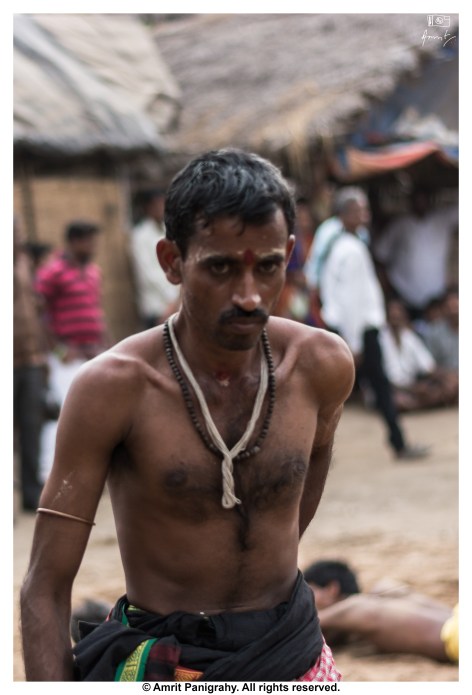
On the day of Vishubh Sankrati (the day when Sun crosses the equator and moves into the northern hemisphere), also the last day of the Danda Jatra, the Pata (Paa-taw) Dandua, the leader of the team who wears only black, plays an important role. It is said that Goddess Dandakaali herself possesses him, and then he is tied upside down with holy fire lit right below his head. Sal tree resin (locally called Jhuna) is thrown into the fire repeatedly and it creates a lot of smoke. Amidst loud chantings, it is repeated till the Pata Dandua bleeds from the nose and exactly three drops of blood fall in the holy fire right below. This signifies Goddess Dandakaali having accepted the offerings, and the Danda Jatra culminates.

Pata Dandua
The Pata Dandua plays a very important role in the Danda Jatra, and acts as the medium of communication between Goddess Dandakaali, the Danduas and the villagers.

Danda Jatra is a religio-spiritual practice, and is held with reverence and much fanfare in rural southern Odisha, even after a millennium since it started. Modernity has influenced it in many ways. And, my quest for knowing the practices around Danda Jatra more intimately, and bringing them out to the larger audience, remains a medium-term project.

Jai Dandakaali!


VERY IMPORTANT TO NOTE: Yes, you can share this work with proper attribution. But, please seek permission before using this work (not including the photo), partially or fully. YOU CAN NOT USE THE PHOTO. Believe me, asking is better than ending up in court or facing public shaming on social media. Thanks for understanding.

© Amrit Panigrahy. All rights reserved.

The Torchbearer

अविद्यारण्यकान्तारे भ्रमतां प्राणिनां सदा ।
विद्यामार्गोपदेष्टारं विद्यारण्यगुरुं श्रये ॥

To souls that wander in utter dismay in the dense forests of ignorance, He shows the path of true wisdom; In sanctuary of that great Saint Vidyaranya!

Not many people from the past have contributed to the shaping of India as a civilization as it is today, like Saint Vidyaranya did. Saint Vidyaranya was 12th Jagadguru of Sringeri Sharada Peeth mutt and was the chief pontiff for six years, from 1380-86 AD, before attaining Samadhi. He succeeded his younger brother, the 11th Jagadguru of Sringeri mutt Sri Bharati Krishna Tirtha, who was the chief pontiff for forty-seven years, from 1333 AD till his Samadhi in 1380 AD. Saint Vidyaranya was probably by far the shortest serving chief pontiff of all the monasteries founded by Adi Shankara. What contribution could Saint Vidyaranya have done in those six years that could have shaped the civilization to such a large extent. Well, it wasn’t what he did in those six years, but what he did before that!

Once Saint Vidyaranya was in deep meditation on the Matanga hill, near Hampi, in present day Karnataka (Oh! You have an idea where this is headed?), when he was approached by two brothers, Hakka (Harihara Raya) and Bukka (Bukka Raya). These two brothers were commanders in the army of the Kakatiya King of Warangal. In the battle with the army of Sultan Mohammed Bin Tughlaq, they were captured and taken to Delhi, where they were forcefully converted to Islam. After having won the confidence of the Sultan, they were sent back south to establish order. Seizing an opportunity, they converted back and declared independence. They had come to Saint Vidyaranya to seek guidance, after one of them had a dream about it. That is how the foundation of Vijayanagara empire was laid.

Legend has it that Saint Vidyaranya chose a site for the capital city, Hampi, for the empire to last for eternity. As per the legend, this was the place where a hare had stared down a tiger while being chased. Apparently, after some studies he came up with the exact date when the foundation was to be laid by the two brothers, and the chosen auspicious time was some time in the night. The legend goes on that he instructed Hakka and Bukka to touch the pick-axe to the ground and there by symbolically lay foundation of the city, at the precise moment when they hear the conch that he would sound from far off. As per the legend, it didn’t go according to the plan. It was pitch dark and both the brothers were waiting for the sound of conch to touch the pick-axe to the ground. And finally, after hearing it, they followed the rituals as instructed. After the rituals were done, they returned back to their horses, and that was when they heard the conch again. Confused, they rode back to Saint Vidyaranya and reported hearing two conchs. That’s when Saint Vidyaranya apparently had an inkling of the empire not lasting forever. Vijayanagara empire lasted for slightly more than three centuries.

The contributions of  Vijayanagara to the civilization, be it in literature, architecture, irrigation, economy, trade, diplomacy or military campaigns and tactics, are immense. For example, when Babur was establishing his foothold in the north, Vijayanagara was being ruled by one of its most prominent rulers – Krishnadevaraya. If not for him, Babur probably wouldn’t have hesitated marching down south, and India as we know today as a civilization would have been completely different. I wrote something on parallel history, where I touched upon this topic and called it “Drawing Parallels”. You can read it here.

As advised by Saint Vidyaranya, Harihara ascended the throne of Vijayanagara empire first, while the work on the new capital in Hampi was still on. He reigned for twenty years. After him, his brother Bukka ascended the throne and reigned for twenty one more years. It is during the reign of Bukka that the capital was shifted from Anegondi to Hampi. Saint Vidyaranya was the spiritual guru and a trusted advisor of the Emperors of Vijayanagara for close to half a century, during which time the boundaries of Vijayanagara as well as its prosperity expanded manifolds. It was during his time that the Sringeri Jagadguru came to be addressed as ‘Karnataka Simhasana Pratishtapanacharya’. It is believed that he also initiated the first three Emperors of Vijayanagara into Atmavidya, the Emperors who ruled Vijayanagara in its formative days for seventy years among themselves.

Legends aside, the new capital of Hampi was designed under the guidance of Saint Vidyaranya as a Sri Chakra. A Sri Chakra has nine triangles of varying sizes with a centre point. The triangles are arranged in five concentric levels, and are circumscribed by two concentric circles, a total of seven levels. Hampi has Virupaksha temple at the center, seven layers of fortified walls, with nine gates around. Well, Connect the dots?

Sun and the hawk
The setting sun over the rugged terrain of Hampi, capital of erstwhile Vijayanagara empire, in Karnataka, India.

Had Saint Vidyaranya not laid the foundation of Vijayanagara empire and had not imbibed his teachings in the early rulers, don’t you think our history would be entirely different? During the course of my research, I have developed an interest for Sringeri, in Karnataka, and have added to the list of places I must visit.

विद्याविद्याविवेकेन पारं संसारवारिधेः ।
प्रापयत्यनिशं भक्तान् तं विद्यारण्यमाश्रये ॥

In the sanctuary of Saint Vidyaranya, who holds aloft the torch of discrimination between the knowledge of the real from unreal, and helps the devoted across the sea of birth!

In frame: The setting sun over the rugged terrain of Hampi, capital of erstwhile Vijayanagara empire, in Karnataka, India. As if the drama unfolding in the horizon to the west was not enough, this hawk while returning to its nest unexpectedly flew into my frame, heightening the drama manifolds. Decisive moment, I say!

VERY IMPORTANT TO NOTE: Yes, you can share this work with proper attribution. But, please seek permission before using this work (not including the photo), partially or fully. YOU CAN NOT USE THE PHOTO. Believe me, asking is better than ending up in court or facing public shaming on social media. Thanks for understanding.

© Amrit Panigrahy. All rights reserved.

Crimson Love

I had fallen back, to witness the drama that was unfolding in the sky.

My guide called out my name from a distance….

It was only minutes ago that he was here,
Telling me stories from the yesteryear,
Tales of opulence, generosity, valor and love,
For an open heart it was like a treasure trove.

Of all the stories, one was of interest in particular,
A King, his Queen, and love that was spectacular,
A poetess and a singer, she could bring words to life,
Smitten by her, the King convinced her to be his wife.

They were living happily ever after, or so they thought,
A big army attacked the kingdom, and a battle fought,
The King was killed in battle, was what the messenger told,
The Queen drank poison, and her lifeless body went cold.

The medieval fort, a witness to her love story,
Her eternal love for him that took her to glory,
Walking on that pavilion even I felt as a part it,
Kind of gloomy that in the end they couldn’t unite.

I glanced beyond the ramparts, as I walked back…

Crimson sun set over the horizon,
Leaving behind a familiar emotion.

And as it went…

The hues that it painted and the winter sky it tore,
Colors of desire and pain, that touches one’s core.

More than a year has gone since…

Crimson, is the color that I remember of that evening,
Of longing, the want of belonging and a love undying.

Crimson Love, ‘t was!

Drama in the sky
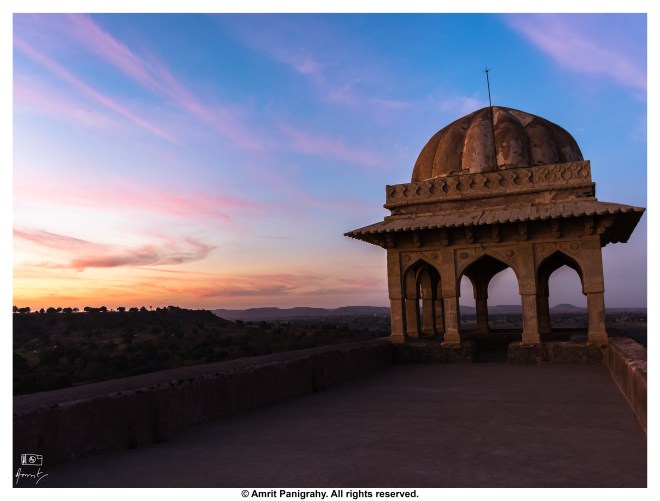
Brilliant hues of the winter sky just after the sunset, as seen from Roopmati pavilion in Mandu

I had earlier written a Hindi poem on Roopmati and called it “Jauhar”. You can read it here.

Mandu, or Mandav was capital of erstwhile kingdom of Malwa. Mandu is dotted with love tales of Sultan Baz Bahadur of Malwa, and his queen consort Roopmati.

Kingdom of Malwa used to be a vassal of the Mughals, and had declared indepedence taking advantage of the instability that ensued just after Akbar had taken control.

Akbar then sent his foster brother Adham Khan and a large contingent of the Mughal army to subdue Malwa. Adham Khan, who had by then heard of Roopmati’s enchanting beauty, had resolved to defeat Malwa and take her as a prized possession of his harem.

Baz Bahadur faced Adham Khan and the Mughals in Sarangpur with a small contingent. Baz Bahadur’s contingent was no match for the mighty Mughals and he escaped after being defeated.

Adham Khan then marched on to Mandav. Thinking that Baz Bahadur was slained in the battle, Roopmati poisoned herself, as she could not have seen another man in her life. Such was her love.

In due time, Adham Khan was executed by Akbar. Baz Bahadur surrendered to Akbar and was in return made the mansabdar of Malwa.

And for Roopmati, her love and loyalty for Baz Bahadur still fascinates imagination of the new generation of tourists to Mandu.

In frame: Brilliant hues of the winter sky just after the sunset, as seen from Roopmati pavilion in Mandu, Madhya Pradesh, India. Roopmati pavilion was built by Sultan Baz Bahadur for Roopmati, so that she could Narmada darshan everyday (one of her pre-conditions to her marriage with him). Narmada flows at a distance, in the plains.

VERY IMPORTANT TO NOTE: Yes, you can share this work with proper attribution. But, please seek permission before using this work (not including the photo), partially or fully. YOU CAN NOT USE THE PHOTO. Believe me, asking is better than ending up in court or facing public shaming on social media. Thanks for understanding.

© Amrit Panigrahy. All rights reserved.

In search of “Nothingness”

Bira (pronounced as Bee-raw, meaning brave in Odia) was born into a Brahmin family, in a Brahman Sasan. In Odisha, a Brahman Sasan is a village where every family is Brahmin. He grew up witnessing the monster called Brahmin supremacy and the twisted, distorted Hindu Sanatan religion. Tired of it, he and few of his friends went to Joranda and embraced Mahima Dharma. That was seven decades ago.

The allegation that was levelled against Bira was that he had converted and was no more a Hindu, so he and his family need to pay a fine to continue to stay in the village, to which Bira sternly refused. As a result, his family was banished from their ancestral village. One of main reasons was, even after being a Brahmin himself, Bira had challenged their supremacy. All other families of the village were asked to not keep any kind transaction with his family.

In the meantime, a letter was written to the high seat of Hindus in Jagannath temple, in Puri, asking them to advise a future course of action in Bira’s case. To which, they replied that it was settled long back and Mahima Dharma was very much a part of the Sanatan Hindu fold. After the ban on Bira’s family was lifted, having his point proven he chose to stay back in his ancestral village fighting further religious atrocities and intolerance, till he left for a city close by for his children’s education few decades later.

Bira Panigrahy was my grandfather. Of the group of people who embraced Mahima Dharma on that day, more than seven decades ago, only my grandfather continued to be a follower till his death. Any history of my association with Mahima Dharma would be incomplete without mentioning the brave man who was much ahead of his time. As I sat down to write this post, devotional songs written by the blind poet Bhim Bhoi and sang by Mahima devotees rang in the background. The devotees, even though having full time professions, accompany the monks  wherever they go. They were at our home as we were conducting something known as a “Balyaleela”, a yagna of sorts. The occasion this time was my grandfather’s death anniversary.

As per the teachings of Mahima Swamy (as the Master of Mahima Dharma is called), a human doesn’t need any intermediaries to reach the Supreme. All humans are born equals despite caste, creed, color, race, gender and religion. That there is only one God, the Supreme, who is shapeless and colorless, the nothingness in other words. The Supreme resides in every living and non-living being and everything resides in the Supreme. Mahima Dharma is a form of Vishisht Advaita, where every living being is respected equally. Followers of Mahima Dharma worship the nature and the universe, the nothingness within and without, and pray for well being of every living being of the universe.

The Offering
A Mahima monk accepting a coconut being offered by a follower of Mahima Dharma at “Dhuni Mandir”, the temple of fire in Mahimagadi, at Joranda, Dhenkanal, Odisha. The offered coconut will be burned in the holy fire.

The monks of Mahima Dharma as directed by Mahima Swamy himself follow an extremely ascetic lifestyle. For example, when they visit the houses of devotees, they not allowed to stay for more than a night, and are not supposed to go inside the house. They eat under the open skies, and are not allowed to sleep on beds for the rest of their lives. Giving up basically everything that would even remotely qualify as modern comfort. They have only one task at hand, spread the message of the Master, and in the process move ahead in their spiritual journey.

When I was on a road trip with parents in Odisha few months back, something strange had happened. After having spent few minutes in the Indralath temple, in Ranipur-Jharial, we came out and were getting ready to get inside the car. A drunk shepherd approached my father from nowhere, and told him “A Mahima monk had come here many many years ago when I was a kid. And he hosted a “Balyaleela” (a ritual done on special occasions), and there were lakhs of people.” There were no identifications either on my father or on our car which suggested that any of us were a follower of Mahima Dharma. The followers of Mahima Dharma are a very very small fraction of the total population.

Before that, when I had gone to see Puri during Rathyatra last year, I received a call from an unknown number. On the other side was a Mahima monk who visits our family very often. “Have you become a Jagannath devotee?”, he asked me, when on being asked I told him that I was in Puri. Worshiping deities, shapes or  forms is forbidden in Mahima Dharma.That the monk had called me for the first time ever, when I had come to see Lord Jagannath had to mean something; also, what the drunk shepherd was mumbling in front of the Indralath temple.

The celestial message was clear to me. I had to go visit the Mahimagadi, the seat of Mahima Dharma at Joranda, in Dhenkanal, Odisha. And what better time than the annual Maghmela, on the full moon day in the Hindu month of Magh.

On 31 January, 2018, Joranda was a mission accomplished!


VERY IMPORTANT TO NOTE: Yes, you can share this work with proper attribution. But, please seek permission before using this work (not including the photo), partially or fully. YOU CAN NOT USE THE PHOTO. Believe me, asking is better than ending up in court or facing public shaming on social media. Thanks for understanding.

© Amrit Panigrahy. All rights reserved.

64 Yoginis – And a message to my father

The 64 Yogini Temple:

Ranipur Jharial was the first stop on the recent road-trip I did with my parents in Odisha. We reached here after a gruelling 6 hours drive from my home town. The 64 Yogini temple of Ranipur Jharial in Bolangir district in Odisha, is one of the only 4 such temples dedicated to 64 Yoginis that exist in the whole country. Two of them are in Odisha – the other one in Hirapur, near Bhubaneswar.

The 64 Yogini temple is located atop small hill, which is a single rock spread over many acres. On that rock there are also many small temples dedicated mainly to Lord Shiva. What would catch your eye however is the peculiar structure of the 64 Yogini temple.

64 Yogini Temple
The 64 Yogini Temple under the sun on a cloudy day, in Ranipur Jharial, Bolangir, Odisha, India.

It is a circular hypaethral temple. The deities of 64 Yoginis adorn the inner side of the circular temple. The centre of the temple is adorned by an image of three faced Lord Shiva, Adi Yogi himself, embracing his wife Goddess Parvati. This temple is believed to have been built by Somavamshi Keshari kings in 9th-10th century AD. All the deities are made of sandstone.

Lord Shiva
Three faced Lord Shiva at the center of 64 Yogini Temple, in Ranipur Jharial, Bolangir, Odisha, India. I shot this frame using my 35mm Canon FTb QL manual film SLR on an Ilford HP5 Plus 400.

The temple is designed in such a way that energy from all the 64 Yoginis would stay within the circular wall of the temple, and the yogis and sadhaks who did their sadhana here would benefit immensely from the concentrated energy from all Yoginis. The 64 Yoginis also represent 64 types of Siddhis a human can achieve.

The Indralath Temple:

Indralath Temple
The elevation of Indralath Temple from up close, in Ranipur Jharial, Bolangir, Odisha, India.

Another attraction in Ranipur Jharial is the 60ft tall Indralath temple, the oldest and tallest brick temple in Odisha. Also built during 9th/10th century AD by Somavamshi Keshari kings, it is believed that this temple was probably dedicated to Lord Shiva or Lord Vishnu. Interestingly however, the designs and statues on the outer wall of the temple suggest Buddhist influence on the architecture. The statues on the outer wall are made of clay and mud and are burnt to give them longevity, as it was done for the bricks.

The Experience:

Before I started the journey, I was told that it is not advisable and safe to go on top of the hill during the month of Ashadh, or the first month of monsoon, because of the numerous lightning strikes that have happened in the past. We were well past Ashadh, so that was a relief.

64 Yogini Temple
The 64 Yogini Temple, in Ranipur Jharial, Bolangir, Odisha, India. I shot this frame using my 35mm Canon FTb QL manual film SLR on an Ilford HP5 Plus 400.

When I went on top of the rock, near the temple, the first thing I noticed about the place was the calmness, even if it was windy. However, the calmness was only on the surface. The place was full of some mystic energy, as if all the yogis and sadhaks who did their sadhana here left their legacy behind for the later generations to experience. Although there were many things running through my mind, when I closed my eyes, it was as if I got teleported instantaneously into another realm. What happened with my father however, was interesting! And I was a witness.

My father, as were both my paternal grand parents, is a follower of Satya Mahima Dharma, and he has been practising meditation for many years now. One of the youngest sects of Hinduism, quite interestingly, this sect also had 64 Siddh Purush (64 men with Siddhis). Numbering just a tiny fraction of Odisha’s population the followers of this sect do not worship any deity. Very much a part of Hinduism, they believe that to reach the Supreme you do not need any mediums. One of my next projects is to highlight this sect to the mainstream, so look out for that.

Being himself, my father decided to check how it feels to sit in meditation near the 64 Yogini temple. So, he removed his shoes, sat on the platform and closed his eyes and went into a meditative state. And I got busy taking photos. Few minutes later, I got back to him, and by that time he was done. I asked him how was it, and he told me that he could feel some kind of energy. After that we decided to visit the nearby Indralath temple nearby, and it was all fine till then.

It got weird when after having spent few minutes in the Indralath temple, we came out and were getting ready to get inside the car. A drunk shepherd approached my father from nowhere, and said “A Mahima sadhu (a preacher of the sect of which my father is a follower) had come here many many years ago when I was a kid. And he hosted a Balyaleela (a ritual done only special occasions), and there were lakhs of people.”

There were no identifications either on my father or on our car which suggested that any of us were a follower of that particular sect. The practitioners of this sect are very very small fraction of  the total population. To give you all an idea, there are only 2/3 families of this sect in my hometown which a population of at least one lakh. Too much of a coincidence, right?

The only thing that could possibly explain this incident was probably the fact that there are strong energies still existent in the 64 Yogini temple and nearby, and after father meditated there, he “was sent a message” that the path he had chosen for himself (that of Satya Mahima Dharma) is right for him, and he does not need to divert now. We reached at this conclusion after discussing on this incident for some time.

And then we decided to move ahead with our journey, a 2,000km road-trip across Odisha, which turned out to be quite eventful in its own right. More on that later!

VERY IMPORTANT TO NOTE: Yes, you can share this work with proper attribution. But, please seek permission before using this work (not including the photo), partially or fully. YOU CAN NOT USE THE PHOTO. Believe me, asking is better than ending up in court or facing public shaming on social media. Thanks for understanding.

© Amrit Panigrahy. All rights reserved.


Jagannath Series – Part II: The Krishna Connection

Today is Niladri Bije, the last day of the Rathjatra festival when the three siblings – Lord Jagannath, Devi Subhadra and Lord Balabhadra enter the temple after coming back from their annual outing to their aunt’s place. No one stops the other two siblings from entering the temple, but when Lord Jagannath approaches the temple gates, his wife Devi Lakshmi closes the gates and does not allow him to enter. She is angry with Him, as He didn’t take Her along when He went out nine days earlier. Like any other husband, Lord Jagannath has to pacify Her with gifts. And He gifts her Kheermohan, a sweet made of chhena, that somewhat looks like His eyes. The modern name of Kheermohan is Rasagola (or like Bengalis would prefer calling it, Rosogulla). Now, that I have put down facts which prove that Rasagola is infact an Odia delicacy, let us move to a rather more serious topic, that of Lord Jagannath’s origins.

“Niladri” means blue mountain in Sanskrit, and “Bije” means climbing. It is believed that the original Jagannath temple was built on a blue mountain. The current Jagannath temple was built on the same site as the original one.

After the Mahabharata, the Yadavs went extinct after killing each other in a fratricidal war. Lord Krishna had one last “leela” to take care of, before the end of the Avatar. The last “leela” had one more character – Jara, reincarnation of Angad, son of Bali from Ramayan, and a tribal hunter in his current life. Angad was given a boon in the previous life by Lord Ram, who had killed his father Bali, that he would get his chance to avenge his father’s death.

One hot afternoon, Lord Krishna was resting under the shade of a tree. Jara, who was out hunting, from behind the bushes mistook Lord Krishna’s toe for the ear of a deer, and shot an arrow. The arrow proved fatal for Lord Krishna, and the Avatar came to an end. Thus, Jara avenged his father’s death.

Krishna Connection

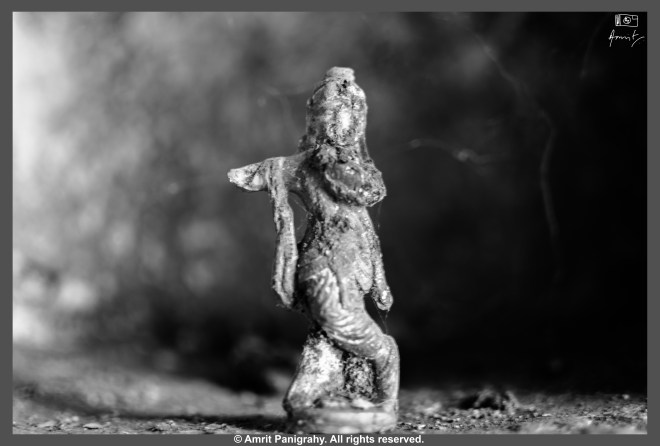
Image: Remains of a statue of Lord Krishna in a dilapidated building near the Ananta Padmanabha Sway temple, in Ananthagiri, Telangana, India. 

Lord Krishna’s dear friend Arjun was called for His cremation. At the end of it, everything else except Lord Krishna’s heart had turned into ash. Arjun then picked up his dear friend’s heart, put it inside a neem log with Shankh (conch), Chakra (disk), Gada (mace) and Padma (lotus) symbols on it (the four symbols of Lord Vishnu, of whom boh Sri Ram and Sri Krishna were avatars), and floated it in the sea.

That piece of log with Sri Krishan’s heart in it voyaged through the sea, from Dwarka on the west coast to Puri on the east, and eventually took the form of the first Lord Jagannath. How it took the form of Lord Jagannath is a tale for another time. Wait! Did I say “first” Lord Jagannath? Does it mean that there were many Lord Jagannaths? Much to your astonishment, the answer is yes!

Every twelve to nineteen years Lord Jagannath reincarnates into a new body, in an event called Nabakalebara. During Nabakalebara, the “brahma” or the “tattva”, the life of Lord Jagannath, which is said to be the heart of Lord Krishna, is placed in a new body, and the old body is cremated. Him going through the cycles of life and death highlights the fact that everything that is here on Martyalok (as Earth is also called in Sanskrit, where death is inevitable) has to function by the rule of the land. More on Nabakalebara is also a tale for another time.

/Disclaimer: Based on legends, folklores and part fiction/

In frame: Remains of a statue of Lord Krishna in a dilapidated building near the Ananta Padmanabha Swamy temple, in Ananthagiri, Telengana, India.

VERY IMPORTANT TO NOTE: Yes, you can share this work with proper attribution. But, please seek permission before using this work (not including the photo), partially or fully. YOU CAN NOT USE THE PHOTO. Believe me, asking is better than ending up in court or facing public shaming on social media. Thanks for understanding.

© Amrit Panigrahy. All rights reserved.


Sees it all!

“Chaka aakhi sabu dekhuchi”, is a popular saying in Odia. Which translates to “Lord Jagannath sees it all”. Chaka in Odia means round, Aakhi in Odia means eyes. Notice His round eyes.

When I was in Puri last month, I had mentioned that I was planning to visit Puri during Rathyatra. Well, here is a secret! I was not planning, I had actually promised Him. 26 years were too long a gap, you see. You can read about my last month’s visit here.

Reached here in Puri, just in time to see the annual outing of the Gods, the Rathyatra of 2017. Saw Him gracefully moving towards his chariot (we call it Pahandi in Odia), with his crown (called Tahia in Odia) moving back and forth as He moved. I was quite far off when this was happening, at least couple of hundred meters, may be more. But as He appeared out of the temple main gates, the atmosphere was filled with cries of His name all around. And guess what, I am the first person from my whole family to witness it happening in front of my eyes (as confirmed by my father).

He sees it all!!
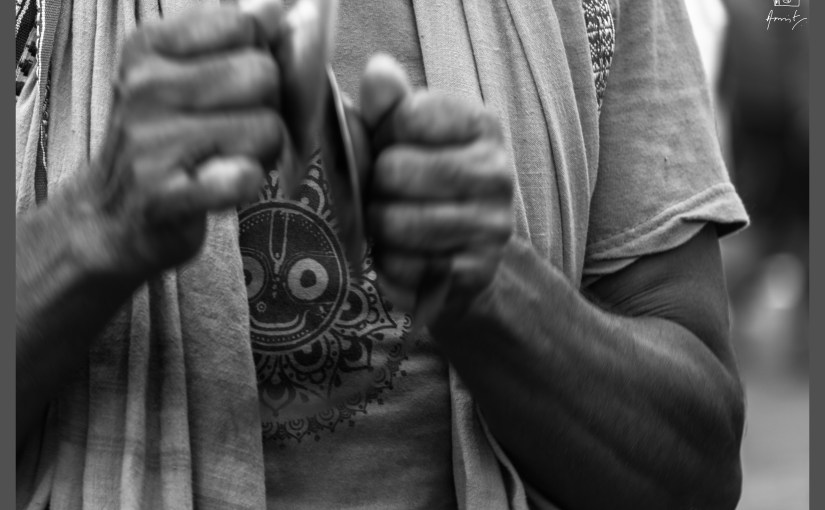
Lord Jagannath on a devotee’s t-shirt as he plays his Gini (a traditional Odia music instrument).

The energy on the Grand road (called Bada Danda in Odia) was so much, I saw people dancing for hours (you read that right!) to folk songs from all over Odisha, as well as to the tune of drums (dhol and mridang) and khanjanis (see picture to know what it is). It was like a rave party from another age. And it was as if they were drawing their energy from an eternal source, may be it was Him as He smilingly moved towards them on top his chariot. Because, what I saw there today is not humanely possible. You got to see it to believe it. And boy, was it overwhelming for me. Add to it all the people around (my estimate is half a million, at least), a perfect recipe to get disoriented (in a good way), call it trance!

There were a lot of traffic restrictions all around the town, so I walked all the way, and the last few kilometers were barefoot on the beach as the waves played hide and seek. By the time I reached back at my hotel, I must have clocked 15 kilometres, all in a days walk.

Now, as I sit in my hotel room and write this, I was thinking. How about I bring to you all the tales, legends, facts and stories about Lord Jagannath, that I know? Also, how about stories of Konark? You know that the construction of the Sun temple in Konark was related to events that unfolded in Puri, right?

So, let’s call them “Jagannath series”.

Signing off from Puri, land of Lord Jagannath!

In frame: Lord Jagannath on a devotee’s t-shirt as he plays his khanjani (a traditional Odia music instrument). You can see Him anywhere you want. You just need to look harder. And He sees you, all the time.

VERY IMPORTANT TO NOTE: Yes, you can share this work with proper attribution. But, please seek permission before using this work (not including the photo), partially or fully. YOU CAN NOT USE THE PHOTO. Believe me, asking is better than ending up in court or facing public shaming on social media. Thanks for understanding.

© Amrit Panigrahy. All rights reserved.

Dome Diaries – Part I: Rise of Adil Shahi, with envy from Delhi?

Dome Diaries Navigator – Prologue  ||  Part I  ||  Part II  ||  Part III  ||  Epilogue

Background:

Black clouds gathered on India’s north western borders adjoining Afghanistan in the middle of 12th century AD. The defeat of Prithviraj Chauhan at the hands of Muhammad of Ghor would create a vaccuum so powerful in the north, that it would suck hordes of invaders. These black clouds as if consolidated into a storm that would batter the Indian sub-continent for almost two centuries.

After having established foothold of Ghurid empire in India, Muhammad of Ghor would leave Delhi and India to his trusted slave and general – Qutbu l-Din Aibak, who would go on to establish the Delhi sultanate under the first dynasty, called the Mamluk or Slave dynasty. The Slave dynasty then would give way to the Khiljis, within a century of Prithviraj Chauhan’s death. The Khiljis would then give way to the Tughluqs in another thirty odd years. The Tughluqs would rule India for another century. Under Muhammad bin Tughluq (of Delhi to Daulatabad fame, also known as the “wise fool”), the Delhi sultanate would reach its maximum size, a size that could rival the Mauryan empire under Emperor Ashoka millenia earlier, or the Mughal empire under Aurangzeb centuries later.

One thing in common between the first three dynasties of Delhi sultanate was the fact that they ruled over this vast expanse of land not as their own, but as invaders. The mindset of invaders and plunderers coupled with insecurities of losing their reigns to their kin or the fear of an uprising by the masses, made most of the early Sultans of Delhi sultanate some of the cruelest rulers the world would ever see. These rulers were so cruel, that even a slightly lenient/tolerant ruler in their comparison will come across as a Messiah. Please refer to Ibn Batuta’s travelogues and other contemporary accounts for better understanding of their cruelty.

Having amassed an empire that could easily rival the largest empires of the world of that time, Muhammad bin Tughluq left it to his trusted generals and governors to take care of the different provinces of his sultanate, before retiring to Delhi. Foreseeing the fading influence of the Sultan, these generals started declaring independence one after the other. No, this wasn’t unusual! In fact, this was the standard practice of the time – Qutbu l-Din Aibak served Muhammad of Ghor, Firuz Khilji (founder of Khilji dynasty) served Qutbu l-Din Aibak’s Mamluk dynasty, Ghiyasuddin Tughlaq (founder of Tughlaq dynasty) served the Khiljis.

The Bahmani Sultanate and emergence of Adil Shahi:

Part 1 Header FB

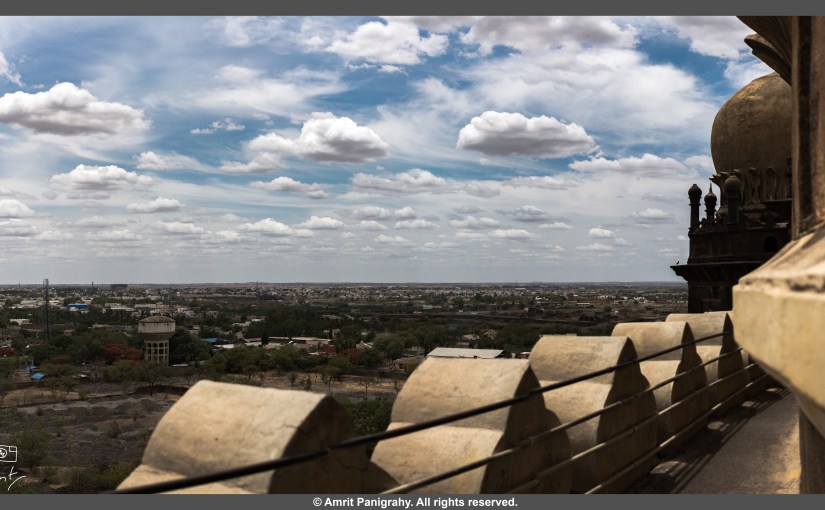
Image: Bijapuri skyline from top of the Gol Gumbuz, in Bijapur, Karnataka, India

As per the norm prevalent at that time, appeared in the scene Ala-ud-Din Hasan Bahman Shah, also known as Hasan Gangu. Bahman Shah was the then governor of Deccan under Muhammad bin Tughluq, and declared independence to establish the Bahmani sultanate, with its capital at Gulbarga (now Kalaburgi) and later moved to Bidar, in Karnataka. Per some historians, Bahman is actually derived from the word Brahmin (the Hindu caste), questionably either because of Bahman Shah’s Brahmin ancestry, or the caste of his earlier master Gangadhar Shastri Wabale (from whom he also got his other name, Hasan Gangu).

Bahman Shah could not have chosen a worse time to lay the foundation of his Bahmani sultanate, as only a decade earlier, further south in the peninsular India had emerged another power – the Vijayanagara empire. For the major part of its existence, the Bahmani sultanate would find itself engaged in mutliple battles with Vijayanagara empire contesting for power and control over land, especially the Raichur doab, before being weakened and disintegrating into five sultanates of Deccan, together called as Deccan sultanates – The sultanates of Nizam Shahi of Ahmednagar, Imad Shahi of Berar, Barid Shahi of Bidar, Qutb Shahi of Golconda and Adil Shahi of Bijapur.

Yusuf Adil Shah, founder of the Adil Shahi dynasty of Bijapur served the Bahmani sultanate before declaring independence. For the next five decades, the five Deccan sultanates would be played against each other by Vijayanagara empire’s diplomacy, before coming together in a confederacy in the battle of Talikota in 1565 AD and defeating Vijayanagara. Vijayanagara empire would not recover from this defeat, paving way for consolidation of power in southern India. Hence, the battle of Talikota is seen as a pivotal point in history of India and southern India in particular. The confederacy of the Deccan sultanates was the brain child of Ali Adil Shah I, the fifth Sultan of Bijapur.

Off the topic, but worth mentioning here that the battle of Talikota also saw the Nizam Shahi of Ahmednagar pressing Malik-e-Maidan, the largest canon of its time into service.
MM-2 FB

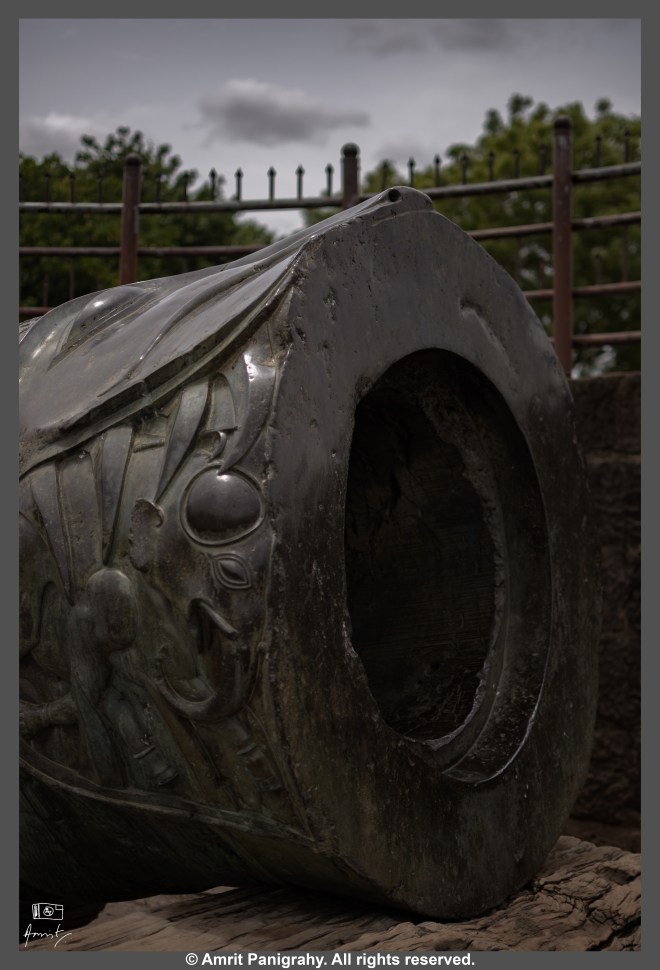
Image: Malik-e-Maidan the second largest medieval canon in India, which now adorns a bastion on the western wall of the fort, in Bijapur, Karnataka, India

Consolidation:

After having tackled the dangers to the south, the Adil Shahis under Ali Adil Shah I and later Sultans, focused on consolidating their power, through a clever combination of marriage alliances (with Nizam Shahis of Ahmednagar and Qutb Shahis of Golconda) and military campaigns (against Barid Shahis of Bidar).

The plundered wealth from Vijayanagara gave the Adil Shahis the much needed capital infusion at the end of a very tumultuous period. The wealth was used to launch numerous ambitious projects under succeeding Sultans. The absence of any real threat for the next eight decades meant that the Adil Shahis focused more on culture, and art and creation of architectural marvels.

While the Adil Shahis were busy consolidating their powers to the south of Vindhyas, the Mughal empire under Akbar was making steady progress into peninsular India, having subdued Malwa and Khandesh in the process. Here, again a precious piece of history is lost as a footnote in the history books, because some historian mistook Akbar and Delhi for India.

I have been reading about history of ancient and medieval India for some time now. It fascinates how (un)related events of India of the past that shaped up the India of today, are (conveniently) ignored by our history books. Few weeks ago, I had written a small piece on drawing parallels during medieval India, and called it “Drawing Parallels”. You can read it here.

END OF PART I

Dome Diaries Navigator – Prologue  ||  Part I  ||  Part II  ||  Part III  ||  Epilogue

In frame (in order of appearance): 1) Cotton candies and Bijapuri skyline, from top of Gol Gombuz, Bijapur, Karnataka. Gol Gombuz is the second largest freestanding dome in the world. The outer as well as inner side of the dome is accessible through staircases inside the minars on all four sides of the structure.

2) Malik-e-Maidan, the second largest medieval canon in Indian subcontinent. Made of five metals, this canon weighs 55 tonnes and had a range of 3-5 kilometers. Noticed closely, you can notice the legs of a horse (signifying the canon’s range), an elephant body (signifying the canon’s weight), inside a lion’s mouth (signifying the canon’s roar when fired). Originally cast by the Nizam Shahis of Ahmednagar in 1549 AD, the Malik-e-Maidan now adorns a bastion on the western wall of the Bijapur fort.

VERY IMPORTANT TO NOTE: Yes, you can share this work with proper attribution. But, please seek permission before using this work (not including the photo), partially or fully. YOU CAN NOT USE THE PHOTO. Believe me, asking is better than ending up in court or facing public shaming on social media. Thanks for understanding.

© Amrit Panigrahy. All rights reserved.


Dome Diaries – Prologue

Dome Diaries Navigator – Prologue  ||  Part I  ||  Part II  ||  Part III  ||  Epilogue

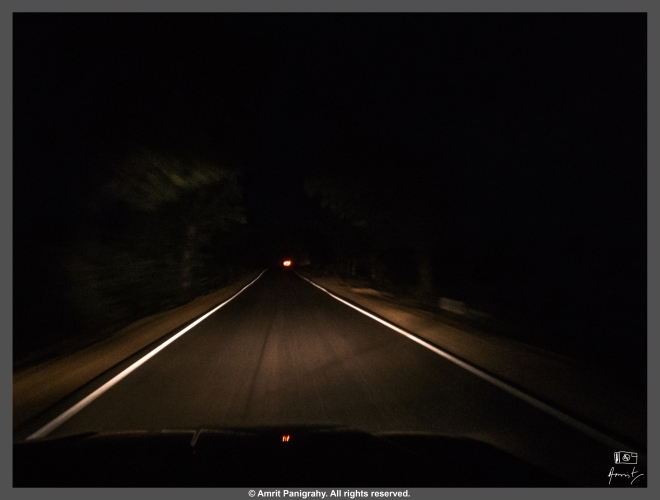
There, a brief but bright lightning far away and on my right side. One more, this time slightly closer and in the front. And as I press the accelerator, dry leaves fly on to my path and get illuminated in front of the headlamps. The winds are picking up and I can feel the crosswinds on my steering wheel. Most probably an end of summer thunderstorm. It has been dark for some time now and this stretch of road is narrow, as it passes through a reserve forest. Bad time and place to get caught in rains!

And my desk phone rang. It was the client. Damn! I was day-dreaming, again, lost in my thoughts as I stared at my desktop monitor. As if I had been teleported to one of the scenes from my recent solo road-trip.

A scene which looked like this!

Screen FB

This happens every time I come back from a trip. As if my heart stays outside the city limits, and refuses to come back in with me. And then, it keeps calling me to get out on my next trip!

This one was a long weekend road-trip. Long weekends are meant for travel, because I have recently realized that sleeping is too lazy. I realize things late, like thirty-odd-years late. Anyways, I thought of taking Pearl (that’s what I call my Scorpio; and yes, it is perfectly normal behavior!) out to stretch her legs a bit. And when you take a Scorpio out to stretch its legs, the most important thing it needs is leg room. My Pearl is no different! I decided 400kms one side was just enough leg room Pearl would need for stretching. So, Bijapur it was!

For starters, Bijapur (presently known as Vijayapura, in Karnataka, India) was the erstwhile capital of the Adil Shahis, one of the five Sultanates that the Bahamani kingdom broke into. It will not be an exaggeration if I call Bijapur as the “City of Domes”, because of the hundred odd small and big domes that dot the city’s skyline.

I have been reading about history of ancient and medieval India for some time now. It fascinates how (un)related events of India of the past that shaped up the India of today, are (conveniently) ignored by our history books. Few weeks ago, I had written a small piece on drawing parallels during medieval India, and called it “Drawing Parallels”. You can read it here.

The reason I chose Bijapur was because of the role it played in our history that shaped our present. After all, Adil Shahis of Bijapur stayed sovereign for two centuries. The same two centuries when Vijayanagara to the south, the Marathas to the west and the Mughals to the north were vying for control of the same piece of land.

Join me in a series of posts titled “Dome Diaries”, in the coming days. I will try to comprehend the later Adil Shahis of Bijapur, and their fascination for grand mausoleums, architectural marvels that are Gol Gombuz and Ibrahim Rouza, discover their religious inclinations (Adil Shahi rulers came from both sides of the Muslim community – the Shias and the Sunnis), and if possible, also their diplomacy and military might.

Dome Diaries Navigator – Prologue  ||  Part I  ||  Part II  ||  Part III  ||  Epilogue

In frame: A narrow stretch of empty road lit by my car’s headlamps and shot on mobile (No! I was not using the mobile while driving). This stretch of road was between Kalaburgi (Gulbarga as it is presently known), Karnataka and Hyderabad, Telengana, in India.

VERY IMPORTANT TO NOTE: Yes, you can share this work with proper attribution. But, please seek permission before using this work (not including the photo), partially or fully. YOU CAN NOT USE THE PHOTO. Believe me, asking is better than ending up in court or facing public shaming on social media. Thanks for understanding.

© Amrit Panigrahy. All rights reserved.