Autumn Resilience

Those were the Autumn days, about two decades back,
Was out and about with family, had festivities to make.

Was on my way back home, when the warning was issued,
The Cyclone was approaching, we tried to rush all we could.

Efforts were not enough, and we got stuck in a bad traffic jam,
With huge trucks around us, ours was a tiny car in the open.

The hours passed, a veil of darkness descended upon us,
We heard big roars, as if the devil’s lung was about to burst.

The Cyclone went about its business for the whole night long,
Destroying vehicles, houses, as if licked with its thorny tongue.

Twisted trees and power poles alike with all its might,
Wiping out years of mankind and civility in just one night.

We stayed in that car for the whole time, huddled and scared,
The winds tried to toss us, and we thought we won’t be spared.

That was one scary Autumn night, like none I had seen before,
With everything else destroyed, as if we were left to tell the lore.

It was long before, when cyclones were without any names,
Less powerful, and may be a slightly less in fearsomeness.

Rising temperatures have made them more common than ever,
Autumn is synonymous with cyclones now, and will be in future.

When the world prepares for festivities at the arrival of Autumn.
My tribe is either preparing for a cyclone or is recovering from one.

As mankind “progresses” towards a better “future” elsewhere,
There will be people here who pay more than their fair share.

Not paying for the “progresses” they haven’t made, not a choice,
Autumn and its cyclones are now a story of my tribe’s resilience.

Having stood steadfast in the face of the cyclone of this year,
They pick up pieces, preparing for the next without any fear.

Autumn Resilience
An old man looks at the restless sea under black clouds as he prays using prayer beads, at Puri in Odisha, India.

My first encounter with a cyclone was way back in 1999, when me and my family were caught unawares while coming back from a roadtrip during Dussehra. We spent a night inside the car, stuck in a traffic jam on the then infamous Andhra-Odisha border. The storm raged on outside, and tried hard to toss and turn our car as the eye of the storm passed right over us. When the storm passed and dawn broke, almost everything around us was destroyed. The super cyclone of 1999 followed it, and became one of the worst natural disasters of the Indian subcontinent.

Over the years we moved to naming cyclones in the Indian ocean region, but the cyclones didn’t relent. On the east coast, Odisha became their primary target, and they came back every year during Autumn, the festive season in India. As global temperatures have risen, Odisha has been gearing up for cyclones, every year since, that is, after facing its annual bout of floods.

And for the people of coastal Odisha and the adjoining hills inland, they don’t understand what on Earth is worth the price they pay for every Autumn, year after year. The industrialisation that doesn’t exist in their backyard, the infrastructure that is just beginning to show up, the vehicles that don’t ply on their roads, or the over-consumption of resources that they are not party to? Or is it that they pay the price for someone else’s luxury?

VERY IMPORTANT TO NOTE: Yes, you can share this work with proper attribution. But, please seek permission before using this work (not including the photo), partially or fully. YOU CAN NOT USE THE PHOTO. Believe me, asking is better than ending up in court or facing public shaming on social media. Thanks for understanding.

© Amrit Panigrahy. All rights reserved.

वो खुद थी

दरवाज़े, जिनकी चाबी उसी के पास ही थी,
कुछ एक मेरे लफ्ज़, जो वो ही थी समझती,
समझ जाती थी ज़ुबान खामोशियों की भी,
सांसे उसके लिए जैसे सरगम किसी गाने की।

एक दिन ऐसा आया, वो बोली में चली जाउंगी,
तुम्हारी कुछ आदते हैं जो मैं कभी सह ना पाउंगी,
क्या पता उसको के सबसे बड़ी आदत वो खुद थी,
मेरे दरवाज़े की चाबी,
मेरे अनसुलझे लफ्ज़,
मेरी सांसे,
और मैं….

वो खुद थी…….

Yes, she was
हां, वो उसकी आदत थी ।। Yes, she was his habit

A Hindi poem, this one talks about the closeness and the “used to” kind of bond the lovers share, so much so that when the lady decides to leave citing few of the man’s habits that she can’t tolerate anymore, it turns out that the man considers her his biggest habit, as his key to happiness, as his unspoken words, even as his breath and he himself.

I have to admit that owing to time constraints and many ongoing projects, I am unable to give time to creative writing as much as I should. So, after a long time, here it is.

VERY IMPORTANT TO NOTE: Yes, you can share this work with proper attribution. But, please seek permission before using this work (not including the photo), partially or fully. YOU CAN NOT USE THE PHOTO. Believe me, asking is better than ending up in court or facing public shaming on social media. Thanks for understanding.

© Amrit Panigrahy. All rights reserved.

The Day I Died

The roar of the river, and so close,
Drowned everything including sound,
Couldn’t even hear my mind’s prose,
Beneath, the slippery shaky ground.

The whirlpool right in front of me,
Couldn’t fathom how deep it could go,
To be locked in it, and lose the key,
Forever, with no more despair to grow.

My mind’s whirlpool was getting bigger,
Consuming everything, from inside out,
Event that led to this, and the rigour,
Everything that I thought I knew about.

Stood there thinking, on the bank of the river,
Cold wind touched my skin and I began to shiver.

Lot of rejections, a failed life I thought,
People who once “adored” had started to hate,
This agony and pain, on myself I had brought,
There won’t be any if they left at this rate.

The image of a life I had in my mind,
Things that I had started to believe,
In last few days all of it came unwind,
It started to question my love to live.

It was the river I had followed,
All the way up, and on way back,
And saw everything it had mowed,
The mountains it made to crack.

I walked a few steps on the bank, and now closer,
Thought it was okay if the world called me a loser.

Everything started to become hazy,
Was getting ready to make the jump,
Thoughts in my head were going crazy,
Clearly heard my heart’s frantic pump.

Everything fell silent all around, including the river’s roar.
I clearly heard but turned to find no one, and it shook my core.

I had clearly heard my Mom’s calling,
But I couldn’t see her anywhere near,
Didn’t know what kept me from falling,
And the whole event too much to bear.

More than a year later, when I think of it,
Perilously close I actually was to commit.

Cannot thank enough the divine intervention,
A blunder it would have been, for any reason.

All these days, this past in me had dormantly lied,
Nothing remained same, that was the day “I” died.

The “I” that was meek, and fragile..
The “I” that was weak and easily broke….


Lot of things were unfolding in my life during that time, and the mountains had turned my life upside down. People had changed, definitions had changed, and outlook had changed, or so I thought. I was finding it really hard to cope with all of it at once. And it is that moment of weakness I have portrayed in my poem above. Depression is a killer. You might not be as lucky as I am to have a divine intervention. So, please talk it out.

Remember, suicide is a crime against your loved ones!

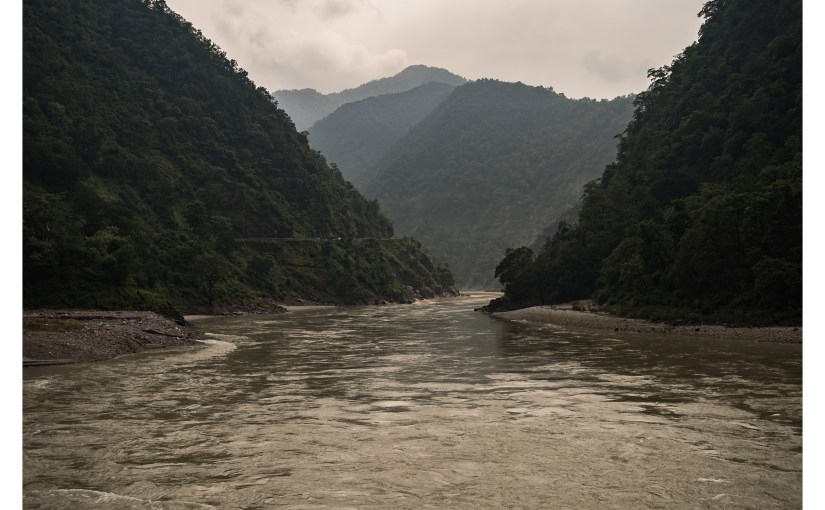
Ganga
River Ganga flowing through a valley, under an overcast sky, downhill from Devprayag, in Uttarakhand, India.

In frame: River Ganga flowing through a valley, under an overcast sky, downhill from Devprayag, in Uttarakhand, India. It was here we had stopped for lunch on our last day in the mountains more than a year ago.

VERY IMPORTANT TO NOTE: Yes, you can share this work with proper attribution. But, please seek permission before using this work (not including the photo), partially or fully. YOU CAN NOT USE THE PHOTO. Believe me, asking is better than ending up in court or facing public shaming on social media. Thanks for understanding.

© Amrit Panigrahy. All rights reserved.
रूही

हर एक आशियाने पे जैसे वो चला देती थी अपनी जादू की छड़ी,
सुला के सबको, सपनों की रखवाली करती हुई रात भर रहती थी खड़ी |

सुबह की पहली रोशनी के साये में जैसे वो लड़खड़ाती हुई चल रही थी,
सपनों से भरी रात के नशे से लगभग बेहोश, अपने कदमों को संभालती।

उसकी अपनी कदमों की आहट जैसे उसी के जादू को थी तोड़ रही,
मुस्कुराती, और एक रूहानी रात का वादा करके चली गयी, रूही।

Daybreak
The setting moon over Hyderabad’s skyline, as seen from Moula Ali, in Hyderabad, India.

As if she ran her magic wand over all the dwellings during the night, and after having made everyone fall asleep,  she stood guard to their dreams. Under the shade of the first light of the morning (poetic expression), she unsteadily walked, still drunk on the dreams from the night, she tried keep herself steady. It was as if her own footsteps were undoing her magic spell, and with a smile on her face, Ruhi walked away promising another intriguing night.


It was magical indeed, my first ever photowalk, and first ever trip to Moula Ali, on the other side of Hyderabad. The moon was setting over the sleepy Hyderabadi skyline, and the dawn was breaking in the opposite direction.

These were my very early days in photography, when I was using a Sony HX100V (with a sensor that was 1/4th of what my current DSLR has). And I didn’t know RAW even existed (yes, perils of being self taught!), so bear with me for the resolution of the image.

In frame: The setting moon over Hyderabad’s skyline, as seen from Moula Ali, in Hyderabad, India. It was magical indeed, just being there at that moment, with the moon setting in front of me, and behind me, the dawn breaking.

VERY IMPORTANT TO NOTE: Yes, you can share this work with proper attribution. But, please seek permission before using this work (not including the photo), partially or fully. YOU CAN NOT USE THE PHOTO. Believe me, asking is better than ending up in court or facing public shaming on social media. Thanks for understanding.

© Amrit Panigrahy. All rights reserved.

ଘରବାହୁଡା

ସବୁ ସନ୍ଧ୍ୟାରେ ସଜବାଜ ହୁଏ ଗତକାଲିର ନିରାଶାକୁ ଭୁଲି,

ବାର ବର୍ଷ କାଳ ଅପେକ୍ଷାରେ ତୋର ହେଇଟି ଆସିବୁ ବୋଲି।

ମାଆ ମୋର କୁହେ, “ଝିଅ ଲୋ, ସେ ଆସିବନି ଆଉ ଫେରି”,

ହେଲେ ମୁଁ ଆସି ଠିଆ ହୁଏ ଦୁଆରେ ହେଲେ ଯେତେ ବି ଡେରି।

ଗାଁକୁ ଫେରନ୍ତି ସାଙ୍ଗ ସାଥି ହେଲେ ତୋର ସେତେ ସମୟ କାହିଁ,

ମନ୍ଦିର ତୋଳାରେ ବ୍ୟସ୍ତ ଅଛୁ ତୁ, ଆଉ କୋଉଠି ତୋ ଧ୍ୟାନ ନାହିଁ।

ତୋ ମୁକୁତା ହାର ଗଳାରେ ମୋର, ସିଏ ବି ଗଲାଣି ଥକି,

ସତେ ଯେମିତି ପଚାରେ ମୋତେ, “ସେ ଆଉ ଆସିବନି କି?”

ସବୁ ସନ୍ଧ୍ୟାରେ ଠିଆ ହୁଏ ବୋଲି ଗାଁ ଲୋକ କହିଲେଣି କେତେ କଥା,

କେହି ଡାକିଲାଣି ମୋତେ ଅଳସକନ୍ୟା ତ ଆଉ କିଏ ଡାକେ ଅଭିସାରିକା।

ବାର ବର୍ଷ ତଳେ ଯାଇଥିଲୁ ତୁ, କହିଲୁ ଫେରିବି କିଛି ଦିନରେ,
ମନ୍ଦିର ତୋଳା ତୋର ସରିନି ଆହୁରି, ଘରକୁ ଜଲଦି ଫେରେ।

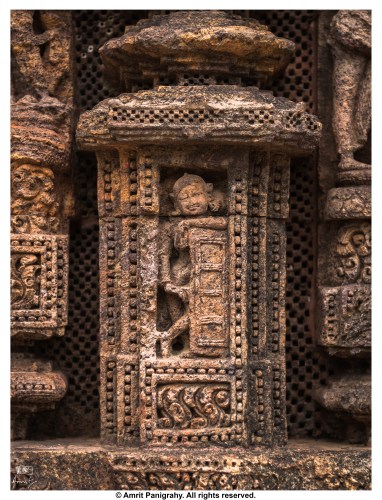
Abhisarika
A sculpture of a lady waiting with half the door open, with a smile on her face. You can see this on the south side of Konark temple, in Odisha, India.

The Odia poem I wrote above is called “ଘରବାହୁଡା”, (pronounced as ghaw-raw-baa(as in baba)-hu(as in who)-da(as in dark), which means homecoming. A fiction based poem, the central character is a woman, who has been separated from his male consort or husband for twelve long years, because he is a sculptor by profession, and has been summoned by the King of the land, for construction of the Sun temple at Konark. She narrates how she dresses up every evening and stands near the door smiling, hoping against hope that he would come back, even though she had returned inside disappointed the previous evening. It has been twelve years and even her mom has now lost hope that he would ever return, but she stands and waits every evening, no matter how late. Even the pearl necklace that he had gifted her has become pale, as if tired of waiting for him and asking her whether he would ever return. Looking at her standing at the door every evening, people around her have starting thinking of her a dance girl, or a whore, in search of patrons. Then she goes on to urge him to come back home as soon as possible, regardless of the temple completion.

This sculpture, might be a figment of imagination of the sculptor, shows how his consort or wife might be waiting for him to return. By the time he must have finished this sculpture, he must have been away from home for twelve long years, or slightly more. Did you notice the smile on the figurine’s face? This was how the sculptor must have imagined to see her upon his return home, with a smile on her face.

1200 architects and sculptors took twelve years to build the Sun temple at Konark and it was finished in 1256 AD. King Narasimha Deva III spent 40cr gold coins to build this architectural marvel, the cost also included that of land reclamation from the sea (you heard that right!), as it is believed that the temple was built in the sea. There are many legends and stories associated with Konark, which I am saving for some other time, with your permission of course!

In frame: A sculpture of a lady waiting with half the door open, with a smile on her face. You can see this on the south side of Konark temple, in Odisha, India. Konark temple is full of sculptures which showcase every human emotion, and not only erotica as is popularly believed. In the words of Ravindranath Tagore, “Here the language of stone surpasses the language of human.”

VERY IMPORTANT TO NOTE: Yes, you can share this work with proper attribution. But, please seek permission before using this work (not including the photo), partially or fully. YOU CAN NOT USE THE PHOTO. Believe me, asking is better than ending up in court or facing public shaming on social media. Thanks for understanding.

© Amrit Panigrahy. All rights reserved.

Crimson Love

I had fallen back, to witness the drama that was unfolding in the sky.

My guide called out my name from a distance….

It was only minutes ago that he was here,
Telling me stories from the yesteryear,
Tales of opulence, generosity, valor and love,
For an open heart it was like a treasure trove.

Of all the stories, one was of interest in particular,
A King, his Queen, and love that was spectacular,
A poetess and a singer, she could bring words to life,
Smitten by her, the King convinced her to be his wife.

They were living happily ever after, or so they thought,
A big army attacked the kingdom, and a battle fought,
The King was killed in battle, was what the messenger told,
The Queen drank poison, and her lifeless body went cold.

The medieval fort, a witness to her love story,
Her eternal love for him that took her to glory,
Walking on that pavilion even I felt as a part it,
Kind of gloomy that in the end they couldn’t unite.

I glanced beyond the ramparts, as I walked back…

Crimson sun set over the horizon,
Leaving behind a familiar emotion.

And as it went…

The hues that it painted and the winter sky it tore,
Colors of desire and pain, that touches one’s core.

More than a year has gone since…

Crimson, is the color that I remember of that evening,
Of longing, the want of belonging and a love undying.

Crimson Love, ‘t was!

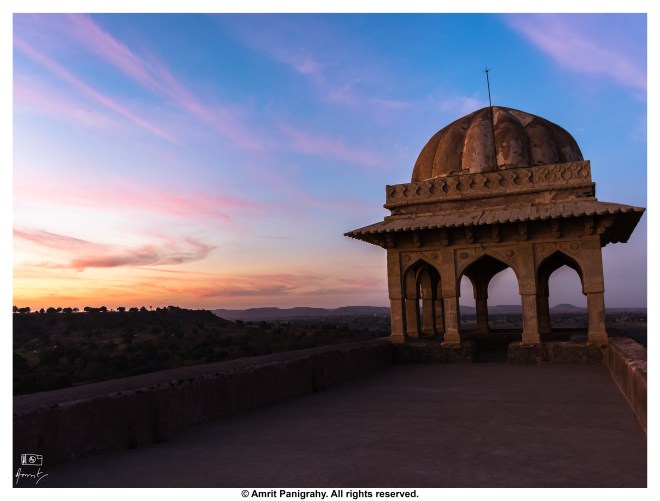
Drama in the sky
Brilliant hues of the winter sky just after the sunset, as seen from Roopmati pavilion in Mandu

I had earlier written a Hindi poem on Roopmati and called it “Jauhar”. You can read it here.

Mandu, or Mandav was capital of erstwhile kingdom of Malwa. Mandu is dotted with love tales of Sultan Baz Bahadur of Malwa, and his queen consort Roopmati.

Kingdom of Malwa used to be a vassal of the Mughals, and had declared indepedence taking advantage of the instability that ensued just after Akbar had taken control.

Akbar then sent his foster brother Adham Khan and a large contingent of the Mughal army to subdue Malwa. Adham Khan, who had by then heard of Roopmati’s enchanting beauty, had resolved to defeat Malwa and take her as a prized possession of his harem.

Baz Bahadur faced Adham Khan and the Mughals in Sarangpur with a small contingent. Baz Bahadur’s contingent was no match for the mighty Mughals and he escaped after being defeated.

Adham Khan then marched on to Mandav. Thinking that Baz Bahadur was slained in the battle, Roopmati poisoned herself, as she could not have seen another man in her life. Such was her love.

In due time, Adham Khan was executed by Akbar. Baz Bahadur surrendered to Akbar and was in return made the mansabdar of Malwa.

And for Roopmati, her love and loyalty for Baz Bahadur still fascinates imagination of the new generation of tourists to Mandu.

In frame: Brilliant hues of the winter sky just after the sunset, as seen from Roopmati pavilion in Mandu, Madhya Pradesh, India. Roopmati pavilion was built by Sultan Baz Bahadur for Roopmati, so that she could Narmada darshan everyday (one of her pre-conditions to her marriage with him). Narmada flows at a distance, in the plains.

VERY IMPORTANT TO NOTE: Yes, you can share this work with proper attribution. But, please seek permission before using this work (not including the photo), partially or fully. YOU CAN NOT USE THE PHOTO. Believe me, asking is better than ending up in court or facing public shaming on social media. Thanks for understanding.

© Amrit Panigrahy. All rights reserved.

The year song


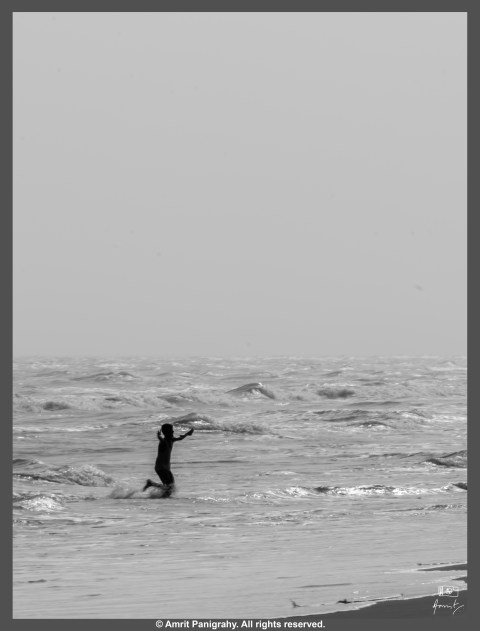
Riding the waves
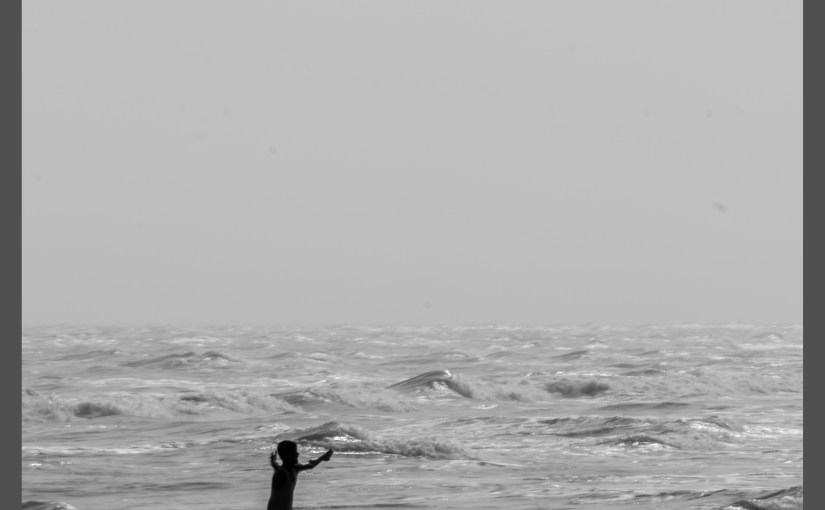
A young man running back to the shore from the sea

A song for the year, I had promised to write,
Taking time out in the middle of the night,
Thoughts rusty, and not organised so well,
But an year it was and many tales to tell.

So, here it is!

Before the year started, in hindsight it was like…

Retreating waves pulled me back to the sea,
Like vices in whose vice like grip I was in,
Vices I left behind on my way to the coast,
And to those no one would raise a toast.

With questions and no answers I started my year,
A start with much less joy and surely a lot of fear,
As if I stepped into the unknown blindfolded,
Fear of an uncertain future, and what lay ahead.

It was the best one ever. To sum it up…

I travelled ten thousand kilomeres on road,
To new places about which I had never heard,
Met people I would never see in my life again,
But memories of a lifetime, of joy and of pain.

I let go of the hands that I never thought I would,
Stopped missing people I never imagined I could,
Worked on myself and learned to be with me,
Had I felt bored with myself, I was in bad company.

Started to see every living being for what they were,
My lack of compassion, and it was totally unfair,
Biggest lesson was on empathy and to be able to relate,
Thank my stars I learned in time, and it wasn’t too late.

The universe has been very kind to me in return,
A lot of gifts and people with best intentions,
Gifts that will stay with me for my entire life,
People who will stay and will help me thrive.

When the waves pulled me, I came back riding them,
Stronger, wiser, calmer, compassionate and brave.

Now with 2017 behind me, here is my 2018 wish for you….

May you have my 2017, if not better than that,
I wish this for you from the bottom of my heart.

Call it a rhyme or a poem, this is my year song,
A song, I won’t mind humming whole life long.


2017 was a life changing year for me, with a lot a of changes for good. This is how good a year it was, in my own words, as a poem.

In frame: A young man running back to the shore from the sea, near Baruva, in Andhra Pradesh, India.

VERY IMPORTANT TO NOTE: Yes, you can share this work with proper attribution. But, please seek permission before using this work (not including the photo), partially or fully. YOU CAN NOT USE THE PHOTO. Believe me, asking is better than ending up in court or facing public shaming on social media. Thanks for understanding.

© Amrit Panigrahy. All rights reserved.

Nine parts of One

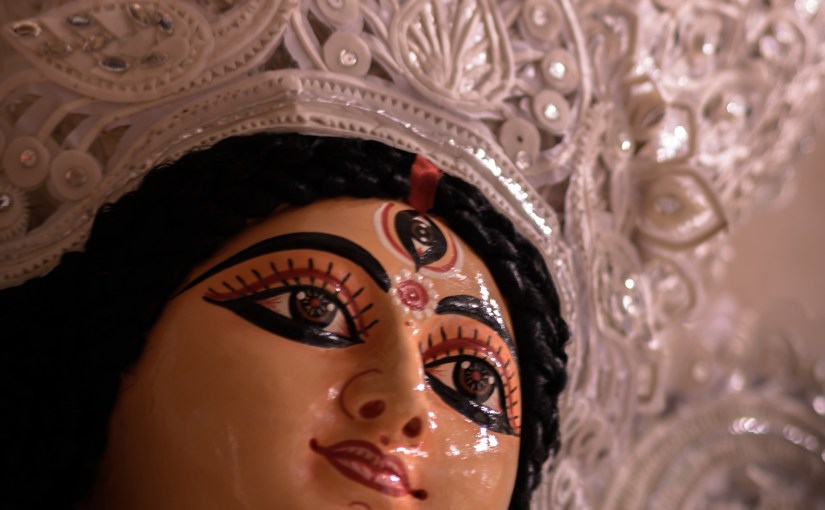
Goddess Durga
Goddess Durga during Durga Puja of 2017 at Hyderabad Bengali Samiti, Hyderabad, Telangana

So big and black a void it was, you could lose everything,
Even the most significant, would seem like nothing.

Into the emptiness of the universe she was summoned,
To lay a strong foundation, we know today as the creation.

The universe that you know as it is today,
She created it in a past far far away.

She then resided in the sun and in the stars,
Emanating light that could wipe out scars.

To marry Shiva, She would be born to a mighty King,
As austerity, from the world She would be abstaining.

As the daughter of the mountain She would be born again,
She would be so fair, not just superficially as others feign.

Married to Shiva again, the half moon would adorn Her head,
Mother to a child, armies of the Gods who eventually led.

Summoned to defeat the dark forces when everything else would fail,
She came as the deadly dark night without leaving behind a trail.

One last demon was left before goodness prevailed,
The demon of disguise who She finally had killed.

She is the saviour, since the days of the time immemorial,
Even by Gods she has been invoked to help good to prevail.

Goddess Durga
Goddess Durga from another angle during Durga Puja of 2017 at Hyderabad Bengali Samiti, Hyderabad, Telangana

This poem is my tribute to the nine forms of Adi Parashakti or, as we know her today, Shakti, worshipped during the nine days of Navaratri. The nine forms of Shakti who are worshipped during Navaratri, are: 1. Shailaputri, 2. Brahmacharini, 3. Chandraghanta, 4. Kushmanda, 5. Skandamata, 6. Katyayani, 7. Kaalratri, 8. Mahagauri, 9. Siddhidatri. Together they are also called Navadurga. The image of Shakti worshipped during the Navaratri/Durga Puja is actually that of Katyayani. To read more about the Navadurga please here.


In frame: Goddess Durga during Durga Puja 2017 at Hyderabad Bengali Samiti, Hyderabad, Telangana.

VERY IMPORTANT TO NOTE: Yes, you can share this work with proper attribution. But, please seek permission before using this work (not including the photo), partially or fully. YOU CAN NOT USE THE PHOTO. Believe me, asking is better than ending up in court or facing public shaming on social media. Thanks for understanding.

© Amrit Panigrahy. All rights reserved.
 

Caro(m)kshetra

Caro(m)kshetra
The Striker and the pieces on a carom board

They are family, kin and friends, how could one kill,
Void they would leave behind, who would be able to fill.

The ones that he grew up playing with, and the ones who taught,
Unable to take on them, was there a way the battle won’t be fought.

The battlefield lay in front of him, and the warriors gave battle cries,
He was unable to pick up his weapon, even after a million tries.

He was given a code to live by, and million reasons to kill,
Told they were his enemies, whose void he need not fill.

He was shaken violently, when he hesitated and refused to fight,
To see things clearly, like he would in the morning after a dark night.

He was chosen for this task because he was mighty and just,
Unlike mightier warriors filled with jealousy and blood-lust.

The ones in front of him were dead the day they joined the wrong,
With justice and morality on his side, he felt ever so strong.

Understanding his duty and worth, he started killing with rage,
Without seeing who was in front of him, or what was their age.

He killed for many days, and many of his beloved ones were taken away,
Rule of justice finally established when he stopped, and was there to stay.


This poem and the accompanying photograph are my attempt to draw an analogy between the Kurukshetra war and our day to day life, even something as uneventful as playing carom.

I try to portray one of the most important teachings of Bhagvad Gita, that attachments make us lose sense of right and wrong, just and injustice, moral and immorality. To uphold and do what is right, one must rise above every form of attachment, and look at things objectively. And when the time comes to do one’s duty, it has to be done no matter what.

In frame: The striker and the pieces on a carom board, clicked on manual mode using my Oneplus 3 phone during the carom tournament at office. This photo was edited using Google Snapseed.

VERY IMPORTANT TO NOTE: Yes, you can share this work with proper attribution. But, please seek permission before using this work (not including the photo), partially or fully. YOU CAN NOT USE THE PHOTO. Believe me, asking is better than ending up in court or facing public shaming on social media. Thanks for understanding.

© Amrit Panigrahy. All rights reserved.

Mountain Song

I was unsure and had many questions when I started,
Unable to understand whether to hold on to those who departed.

I tried and any attempt to touch my past was futile,
As from behind the veil it waved at me with a “smile”.

In a failed attempt, I fought with my past in present,
An act that I would never consider to be decent.

I cried as I saw the past slip away, to which I was so attached,
It was a healing process and I thought I was being attacked.

I decided to quit the things that I was doing,
With tears in my eyes I tried a new beginning.

There was one more thing that I had still to let go,
The sense of I, me and mine, which they call the ego.

As I looked at the winding road up the hill,
Towards a destination I hadn’t started still.

It looked like I was a long long way away from my goal,
I decided to climb nonetheless and it started taking a toll.

Shivering while climbing as cold touched my bones,
On the roads I found freshly fallen pine cones.

The pine cones reminded something that I had chosen to forget,
That even those high up also fall and eventually turn to dust.

When hungry, I found fresh apples from a road side garden,
Tastier I am sure than the one had by Eve and Adam.

When I was thirsty I drank from a mountain spring,
A respite that only pure mountain water could bring.

It was the Almighty telling me to relax and not to worry,
And that I would be provided for and I need not be sorry.

The mountains and highlands that people called divine,
When I reached there, I was sure I would be fine.

The mountains were so big, and the snow so white,
And I told myself that the teachers were always right.

Mountains told me to accept that I was puny and the outcome I can’t influence,
I am not even a speck of dust, when it comes to the whole vast universe.

The snows told me that everything here is inherently pure,
And we pollute everything looking for useless cure.

When I came down from the mountains, I was not like when I went,
Left there many things I was attached to, for which I was sent.

I was questioned for the decisions I took and things I left behind,
I told them as long as this did good to me, I really didn’t mind.

Been a year since I came back from the mountains,
And the memory still as fresh as last night’s rains.

Looking back at last year, it all makes sense now,
The answers to my why, what, when and how.

In human terms, this journey has lasted only a year long,
Ode to the mountains and my evolution, this mountain song.

Mountain song
A temple by the mountain road, high in the Himalayas

The poem was penned by me, where I have tried to put in to words my evolution from what I was a year back when I went to the Himalayas.

In frame: A temple by the mountain road high in the Himalayas, on the way from Naitala to Guptakashi, in Uttarakhand, India. I found these small temples dedicated to local Gods as well as such ritualistic things, common place in the Himalayas.

VERY IMPORTANT TO NOTE: Yes, you can share this work with proper attribution. But, please seek permission before using this work (not including the photo), partially or fully. YOU CAN NOT USE THE PHOTO. Believe me, asking is better than ending up in court or facing public shaming on social media. Thanks for understanding.

© Amrit Panigrahy. All rights reserved.
Advertisements