Mountain Song

I was unsure and had many questions when I started,
Unable to understand whether to hold on to those who departed.

I tried and any attempt to touch my past was futile,
As from behind the veil it waved at me with a “smile”.

In a failed attempt, I fought with my past in present,
An act that I would never consider to be decent.

I cried as I saw the past slip away, to which I was so attached,
It was a healing process and I thought I was being attacked.

I decided to quit the things that I was doing,
With tears in my eyes I tried a new beginning.

There was one more thing that I had still to let go,
The sense of I, me and mine, which they call the ego.

As I looked at the winding road up the hill,
Towards a destination I hadn’t started still.

It looked like I was a long long way away from my goal,
I decided to climb nonetheless and it started taking a toll.

Shivering while climbing as cold touched my bones,
On the roads I found freshly fallen pine cones.

The pine cones reminded something that I had chosen to forget,
That even those high up also fall and eventually turn to dust.

When hungry, I found fresh apples from a road side garden,
Tastier I am sure than the one had by Eve and Adam.

When I was thirsty I drank from a mountain spring,
A respite that only pure mountain water could bring.

It was the Almighty telling me to relax and not to worry,
And that I would be provided for and I need not be sorry.

The mountains and highlands that people called divine,
When I reached there, I was sure I would be fine.

The mountains were so big, and the snow so white,
And I told myself that the teachers were always right.

Mountains told me to accept that I was puny and the outcome I can’t influence,
I am not even a speck of dust, when it comes to the whole vast universe.

The snows told me that everything here is inherently pure,
And we pollute everything looking for useless cure.

When I came down from the mountains, I was not like when I went,
Left there many things I was attached to, for which I was sent.

I was questioned for the decisions I took and things I left behind,
I told them as long as this did good to me, I really didn’t mind.

Been a year since I came back from the mountains,
And the memory still as fresh as last night’s rains.

Looking back at last year, it all makes sense now,
The answers to my why, what, when and how.

In human terms, this journey has lasted only a year long,
Ode to the mountains and my evolution, this mountain song.

Mountain song
A temple by the mountain road, high in the Himalayas

The poem was penned by me, where I have tried to put in to words my evolution from what I was a year back when I went to the Himalayas.

In frame: A temple by the mountain road high in the Himalayas, on the way from Naitala to Guptakashi, in Uttarakhand, India. I found these small temples dedicated to local Gods as well as such ritualistic things, common place in the Himalayas.

VERY IMPORTANT TO NOTE: Yes, you can share this work with proper attribution. But, please seek permission before using this work (not including the photo), partially or fully. YOU CAN NOT USE THE PHOTO. Believe me, asking is better than ending up in court or facing public shaming on social media. Thanks for understanding.

© Amrit Panigrahy. All rights reserved.

Advertisements

As per the King’s order

“You are hereby commissioned, by the King’s order, to build the largest monolithic statue of our Lord, Shri Ganapati, from the large boulder that is marked by the royal flag, on top of the Hemakunta hill. On completion of this order, which can not exceed three years, you will receive a grant of five villages and the adjoining fertile land from the royal court.”, read the King’s messenger from the order signed by the King himself, as the master sculptor Narasimhulu listened in disbelief.

The messenger went on, “You can employ your own artisans for this order, and all such artisans will be on the payrolls of the royal court. Should you fail to execute this order, this same order will be passed on to your elder son, and you will be convicted of disobeying the King’s order and will be tried of high treason.” That was almost 3 years back, and he had gladly accepted the offer, not that he had too many choices at that time. In all these days, the statue of Lord Ganapati was only half done. With the King’s deadline expiring only a fortnight later, there was no way the order could be executed now. The King had already gotten a temple built around the half-finished statue. And Narasimhulu could not afford even a minute mistake, by increasing the pace of the work.

Knowing he could never complete the order in time, Narasimhulu asked all the artisans to leave. He locked himself inside the temple with the half finsihed statue and decided to starve himself to death.

He prayed to Lord Ganapati, asked for His forgiveness as he was leaving the statue unfinished. In a day or two he fell down in the corner, weakened by lack of food. He thought his end was near and he was hallucinating, as he saw a figure, much bigger than a normal human being, working on the unfinished statue with a chisel and a hammer. Other than his size, all Narasimhulu could notice was his larger than usual ears. He couldn’t see the face of the unknown sculptor, as he had his back to Narasimhulu at all times, and he was himself very weak to walk up and find out.

Meanwhile, in the outer world it was the day when the King’s deadline ended. The King came with all his courtesans and the royal family and found the temple doors locked from inside. He ordered the doors to be broken.

Narasimhulu, very weak from starvation for days, could faintly hear the sounds of heavy objects hitting the temple door from outside. When he heard the door open, he gathered all his energy and opened hi eyes. As light entered the temple, he could see the faces of the statue of Lord Ganapati.

Narasimhulu could see that the statue was complete, as per the King’s order.

Ganesha
Kadalekalu Ganesha, in Hampi, Karnataka, India.

DISCLAIMER: This is a work of fiction. Any resemblance to any person living or dead is purely coincidental.

In frame: Kadalekalu Ganesha, a 4.5 meters tall monolithic statue, located in a temple on the Hemakunta hill, in Hampi, Karnataka, India.

VERY IMPORTANT TO NOTE: Yes, you can share this work with proper attribution. But, please seek permission before using this work (not including the photo), partially or fully. YOU CAN NOT USE THE PHOTO. Believe me, asking is better than ending up in court or facing public shaming on social media. Thanks for understanding.

© Amrit Panigrahy. All rights reserved.


Buddha, who?

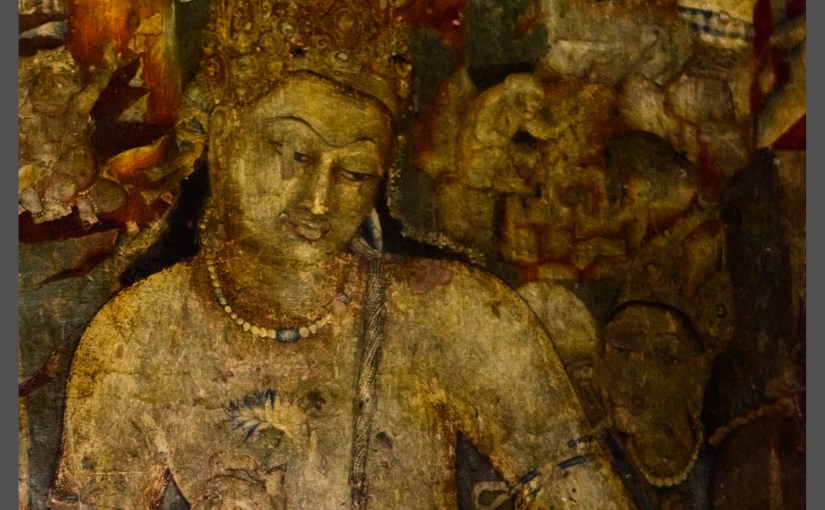
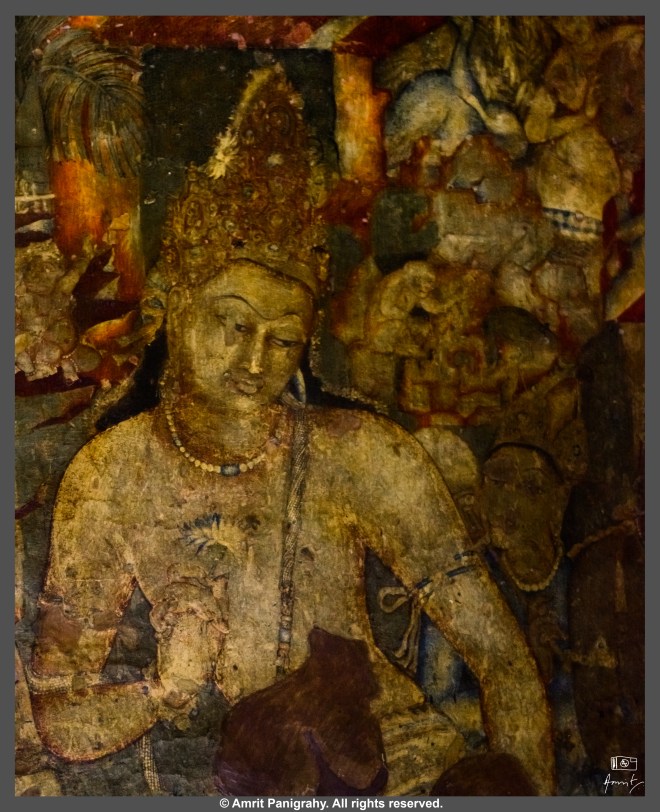
He is Avalokiteshwara also known as Padmapani. He is a Bodhisattva, who embodies compassion of all the Buddhas. Avalokiteshwara literally translates into “Lord who contemplates”, and Padmapani is someone who has a lotus in his hand (Padma – lotus, Pani – hand).

Per early Buddhism, Bodhisattva is Gautama Buddha in his previous lives, and forms the very foundation of Jataka tales. According to later Buddhism, Bodhisattva is someone who has a wish and mind compassionate enough to attain Buddhahood.

Who is a Buddha?

Wait! What do I mean by “a” Buddha? Were there more than one Buddhas?

By Buddha, we generally mean Gautama Buddha. And He was just one of them, but unquestionably the most popular one. Actually, Buddha is someone who has attained enlightenment and has fully comprehended the four noble truths of – pain, origin of pain, cessation of pain, and the path that will lead to the cessation of pain.

According to contemporary Tibetan Buddhism, Avalokiteshwara is someone who looks after all beings with compassion, and usually emanates as Dalai Lama. He is also known as Shadakshari, the “Lord of six syllables”.

What six syllables?

If you have seen those colourful Tibetan prayer flags, have you ever wondered what is written on them? This is what you will find written on them – “Om Ma Ni Pad Me Hum”. That’s six syllables. Each of these six syllables are believed to purify the following things in humans, respectively – Pride or Ego, Jealousy or Lust, Passion or Desire, Ignorance or Prejudice, Greed or Possessiveness, Aggression or Hatred. That is precisely all of humanity’s problems in six syllables.

Padmapani
Padmapani, the most famous painting in Ajanta caves, Maharashtra, India.

Why Buddha?

In ancient India, when the vedic culture turned from being highly scientific into merely ritualistic, the caste system became very rigid. And a vacuum was created which demanded the presence of a spiritual leader who could make humans see the things the way the were, and hence emergence of Gautama Buddha. And He became popular for taking a scientific approach towards attaining Nirvana. His teachings were very simple and spread like wildfire, sweeping settlement after settlement, and laid foundation of early Buddhism.

In frame: Padmapani, the most famous painting in Ajanta caves, Maharashtra, India. You can find this painting on the left side of the sanctum in cave no.: 1 of Ajanta. Because of extremely low light, photographing paintings inside the Ajanta caves can be challenging and can put your technical skills to test, especially if you are clicking in manual mode.

VERY IMPORTANT TO NOTE: Yes, you can share this work with proper attribution. But, please seek permission before using this work (not including the photo), partially or fully. YOU CAN NOT USE THE PHOTO. Believe me, asking is better than ending up in court or facing public shaming on social media. Thanks for understanding.

© Amrit Panigrahy. All rights reserved.

Jagannath Series – Part II: The Krishna Connection

Today is Niladri Bije, the last day of the Rathjatra festival when the three siblings – Lord Jagannath, Devi Subhadra and Lord Balabhadra enter the temple after coming back from their annual outing to their aunt’s place. No one stops the other two siblings from entering the temple, but when Lord Jagannath approaches the temple gates, his wife Devi Lakshmi closes the gates and does not allow him to enter. She is angry with Him, as He didn’t take Her along when He went out nine days earlier. Like any other husband, Lord Jagannath has to pacify Her with gifts. And He gifts her Kheermohan, a sweet made of chhena, that somewhat looks like His eyes. The modern name of Kheermohan is Rasagola (or like Bengalis would prefer calling it, Rosogulla). Now, that I have put down facts which prove that Rasagola is infact an Odia delicacy, let us move to a rather more serious topic, that of Lord Jagannath’s origins.

“Niladri” means blue mountain in Sanskrit, and “Bije” means climbing. It is believed that the original Jagannath temple was built on a blue mountain. The current Jagannath temple was built on the same site as the original one.

After the Mahabharata, the Yadavs went extinct after killing each other in a fratricidal war. Lord Krishna had one last “leela” to take care of, before the end of the Avatar. The last “leela” had one more character – Jara, reincarnation of Angad, son of Bali from Ramayan, and a tribal hunter in his current life. Angad was given a boon in the previous life by Lord Ram, who had killed his father Bali, that he would get his chance to avenge his father’s death.

One hot afternoon, Lord Krishna was resting under the shade of a tree. Jara, who was out hunting, from behind the bushes mistook Lord Krishna’s toe for the ear of a deer, and shot an arrow. The arrow proved fatal for Lord Krishna, and the Avatar came to an end. Thus, Jara avenged his father’s death.

Krishna Connection

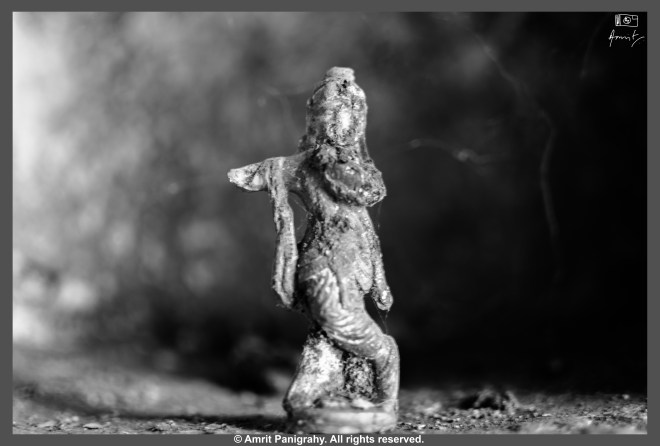
Image: Remains of a statue of Lord Krishna in a dilapidated building near the Ananta Padmanabha Sway temple, in Ananthagiri, Telangana, India. 

Lord Krishna’s dear friend Arjun was called for His cremation. At the end of it, everything else except Lord Krishna’s heart had turned into ash. Arjun then picked up his dear friend’s heart, put it inside a neem log with Shankh (conch), Chakra (disk), Gada (mace) and Padma (lotus) symbols on it (the four symbols of Lord Vishnu, of whom boh Sri Ram and Sri Krishna were avatars), and floated it in the sea.

That piece of log with Sri Krishan’s heart in it voyaged through the sea, from Dwarka on the west coast to Puri on the east, and eventually took the form of the first Lord Jagannath. How it took the form of Lord Jagannath is a tale for another time. Wait! Did I say “first” Lord Jagannath? Does it mean that there were many Lord Jagannaths? Much to your astonishment, the answer is yes!

Every twelve to nineteen years Lord Jagannath reincarnates into a new body, in an event called Nabakalebara. During Nabakalebara, the “brahma” or the “tattva”, the life of Lord Jagannath, which is said to be the heart of Lord Krishna, is placed in a new body, and the old body is cremated. Him going through the cycles of life and death highlights the fact that everything that is here on Martyalok (as Earth is also called in Sanskrit, where death is inevitable) has to function by the rule of the land. More on Nabakalebara is also a tale for another time.

/Disclaimer: Based on legends, folklores and part fiction/

In frame: Remains of a statue of Lord Krishna in a dilapidated building near the Ananta Padmanabha Swamy temple, in Ananthagiri, Telengana, India.

VERY IMPORTANT TO NOTE: Yes, you can share this work with proper attribution. But, please seek permission before using this work (not including the photo), partially or fully. YOU CAN NOT USE THE PHOTO. Believe me, asking is better than ending up in court or facing public shaming on social media. Thanks for understanding.

© Amrit Panigrahy. All rights reserved.


Jagannath Series – Part I: Master of the Universe

There is hardly any lingusitic tribe in India, which relates to any particular God like Odias relate to Lord Jagannath. Being an Odia myself, I grew up in the midst of Jagannath culture. Most part of a religious Odia’s life (and majority of us are quite religious) revolves around Lord Jagannath, to the extent that the first invitation card of any auspicious occasion from an Odia household goes to Him. In even the smallest villages of Odisha, you will find a Jagannath temple, and all the rituals/festivals being observed as it happens in the Jagannath temple of Puri. Oh, and yes! For those of you unaware, it is said Odias observe thirteen festivals in a year i.e. in twelve months, and almost all of them are someway or the other related to Lord Jagannath.

Jagannath FB

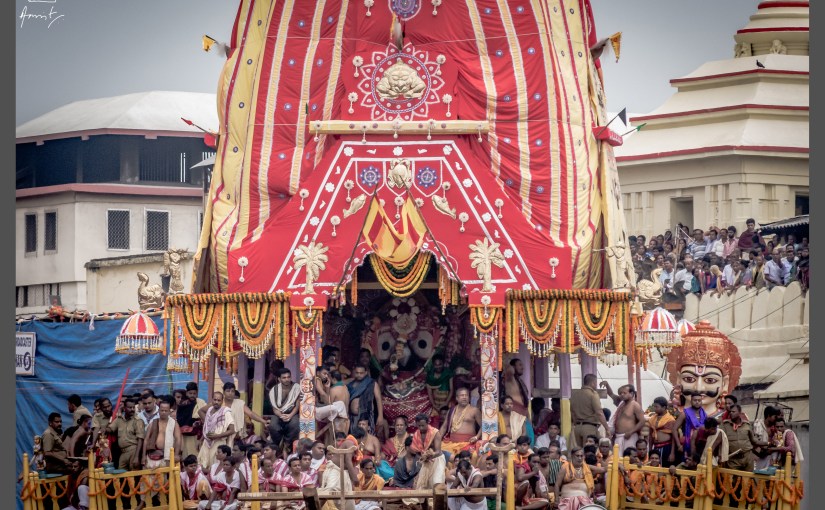
Image: Lord Jagannath on his chariot Nandighosh, on His way to His aunt’s place during Rathyatra. 

So, what is it with the Odias and this seemingly “physically incomplete” deity? Wait! Did I just call a God “physically incomplete”? Well, I am allowed to. Because, although his name translates to “Master of the Universe” and Kings sweep his chariot, Lord Jagannath is as much a friend to all Odias, as he is God. He inspires as a friend, philosopher and guide to every Odia in true sense, to the extent that He lives like a human, His wife fights with Him like any other man’s wife, and He also dies like a human to take birth again. And He is also known as “Patitpavan”, which translates to “He who lifts the downtrodden”.

Among all the things that Lord Jagannath is to Odias, most importantly He is the pride, He is The Odia identity. And He is the ultimate symbol of valiant resistance by this tribe against attacks and oppression by foreign invaders – from Turks to Afghans to Mughals. The Jagannath temple in Puri has been attacked twenty times, over the centuries. And the tremendous belief that Odias put on Him can not be described in simple words. Why not! I mean, no other God is accessible, like Lord Jagannath is.

When a King was marching on a mighty kingdom to the south, He answered the King’s prayers, came out and marched ahead of the King’s army, and fought on the King’s side. When a low caste devotee was not allowed inside the temple to offer his prayers, Lord Jagannath himself walked down from his temple to accept his devotee’s offering. When his favorite devotee was not allowed inside the temple because he was a Muslim, Lord Jagannath made sure that His chariot stops in front of His favorite devotee’s tomb every year during Rathyatra.

Today happens to be “Bahuda”, the day of homecoming from His annual outing to his Aunt’s place. Well, that is what Rathyatra is all about! Didn’t I tell you in the beginning that He is more human than any God can be? At the same time, Rathyatra is also about meeting all those who could not pay Him a visit at His abode. And it is said, if you see Lord Jagannath on his chariot only once, you are free from the cycle of life and death and will attain Moksh.

True Master of the Universe, don’t you think?

And what better day to start a series on Him and related tales, legends and history (which also includes that of Konark, by the way), than on the day of His homecoming. Get ready for the “Jagannath series”, all of you!

Jai Jagannath!

In frame: Lord Jagannath on His chariot Nandighosh, on the way to His aunt’s place during Rathyatra 2017. Rathyatra is also one of the largest congregation of humans in the world.

VERY IMPORTANT TO NOTE: Yes, you can share this work with proper attribution. But, please seek permission before using this work (not including the photo), partially or fully. YOU CAN NOT USE THE PHOTO. Believe me, asking is better than ending up in court or facing public shaming on social media. Thanks for understanding.

© Amrit Panigrahy. All rights reserved.

Dome Diaries – Epilogue

Dome Diaries Navigator – Prologue  ||  Part I  ||  Part II  ||  Part III  ||  Epilogue

When I first thought of visiting Bijapur and started doing my “research”, I was fascinated to find out how the Adil Shahis of Bijapur stayed sovereign for the two centuries, during which a great churning of power was happening across our counry. It was the same two centuries when Vijayanagara to the south, the Marathas to the west and the Mughals to the north were vying for control of the same piece of land.

Part 3-6 FB

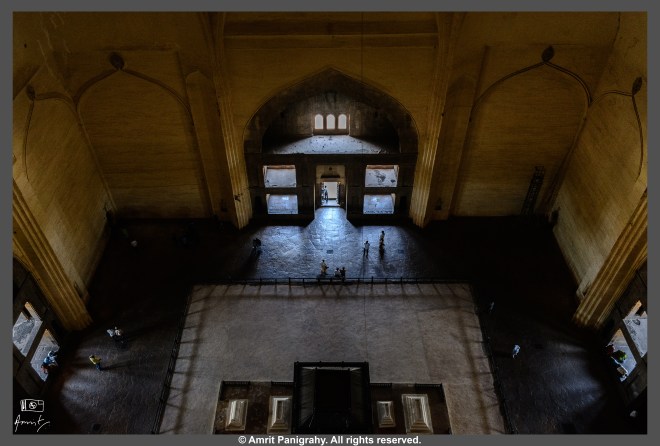
Image: Epitaph of Mohammed Adil Shah, as seen from the balcony seven storeys high, inside the Gol Gumbaz

The things that the Adil Shahi dynasty got right, the things that they got wrong, some pure chance and some meticulous planning. Through this series, I have tried to cover everything that I thought mattered, as far as history of India is concerned. This visit opened up more questions than it actually answered, mostly pertaining to the Marathas. This will mean travelling to the Maratha land, which makes me excited. In due course, I will plan and visit, and whatever happens thereafter, rest assured you will read them here.

Also, customary vote-of-thanks time now! I stayed in “Maurya Adil Shahi” during my visit to Bijapur, a property owned and operated by Karnataka State Tourism Development Corporation (KSTDC). This place had a cordial and helping staff, food was okayish. I was not in Bijapur for food, anyways. KSTDC gives guided tour of Bijapur, for a price. However, I chose to pick a guide on my own. And this is where comes Jehangir, my guide in Bijapur, a learned chap and a patient guide, who answered almost all my questions. And given his hold over Indian history, I had a good time discussing history with him. If you are planning a visit to Bijapur, and looking for a guide, do get in touch with me for his number.

That’s it! Hope you enjoyed the series. And as I plan and cover more of this land, you will get to hear from me, ermmm.. read from me.. Whatever! You got what I wanted to say.

Ciao!

Dome Diaries Navigator – Prologue  ||  Part I  ||  Part II  ||  Part III  ||  Epilogue

In frame: Epitaph of Mohammed Adil Shah, as seen from the balcony seven storeys high, inside the Gol Gumbaz, in Bijapur, Karnataka, India.

VERY IMPORTANT TO NOTE: Yes, you can share this work with proper attribution. But, please seek permission before using this work (not including the photo), partially or fully. YOU CAN NOT USE THE PHOTO. Believe me, asking is better than ending up in court or facing public shaming on social media. Thanks for understanding.

Dome Diaries – Part III: Two and a half tombs, and other things

Dome Diaries Navigator – Prologue  ||  Part I  ||  Part II  ||  Part III  ||  Epilogue

Introduction:

With more than hundred domes of all sizes (the largest of them is 44 mts in diameter, you read that right!), Bijapur is called the “City of Domes”. Of all the structures, the most imposing, intriguing and fascinating are the mausoleums of Ibrahim Adil Shah II and Mohammed Adil Shah, namely Ibrahim Rouza and Gol Gumbaz, respectively. Looks like these Sultans who reigned over Bijapur during its most prosperous period had their mortal life sorted, so they focused more on making their permanent resting places (read tombs) worth staying for a really long long time.

Why tombs-4 FB

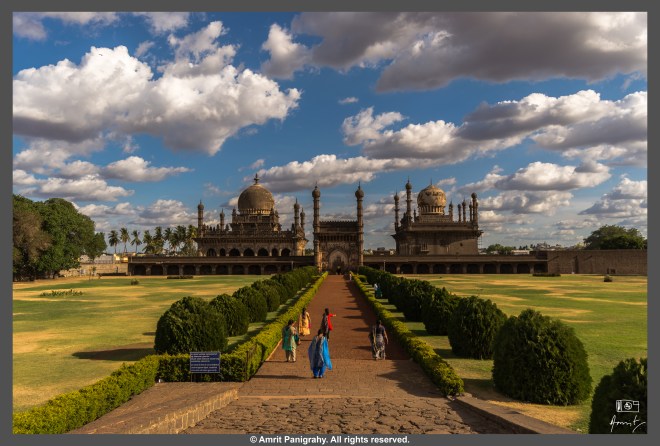
Image: Ibrahim Rouza and the mosque in Bijapur, Karnataka, India under the pre-monsoon cotton candies, as seen from the entrance

Wait! That’s just two tombs. What is half a tomb? Read on, and you will find out.

TOMB I: Ibrahim Rouza

Ibrahim Rouza was originally commissioned by Ibrahim Adil Shah II as a mausoleum for his beloved queen consort, Taj Sultana, at least half a century before the “monument of love”. That’s right! The Sultan probably laid the foundation of the idea to dedicate grand mausoleums to consorts, which culminated in the grandest of them all, the Taj Mahal in Agra. Although he commissioned the mausoleum for his queen, it was Ibrahim Adil Shah II who died first, and was eventually buried there. Hence, it is named after him, Ibrahim Rouza. It is widely believed that Ibrahim Rouza was the inspiration behind Taj Mahal.

Part 3 FB

Image: Ibrahim Rouza in Bijapur, Karnataka, India, as seen up close 

Designed by Persian architect Malik Sandal, this magnificently ornate structure is built of dark grey basalt till the base of the dome. The dome is made of brick and mortar. What makes Ibrahim Rouza stunning is not what is visible from far away, but what is visible from up close. Its walls are filled with fine calligraphy in Arabic, mainly religious. The top portions of the windows also have religious calligraphy in Arabic, but in the form of lattice work on stone. The workers who created these masterpieces would have to be expert craftsmen in lattice work, as well as well-versed with religious scriptures and Arabic.

TOMB II: Gol Gumbaz

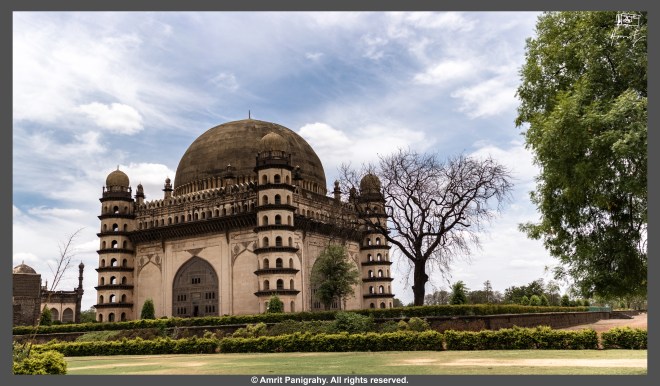
Also designed as a mausoleum by Malik Sandal for Mohammed Adil Shah, son of Ibrahim Adil Shah II, at more than seven storeys high Gol Gambuz is the most iconic structure of Bijapur, and the second largest freestanding dome in the world, measuring 44 meters in diameter. The location was chosen for this grand structure because the builders could use a very large basalt as a foundation for this imposing structure. It is said that it took 20,000 men, 23 years to build Gol Gumbaz.

Part 3-3 FB

Image: Gol Gumbaz, the most iconic structure in Bijapur, Karnataka, India

The technique they used here is interesting – perpendicularly overlapping squares as the base, intersecting arches using interlocking stones till the base of the dome, brick mortar on an wooden false structure for the dome, and the wooden structure was removed once the dome was complete. The thickness of the walls on the ground level is about 15 feets, at the base of the dome it is 10 feets, and the width of the dome itself is 9 feets.

HALF A TOMB: Barakamaan

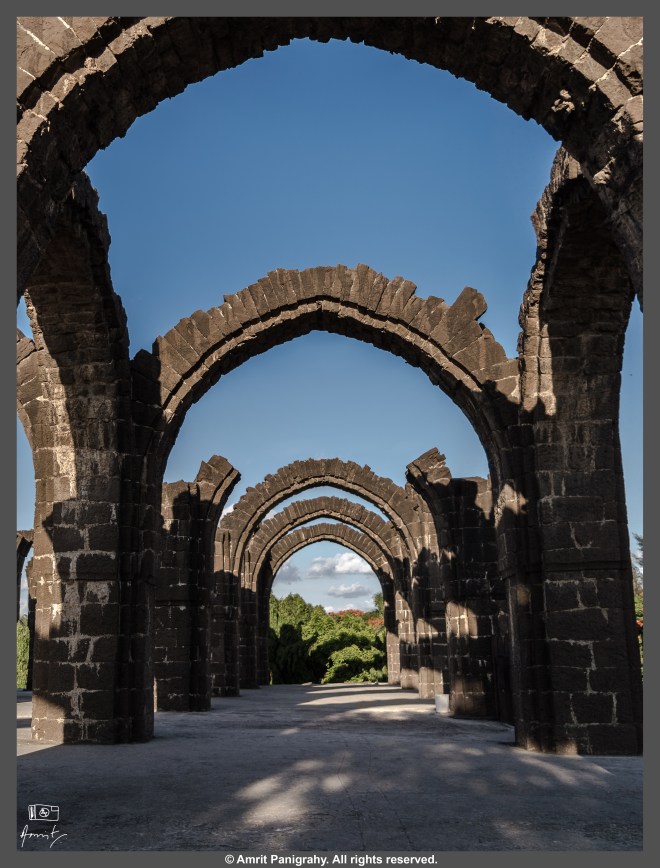
Inspired by his grandfather and father’s mausoleums, Ali Adil Shah II went about starting the work on his mausoleum. Actually planned to be more than twelve storeys high (and hence the name Barakamaan – Bara means twelve and Kamaan means arch) when complete, this structure would have dwarfed the Gol Gumbaz, and could have claimed to be the largest freestanding dome in the world.

Why tombs-2 FB

Image: The arches of Barakamaan in Bijapur, Karnataka, India

Constant power struggle with the Marathas and pressure from the Mughals meant Ali Adil Shah II could not make available all the resources that this mega structure would need to be completed. And as luck would have it, he would die with his mausoleum still unfinished and would be buried there. As he was the last Sultan of Bijapur to die independent, he would continue to lay under the open skies for eternity.

And other things..

Apart from the two and a half tombs, Bijapur also has two palaces – Gagan Mahal and Asar Mahal built by Ali Adil Shah I and Mohammed Adil Shah, respectively. Built in Persian style, these palaces are much less ornamental than the Adil Shahi mausoleums. Usually two stories high, the roofs were supported by wooden beams, made of teak wood. One such beam can be seen lying beside the Asar Mahal. It is said that the last Adil Shahi Sultan, Sikander Adil Shah surrendered in front of Aurangzeb in Gagan Mahal.

Part 3-8 FB

Image: Asar Mahal in Bijapur, Karnataka, India

The initial Adil Shahi rulers mostly followed Shia Islam, until Ibrahim Adil Shah II converted to Sunni Islam in 1552. His father Ali Adil Shah I had built the Jama Masjid, the Mehraab of which was redecorated with gold paintings by his son Mohammed Adil Shah, and is still one of the most decorated Mehraabs in India. The mosque was built to be used for prayers on special occasions. Given that Adil Shah I was born a Sunni but converted to Shia during later years, the Jama mosque did not have an eastern gate, as is the Sunni practice. The eastern gate was a later addition.

Part 3-10 For FB

Image: A guide explains its history to visitors in front of the beautiful Mehraab of Jama Masjid in Bijapur, Karnataka, India

Ali Adil Shah I is also credited with building the citadel and the fort, among other things, especially in the post Talikota period. It was during his reign, and reigns of his adopted son Ibrahim Adil Shah II and Mohammed Adil Shah, Bijapur got its iconic buildings. It was a period when Bijapur bloomed, before fading away in the pages of history.

END OF PART III

Dome Diaries Navigator – Prologue  ||  Part I  ||  Part II  ||  Part III  ||  Epilogue

In frame (in order of appearance): 1)  Ibrahim Rouza and the mosque in Bijapur, Karnataka, India under the pre-monsoon cotton candies, as seen from the entrance.

2) Ibrahim Rouza in Bijapur, Karnataka, India, as seen up close. It is also called the “Black Taj” or the “Taj of Deccan”.

3) Gol Gumbaz, the most iconic structure in Bijapur, Karnataka, India. It is the second largest freestanding dome in the world, measuring 44 meters at diameter.

4) The arches of Barakamaan in Bijapur, Karnataka, India. It was planned to be the much bigger than Gol Gumbaz, and could have claimed the distinction of being the largest freestanding dome in the world. But fate had other plans.

5) Asar Mahal in Bijapur, Karnataka, India. Unlike their mausoleums, the Sultans’ palaces were very simple two storeyed structures.

6) A guide explains its history to visitors in front of the beautiful Mehraab of Jama Masjid in Bijapur, Karnataka, India, which was redecorated in its current golden paint on orders of Mohammed Adil Shah.

VERY IMPORTANT TO NOTE: Yes, you can share this work with proper attribution. But, please seek permission before using this work (not including the photo), partially or fully. YOU CAN NOT USE THE PHOTO. Believe me, asking is better than ending up in court or facing public shaming on social media. Thanks for understanding.

© Amrit Panigrahy. All rights reserved.

Sees it all!

“Chaka aakhi sabu dekhuchi”, is a popular saying in Odia. Which translates to “Lord Jagannath sees it all”. Chaka in Odia means round, Aakhi in Odia means eyes. Notice His round eyes.

When I was in Puri last month, I had mentioned that I was planning to visit Puri during Rathyatra. Well, here is a secret! I was not planning, I had actually promised Him. 26 years were too long a gap, you see. You can read about my last month’s visit here.

Reached here in Puri, just in time to see the annual outing of the Gods, the Rathyatra of 2017. Saw Him gracefully moving towards his chariot (we call it Pahandi in Odia), with his crown (called Tahia in Odia) moving back and forth as He moved. I was quite far off when this was happening, at least couple of hundred meters, may be more. But as He appeared out of the temple main gates, the atmosphere was filled with cries of His name all around. And guess what, I am the first person from my whole family to witness it happening in front of my eyes (as confirmed by my father).

He sees it all!!
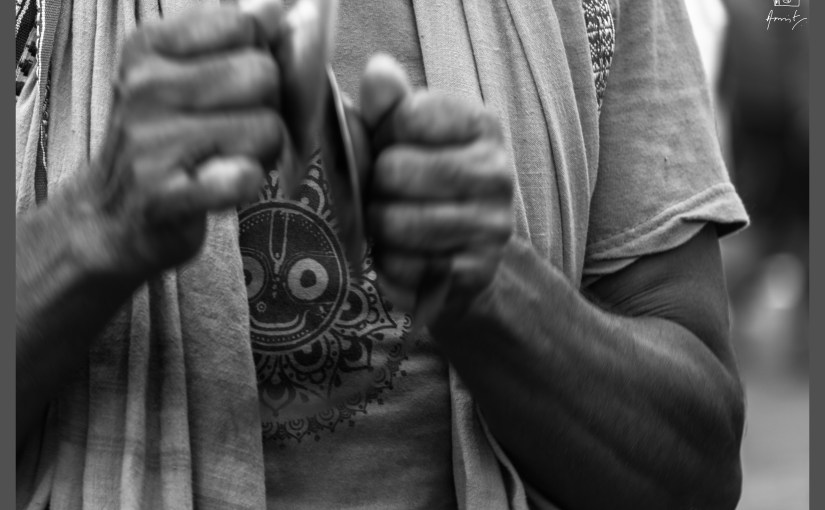
Lord Jagannath on a devotee’s t-shirt as he plays his Gini (a traditional Odia music instrument).

The energy on the Grand road (called Bada Danda in Odia) was so much, I saw people dancing for hours (you read that right!) to folk songs from all over Odisha, as well as to the tune of drums (dhol and mridang) and khanjanis (see picture to know what it is). It was like a rave party from another age. And it was as if they were drawing their energy from an eternal source, may be it was Him as He smilingly moved towards them on top his chariot. Because, what I saw there today is not humanely possible. You got to see it to believe it. And boy, was it overwhelming for me. Add to it all the people around (my estimate is half a million, at least), a perfect recipe to get disoriented (in a good way), call it trance!

There were a lot of traffic restrictions all around the town, so I walked all the way, and the last few kilometers were barefoot on the beach as the waves played hide and seek. By the time I reached back at my hotel, I must have clocked 15 kilometres, all in a days walk.

Now, as I sit in my hotel room and write this, I was thinking. How about I bring to you all the tales, legends, facts and stories about Lord Jagannath, that I know? Also, how about stories of Konark? You know that the construction of the Sun temple in Konark was related to events that unfolded in Puri, right?

So, let’s call them “Jagannath series”.

Signing off from Puri, land of Lord Jagannath!

In frame: Lord Jagannath on a devotee’s t-shirt as he plays his khanjani (a traditional Odia music instrument). You can see Him anywhere you want. You just need to look harder. And He sees you, all the time.

VERY IMPORTANT TO NOTE: Yes, you can share this work with proper attribution. But, please seek permission before using this work (not including the photo), partially or fully. YOU CAN NOT USE THE PHOTO. Believe me, asking is better than ending up in court or facing public shaming on social media. Thanks for understanding.

© Amrit Panigrahy. All rights reserved.

Dome Diaries – Part II: Adil Shahi and curse of the Maratha

Dome Diaries Navigator – Prologue  ||  Part I  ||  Part II  ||  Part III  ||  Epilogue

Background:

The battle of Talikota in 1565 AD and the ensuing defeat of Vijayanagara empire ushered in a period of relative stability, which resulted in prosperity for all the Deccan sultanates. It was particularly so for the Adil Shahis of Bijapur as they shared the longest border with Vijayanagara. Post Talikota Adil Shahi diplomacy was a perfect balance between marriage alliances (with Nizam Shahis of Ahmednagar and Qutb Shahis of Golconda) and military campaigns (against Barid Shahis of Bidar). The idea of peace is a relative term, and in medieval India it could be gauged by comparing the length of the reigns of different rulers. Ibrahim Adil Shah II, the sixth Sultan of Bijapur and later his son Mohammed Adil Shah reigned over Bijapur of eight decades. The Bijapur sultanate remained in existence for two centuries in total. Now, that’s peaceful!
Part 2-2 FB

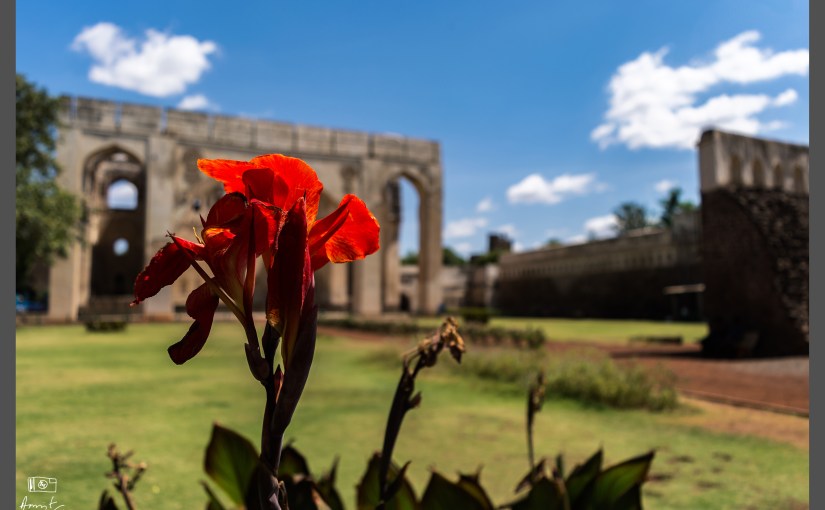
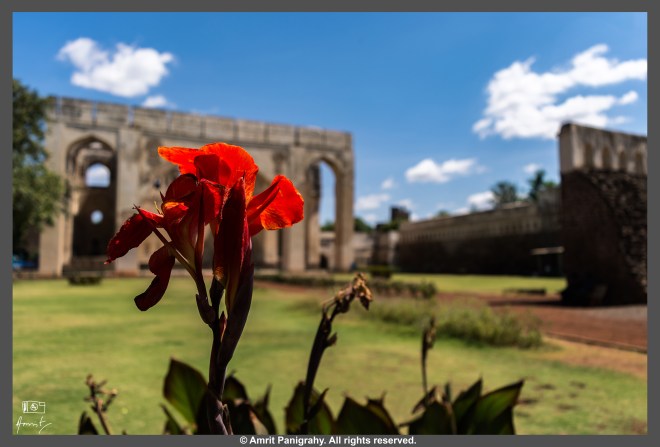
Image: A Canna Red King Humbert flower with Gagan Mahal in the background, in Bijapur, Karnataka, India

Absence of any threat from Vijayanagara and the diplomacy with other Deccan sultanates meant Bijapur could now exert its control over the majority of the newly conquered area, and most importantly over the very fertile Raichur doab. Steady revenue inflows from the Raichur doab and other conquered  dominions down south, and the immense wealth that was plundered after sacking of the capital of Vijayanagara, improved Bijapur’s finances by manifolds. This newfound abundance was used in uplifting the lifestyle of the subjects, creating architectural marvels, and patronizing art.

The Jagadguru Badshah:

After the demise of Ali Adil Shah I in 1579 AD, his adopted son Ibrahim Adil Shah II took over the reign as Sultan of Bijapur. The new Sultan was a class apart from his predecessors, and would stay so from his successors too. His reign would last for five decades, one fourths of Bijapur sultanate’s total existence. These five decades would unquestionably be the golden period of Bijapur sultanate. The sultanate would transform from religious tolerance as a state policy to religious inclusion, thanks to the Sultan’s efforts to bring cultural harmony between Shias and Sunnis, and Hindus and Muslims.

Ibrahim Adil Shah II would go on to become an acclaimed poet, in addition to being an able and just ruler. He is credited with composing Kitab-e-Navras, which is a collection of 59 poems and 17 couplets, dedicated to Goddess Saraswati, Lord Ganapati, his queen Chaand Sultana, and also his Tanpura “Moti Khan” and his elephant “Atis Khan”, among other things.

All of this earned him the title of “Jagadguru Badshah”. In addition, Ibrahim Adil Shah II gave Bijapur its most prized possession. No, it is not the Gol Gumbaz. He commissioned building of a very ornate mausoleum for his queen consort, Taj Sultana. And by doing so, in all probability he laid the foundation of the idea to dedicate grand mausoleums to consorts, which culminated in the grandest of them all, the Taj Mahal in Agra. Though the mausoleum he had commissioned was built for his queen consort, he was the one to die first and to be buried there. Hence, the mausoleum got its name, Ibrahim Rouza, also called the Black Taj, or the Taj of Deccan (contested, as Bibi ka Maqbara in Aurangabad is also known as the Taj of Deccan).
Part 2 FB

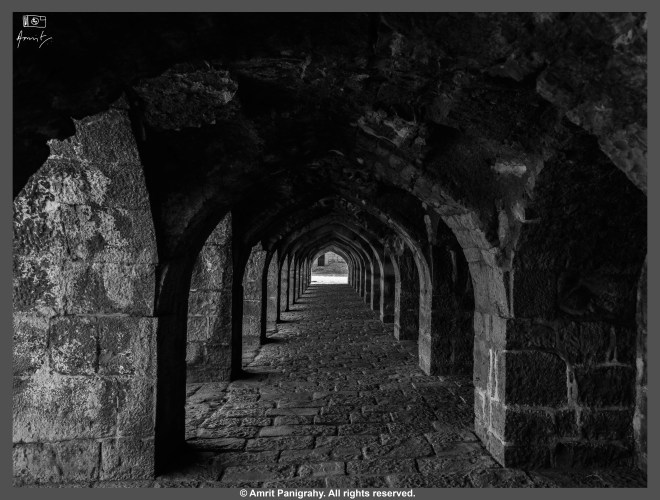
Image: The corridor outside the catacomb of Ibrahim Rouza, in Bijapur, Karnataka, India

With the demise of Ibrahim Adil Shah II in 1627 AD, Bijapur would near the end of its golden period.

Mohammaed Adil Shah and the curse of the Maratha:

Mohammed Adil Shah took over the throne of Bijapur after his father’s death in 1627 AD. He took over the reigns of Bijapur when the sultanate was at its zenith, and he tried his best to live up to his father’s reputation in his three decades of rule. His efforts were mainly focused on improving the socio-economic and educational standards of his subjects, and succeeded to a large extent.

However, his best known contributions to the history would be these two: 1) Gol Gumbaz, his mausoleum, which is the world’s second largest freestanding dome, and dominates the Bijapuri skyline to date; and 2) His dealing with the revolt of Shahji (Shivaji’s father) and later Shivaji, which turned the Marathas against Bijapur and shaped the present of India as we know today.
MM-4 FB

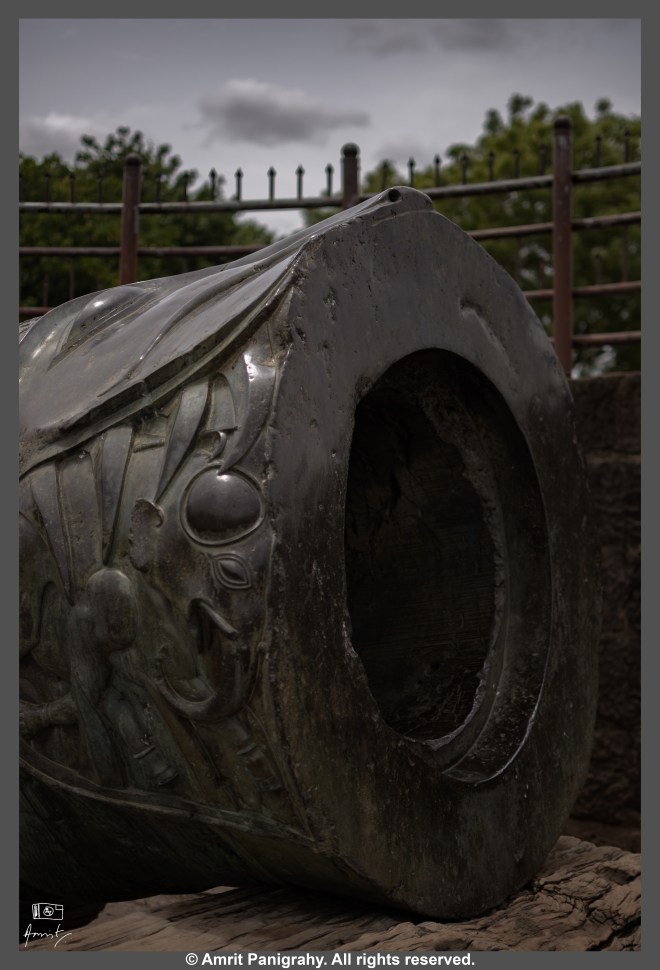
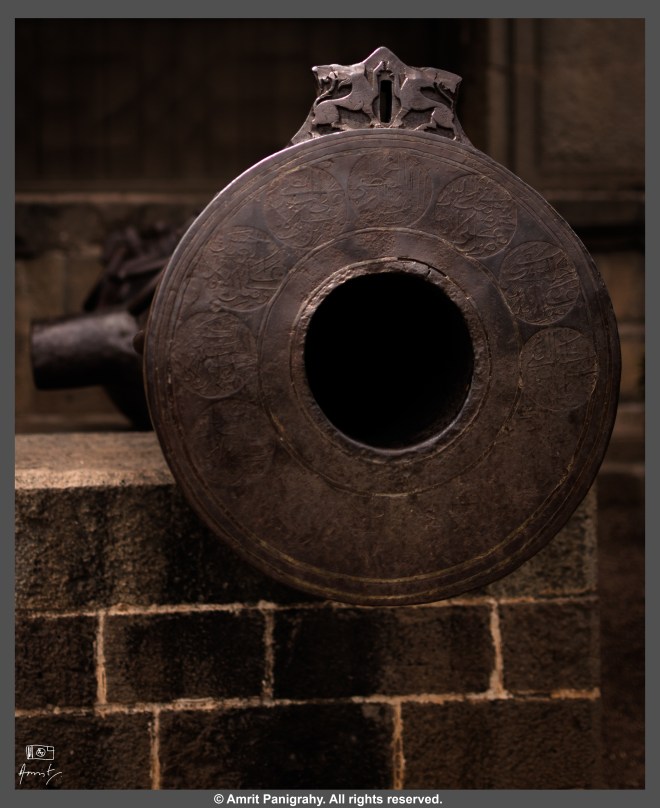
Image: One of the canons outside the museum near Gol Gumbaz, in Bijapur, Karnataka, India

The Marathas had fought alongside the Deccan sultanates in the battle of Talikota against the Vijayanagara empire. However, events leading up to Bijapur’s alliance with the Mughals during Shah Jahan’s campaign against the Nizam Shahis of Ahmednagar saw Shahji’s Maratha forces fighting for the sovereignty of the Nizam Shahis. During this campaign Shahji is credited with the decimation of the combined Mughal and Adil Shahi forces manifolds larger than that of his Marathas. Unfavorable turn of events would see Shahji accepting Adil Shahi supremacy and being deputed to manage the jagir of Bangalore, further south.

Shahji would then send his son Shivaji and wife Jijabai to manage his jagirs in Pune. Driven by the vengeance to correct the injustice done to his father by the Adil Shahis, Shivaji would start taking over Bijapur territories, capturing his first fort at a tender age of fifteen. Shivaji’s “misadventures” would “compel” Mohammed Adil Shah to let lose his trusted general Afzal Khan, to teach Shivaji a lesson. This decision, as the Adil Shahis would realize later, would cost them dearly.

Afzal Khan was a big man driven by a strong desire to prove his worth. Notwithstanding Afzal Khan’s bravery on battlefields and physical built, he was of questionable repute and on many occasions had used deception to his advantage. Till this point in time, Marathas were unaffected by the ongoing rivalry between Shivaji and Adil Shahis.
Part 2-3 FB

Image: A priest in Tulja Bhavani temple, in Tuljapur, Maharashtra, India

On a relentless pursuit, Afzal Khan would then kill Shivaji’s elder brother Sambhaji using deception, after having asked him to come for negotiations. Sometime later, to provoke and drive out Shivaji, Afzal Khan would attack on the Bhavani temple, in Tuljapur, and Vittala temple, in Pandharpur, desecrating the temples in the process. This was a stark departure from Adil Shahi state policy of religious tolerance and inclusion. These events would slowly turn the tides in favor of Shivaji, when other Maratha clans and sub-clans would rally behind him against the Bijapuri forces, grossly angered and humiliated by Afzal Khan’s actions.

Shivaji would kill Afzal Khan, when the latter would try to kill him using the same tactic he had used against Sambhaji, and in the ensuing battle of Pratapgadh, Bijapuri forces would be annihilated. Even after the defeat of Bijapuri forces in subsequent battles with the Marathas, Shah Jahan would still be respecting his treaty with Mohammed Adil Shah, and would allow the latter rule over a sovereign Bijapur. But this wouldn’t last long.

After Mohammed Adil Shah’s demise, his son Ali Adil Shah II would ascend the throne. Constant fighting with the Marathas had already weakened the Bijapur sultanate by then. And a few years later Shah Jahan would give in to the pressure from Aurangzeb and sanction a war against Bijapur to annex it into the Mughal empire. Ali Adil Shah II would die as the last independent Sultan of Bijapur, in 1672 AD. Mughal’s under Aurangzeb would finally annex Bijpaur in 1686 AD. This would give rise to the last of the three most bitterly fought rivalries of the Indian subcontinent of that millenium, that of Shivaji and Aurangzeb (the first being between Prithviraj Chauhan and Muhammed of Ghor, and the second between Rana Pratap and Akbar).

Conclusion:

There, two centuries of Adil Shahi history of Bijapur in two parts of “Dome Diaries”. It is fascinating how a certain event leads to a chain of events that change the course of time. For example, had Mohammed Adil Shah tried to negotiate with Shivaji instead of using a military commander like Afzal Khan, India’s past and present would have been entirely different.

Unfortunately, we have not been fully appraised of the past that has shaped our present. I have been reading about history of ancient and medieval India for some time now. It fascinates how (un)related events of India of the past that shaped up the India of today, are (conveniently) ignored by our history books. Few weeks ago, I had written a small piece on drawing parallels during medieval India, and called it “Drawing Parallels”. You can read it here.

END OF PART II

Dome Diaries Navigator – Prologue  ||  Part I  ||  Part II  ||  Part III  ||  Epilogue

In frame (in order of appearance): 1) A Canna Red King Humbert flower with Gagan Mahal in the background, in Bijapur, Karnataka, India. Gagan Mahal is one of the many palaces in Bijapur.

2) The corridor outside the catacomb in Ibrahim Rouza, Bijapur, Karnataka, India.

3) One of the many canons outside the museum near Gol Gumbaz, in Bijapur, Karnataka, India. The inscriptions on the face are names of the twelve Imams of the Shia Muslims. This canon is believed to have adorned one of the many bastions on the fort wall, during the reign of Ali Adil Shah I.

4) A priest of Tulja Bhavani, inside the Tulja Bhavani temple, in Tuljapur, Maharashtra, India.

VERY IMPORTANT TO NOTE: Yes, you can share this work with proper attribution. But, please seek permission before using this work (not including the photo), partially or fully. YOU CAN NOT USE THE PHOTO. Believe me, asking is better than ending up in court or facing public shaming on social media. Thanks for understanding.

© Amrit Panigrahy. All rights reserved.

Dome Diaries – Part I: Rise of Adil Shahi, with envy from Delhi?

Dome Diaries Navigator – Prologue  ||  Part I  ||  Part II  ||  Part III  ||  Epilogue

Background:

Black clouds gathered on India’s north western borders adjoining Afghanistan in the middle of 12th century AD. The defeat of Prithviraj Chauhan at the hands of Muhammad of Ghor would create a vaccuum so powerful in the north, that it would suck hordes of invaders. These black clouds as if consolidated into a storm that would batter the Indian sub-continent for almost two centuries.

After having established foothold of Ghurid empire in India, Muhammad of Ghor would leave Delhi and India to his trusted slave and general – Qutbu l-Din Aibak, who would go on to establish the Delhi sultanate under the first dynasty, called the Mamluk or Slave dynasty. The Slave dynasty then would give way to the Khiljis, within a century of Prithviraj Chauhan’s death. The Khiljis would then give way to the Tughluqs in another thirty odd years. The Tughluqs would rule India for another century. Under Muhammad bin Tughluq (of Delhi to Daulatabad fame, also known as the “wise fool”), the Delhi sultanate would reach its maximum size, a size that could rival the Mauryan empire under Emperor Ashoka millenia earlier, or the Mughal empire under Aurangzeb centuries later.

One thing in common between the first three dynasties of Delhi sultanate was the fact that they ruled over this vast expanse of land not as their own, but as invaders. The mindset of invaders and plunderers coupled with insecurities of losing their reigns to their kin or the fear of an uprising by the masses, made most of the early Sultans of Delhi sultanate some of the cruelest rulers the world would ever see. These rulers were so cruel, that even a slightly lenient/tolerant ruler in their comparison will come across as a Messiah. Please refer to Ibn Batuta’s travelogues and other contemporary accounts for better understanding of their cruelty.

Having amassed an empire that could easily rival the largest empires of the world of that time, Muhammad bin Tughluq left it to his trusted generals and governors to take care of the different provinces of his sultanate, before retiring to Delhi. Foreseeing the fading influence of the Sultan, these generals started declaring independence one after the other. No, this wasn’t unusual! In fact, this was the standard practice of the time – Qutbu l-Din Aibak served Muhammad of Ghor, Firuz Khilji (founder of Khilji dynasty) served Qutbu l-Din Aibak’s Mamluk dynasty, Ghiyasuddin Tughlaq (founder of Tughlaq dynasty) served the Khiljis.

The Bahmani Sultanate and emergence of Adil Shahi:

Part 1 Header FB

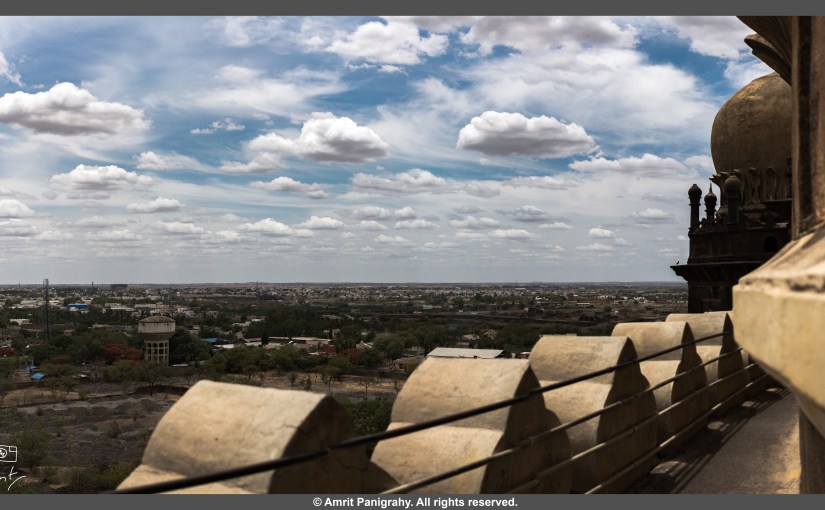
Image: Bijapuri skyline from top of the Gol Gumbuz, in Bijapur, Karnataka, India

As per the norm prevalent at that time, appeared in the scene Ala-ud-Din Hasan Bahman Shah, also known as Hasan Gangu. Bahman Shah was the then governor of Deccan under Muhammad bin Tughluq, and declared independence to establish the Bahmani sultanate, with its capital at Gulbarga (now Kalaburgi) and later moved to Bidar, in Karnataka. Per some historians, Bahman is actually derived from the word Brahmin (the Hindu caste), questionably either because of Bahman Shah’s Brahmin ancestry, or the caste of his earlier master Gangadhar Shastri Wabale (from whom he also got his other name, Hasan Gangu).

Bahman Shah could not have chosen a worse time to lay the foundation of his Bahmani sultanate, as only a decade earlier, further south in the peninsular India had emerged another power – the Vijayanagara empire. For the major part of its existence, the Bahmani sultanate would find itself engaged in mutliple battles with Vijayanagara empire contesting for power and control over land, especially the Raichur doab, before being weakened and disintegrating into five sultanates of Deccan, together called as Deccan sultanates – The sultanates of Nizam Shahi of Ahmednagar, Imad Shahi of Berar, Barid Shahi of Bidar, Qutb Shahi of Golconda and Adil Shahi of Bijapur.

Yusuf Adil Shah, founder of the Adil Shahi dynasty of Bijapur served the Bahmani sultanate before declaring independence. For the next five decades, the five Deccan sultanates would be played against each other by Vijayanagara empire’s diplomacy, before coming together in a confederacy in the battle of Talikota in 1565 AD and defeating Vijayanagara. Vijayanagara empire would not recover from this defeat, paving way for consolidation of power in southern India. Hence, the battle of Talikota is seen as a pivotal point in history of India and southern India in particular. The confederacy of the Deccan sultanates was the brain child of Ali Adil Shah I, the fifth Sultan of Bijapur.

Off the topic, but worth mentioning here that the battle of Talikota also saw the Nizam Shahi of Ahmednagar pressing Malik-e-Maidan, the largest canon of its time into service.

MM-2 FB

Image: Malik-e-Maidan the second largest medieval canon in India, which now adorns a bastion on the western wall of the fort, in Bijapur, Karnataka, India

Consolidation:

After having tackled the dangers to the south, the Adil Shahis under Ali Adil Shah I and later Sultans, focused on consolidating their power, through a clever combination of marriage alliances (with Nizam Shahis of Ahmednagar and Qutb Shahis of Golconda) and military campaigns (against Barid Shahis of Bidar).

The plundered wealth from Vijayanagara gave the Adil Shahis the much needed capital infusion at the end of a very tumultuous period. The wealth was used to launch numerous ambitious projects under succeeding Sultans. The absence of any real threat for the next eight decades meant that the Adil Shahis focused more on culture, and art and creation of architectural marvels.

While the Adil Shahis were busy consolidating their powers to the south of Vindhyas, the Mughal empire under Akbar was making steady progress into peninsular India, having subdued Malwa and Khandesh in the process. Here, again a precious piece of history is lost as a footnote in the history books, because some historian mistook Akbar and Delhi for India.

I have been reading about history of ancient and medieval India for some time now. It fascinates how (un)related events of India of the past that shaped up the India of today, are (conveniently) ignored by our history books. Few weeks ago, I had written a small piece on drawing parallels during medieval India, and called it “Drawing Parallels”. You can read it here.

END OF PART I

Dome Diaries Navigator – Prologue  ||  Part I  ||  Part II  ||  Part III  ||  Epilogue

In frame (in order of appearance): 1) Cotton candies and Bijapuri skyline, from top of Gol Gombuz, Bijapur, Karnataka. Gol Gombuz is the second largest freestanding dome in the world. The outer as well as inner side of the dome is accessible through staircases inside the minars on all four sides of the structure.

2) Malik-e-Maidan, the second largest medieval canon in Indian subcontinent. Made of five metals, this canon weighs 55 tonnes and had a range of 3-5 kilometers. Noticed closely, you can notice the legs of a horse (signifying the canon’s range), an elephant body (signifying the canon’s weight), inside a lion’s mouth (signifying the canon’s roar when fired). Originally cast by the Nizam Shahis of Ahmednagar in 1549 AD, the Malik-e-Maidan now adorns a bastion on the western wall of the Bijapur fort.

VERY IMPORTANT TO NOTE: Yes, you can share this work with proper attribution. But, please seek permission before using this work (not including the photo), partially or fully. YOU CAN NOT USE THE PHOTO. Believe me, asking is better than ending up in court or facing public shaming on social media. Thanks for understanding.

© Amrit Panigrahy. All rights reserved.