Jagannath Series – Part II: The Krishna Connection

Today is Niladri Bije, the last day of the Rathjatra festival when the three siblings – Lord Jagannath, Devi Subhadra and Lord Balabhadra enter the temple after coming back from their annual outing to their aunt’s place. No one stops the other two siblings from entering the temple, but when Lord Jagannath approaches the temple gates, his wife Devi Lakshmi closes the gates and does not allow him to enter. She is angry with Him, as He didn’t take Her along when He went out nine days earlier. Like any other husband, Lord Jagannath has to pacify Her with gifts. And He gifts her Kheermohan, a sweet made of chhena, that somewhat looks like His eyes. The modern name of Kheermohan is Rasagola (or like Bengalis would prefer calling it, Rosogulla). Now, that I have put down facts which prove that Rasagola is infact an Odia delicacy, let us move to a rather more serious topic, that of Lord Jagannath’s origins.

“Niladri” means blue mountain in Sanskrit, and “Bije” means climbing. It is believed that the original Jagannath temple was built on a blue mountain. The current Jagannath temple was built on the same site as the original one.

After the Mahabharata, the Yadavs went extinct after killing each other in a fratricidal war. Lord Krishna had one last “leela” to take care of, before the end of the Avatar. The last “leela” had one more character – Jara, reincarnation of Angad, son of Bali from Ramayan, and a tribal hunter in his current life. Angad was given a boon in the previous life by Lord Ram, who had killed his father Bali, that he would get his chance to avenge his father’s death.

One hot afternoon, Lord Krishna was resting under the shade of a tree. Jara, who was out hunting, from behind the bushes mistook Lord Krishna’s toe for the ear of a deer, and shot an arrow. The arrow proved fatal for Lord Krishna, and the Avatar came to an end. Thus, Jara avenged his father’s death.
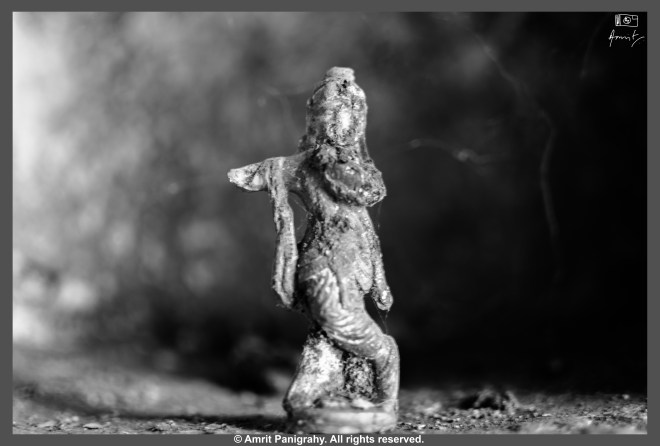
Krishna Connection

Image: Remains of a statue of Lord Krishna in a dilapidated building near the Ananta Padmanabha Sway temple, in Ananthagiri, Telangana, India. 

Lord Krishna’s dear friend Arjun was called for His cremation. At the end of it, everything else except Lord Krishna’s heart had turned into ash. Arjun then picked up his dear friend’s heart, put it inside a neem log with Shankh (conch), Chakra (disk), Gada (mace) and Padma (lotus) symbols on it (the four symbols of Lord Vishnu, of whom boh Sri Ram and Sri Krishna were avatars), and floated it in the sea.

That piece of log with Sri Krishan’s heart in it voyaged through the sea, from Dwarka on the west coast to Puri on the east, and eventually took the form of the first Lord Jagannath. How it took the form of Lord Jagannath is a tale for another time. Wait! Did I say “first” Lord Jagannath? Does it mean that there were many Lord Jagannaths? Much to your astonishment, the answer is yes!

Every twelve to nineteen years Lord Jagannath reincarnates into a new body, in an event called Nabakalebara. During Nabakalebara, the “brahma” or the “tattva”, the life of Lord Jagannath, which is said to be the heart of Lord Krishna, is placed in a new body, and the old body is cremated. Him going through the cycles of life and death highlights the fact that everything that is here on Martyalok (as Earth is also called in Sanskrit, where death is inevitable) has to function by the rule of the land. More on Nabakalebara is also a tale for another time.

/Disclaimer: Based on legends, folklores and part fiction/

In frame: Remains of a statue of Lord Krishna in a dilapidated building near the Ananta Padmanabha Swamy temple, in Ananthagiri, Telengana, India.

VERY IMPORTANT TO NOTE: Yes, you can share this work with proper attribution. But, please seek permission before using this work (not including the photo), partially or fully. YOU CAN NOT USE THE PHOTO. Believe me, asking is better than ending up in court or facing public shaming on social media. Thanks for understanding.

© Amrit Panigrahy. All rights reserved.
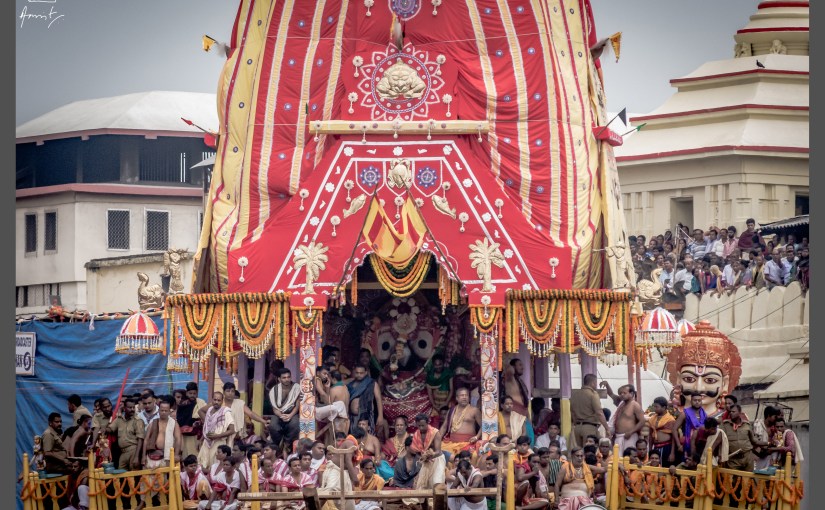
 

Jagannath Series – Part I: Master of the Universe

There is hardly any lingusitic tribe in India, which relates to any particular God like Odias relate to Lord Jagannath. Being an Odia myself, I grew up in the midst of Jagannath culture. Most part of a religious Odia’s life (and majority of us are quite religious) revolves around Lord Jagannath, to the extent that the first invitation card of any auspicious occasion from an Odia household goes to Him. In even the smallest villages of Odisha, you will find a Jagannath temple, and all the rituals/festivals being observed as it happens in the Jagannath temple of Puri. Oh, and yes! For those of you unaware, it is said Odias observe thirteen festivals in a year i.e. in twelve months, and almost all of them are someway or the other related to Lord Jagannath.

Jagannath FB

Image: Lord Jagannath on his chariot Nandighosh, on His way to His aunt’s place during Rathyatra. 

So, what is it with the Odias and this seemingly “physically incomplete” deity? Wait! Did I just call a God “physically incomplete”? Well, I am allowed to. Because, although his name translates to “Master of the Universe” and Kings sweep his chariot, Lord Jagannath is as much a friend to all Odias, as he is God. He inspires as a friend, philosopher and guide to every Odia in true sense, to the extent that He lives like a human, His wife fights with Him like any other man’s wife, and He also dies like a human to take birth again. And He is also known as “Patitpavan”, which translates to “He who lifts the downtrodden”.

Among all the things that Lord Jagannath is to Odias, most importantly He is the pride, He is The Odia identity. And He is the ultimate symbol of valiant resistance by this tribe against attacks and oppression by foreign invaders – from Turks to Afghans to Mughals. The Jagannath temple in Puri has been attacked twenty times, over the centuries. And the tremendous belief that Odias put on Him can not be described in simple words. Why not! I mean, no other God is accessible, like Lord Jagannath is.

When a King was marching on a mighty kingdom to the south, He answered the King’s prayers, came out and marched ahead of the King’s army, and fought on the King’s side. When a low caste devotee was not allowed inside the temple to offer his prayers, Lord Jagannath himself walked down from his temple to accept his devotee’s offering. When his favorite devotee was not allowed inside the temple because he was a Muslim, Lord Jagannath made sure that His chariot stops in front of His favorite devotee’s tomb every year during Rathyatra.

Today happens to be “Bahuda”, the day of homecoming from His annual outing to his Aunt’s place. Well, that is what Rathyatra is all about! Didn’t I tell you in the beginning that He is more human than any God can be? At the same time, Rathyatra is also about meeting all those who could not pay Him a visit at His abode. And it is said, if you see Lord Jagannath on his chariot only once, you are free from the cycle of life and death and will attain Moksh.

True Master of the Universe, don’t you think?

And what better day to start a series on Him and related tales, legends and history (which also includes that of Konark, by the way), than on the day of His homecoming. Get ready for the “Jagannath series”, all of you!

Jai Jagannath!

In frame: Lord Jagannath on His chariot Nandighosh, on the way to His aunt’s place during Rathyatra 2017. Rathyatra is also one of the largest congregation of humans in the world.

VERY IMPORTANT TO NOTE: Yes, you can share this work with proper attribution. But, please seek permission before using this work (not including the photo), partially or fully. YOU CAN NOT USE THE PHOTO. Believe me, asking is better than ending up in court or facing public shaming on social media. Thanks for understanding.

© Amrit Panigrahy. All rights reserved.

Sees it all!

“Chaka aakhi sabu dekhuchi”, is a popular saying in Odia. Which translates to “Lord Jagannath sees it all”. Chaka in Odia means round, Aakhi in Odia means eyes. Notice His round eyes.

When I was in Puri last month, I had mentioned that I was planning to visit Puri during Rathyatra. Well, here is a secret! I was not planning, I had actually promised Him. 26 years were too long a gap, you see. You can read about my last month’s visit here.

Reached here in Puri, just in time to see the annual outing of the Gods, the Rathyatra of 2017. Saw Him gracefully moving towards his chariot (we call it Pahandi in Odia), with his crown (called Tahia in Odia) moving back and forth as He moved. I was quite far off when this was happening, at least couple of hundred meters, may be more. But as He appeared out of the temple main gates, the atmosphere was filled with cries of His name all around. And guess what, I am the first person from my whole family to witness it happening in front of my eyes (as confirmed by my father).

He sees it all!!
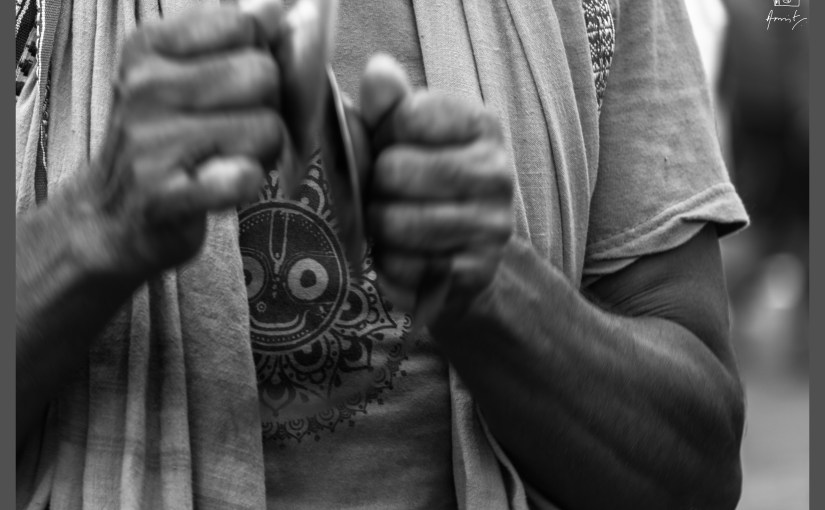
Lord Jagannath on a devotee’s t-shirt as he plays his Gini (a traditional Odia music instrument).

The energy on the Grand road (called Bada Danda in Odia) was so much, I saw people dancing for hours (you read that right!) to folk songs from all over Odisha, as well as to the tune of drums (dhol and mridang) and khanjanis (see picture to know what it is). It was like a rave party from another age. And it was as if they were drawing their energy from an eternal source, may be it was Him as He smilingly moved towards them on top his chariot. Because, what I saw there today is not humanely possible. You got to see it to believe it. And boy, was it overwhelming for me. Add to it all the people around (my estimate is half a million, at least), a perfect recipe to get disoriented (in a good way), call it trance!

There were a lot of traffic restrictions all around the town, so I walked all the way, and the last few kilometers were barefoot on the beach as the waves played hide and seek. By the time I reached back at my hotel, I must have clocked 15 kilometres, all in a days walk.

Now, as I sit in my hotel room and write this, I was thinking. How about I bring to you all the tales, legends, facts and stories about Lord Jagannath, that I know? Also, how about stories of Konark? You know that the construction of the Sun temple in Konark was related to events that unfolded in Puri, right?

So, let’s call them “Jagannath series”.

Signing off from Puri, land of Lord Jagannath!

In frame: Lord Jagannath on a devotee’s t-shirt as he plays his khanjani (a traditional Odia music instrument). You can see Him anywhere you want. You just need to look harder. And He sees you, all the time.

VERY IMPORTANT TO NOTE: Yes, you can share this work with proper attribution. But, please seek permission before using this work (not including the photo), partially or fully. YOU CAN NOT USE THE PHOTO. Believe me, asking is better than ending up in court or facing public shaming on social media. Thanks for understanding.

© Amrit Panigrahy. All rights reserved.
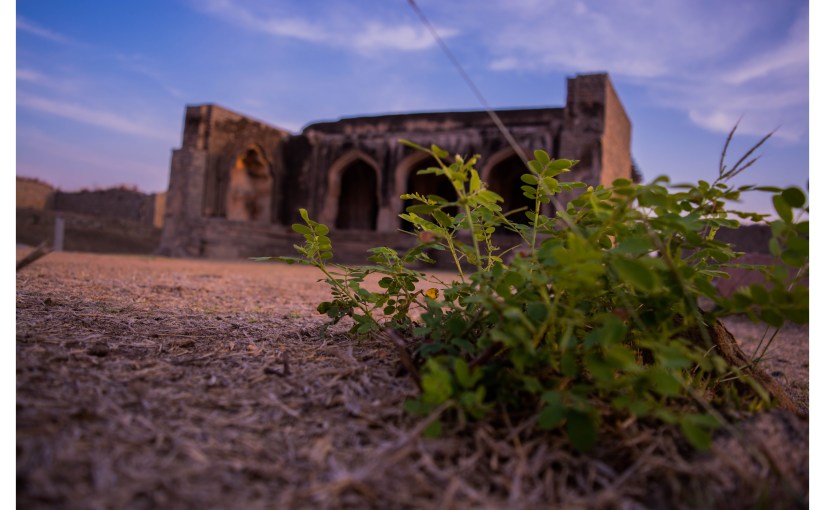
Arsalan’s last prayer

The instructions were very specific. The client wanted the knife to be extra sharp, and dipped in deadly poison. Just to be doubly sure. So that, even if the knife didn’t kill him, the poison definitely would. And it had to be on a Friday, a day Arsalan devoted completely to his God, a day he didn’t touch his weapon and wore no armor.

Arsalan, a warrior of Persian decent and a Muslim, was a general in the Vijayanagara army, Vijayanagara’s chief military strategist and commander of its famed artillery and cavalry units. A middle-aged battle hardened man, he had won many battles for Vijayanagara, with his unquestionable loyalty to the King, his valor and strategies.

He was born in Persia to an unmarried woman and was left to his own fate after his mother died. While fending for himself in the streets of Isfahan, he had heard tales of a place called Hindustan. After having saved enough, he traveled to Hindustan at the age of thirteen, and was hired by a Turkish noble as a help. Few months later, his master had taken him in a hunting expedition. This is when a Lion sneaked in to the camp on one night. He killed the lion with nothing but a knife, and he was just fourteen. This is from where he got his name – Arsalan, Turkish for lion. And he never looked back from that day on.

A man without any family, Arsalan used to be a hired hand till few years back, a commander of a group of merceneries with their loyalty only to the highest bidder. He fought many battles on the side of the highest bidder, saw many atrocities being committed in the name of religion, and God.

During his last assignment as a hired hand, he was to join the forces of the Sultan of Berar, who was mounting an expedition on an empire of infidels to the south, the Vijayanagara empire. It was on a Friday that the battle was fought. Arsalan, had never in his entire life seen such brave soldiers, the soldiers of Vijayanagara. Arsalan killed hundreds of them and they still kept coming. At the end, the army of the Sultan of Berar was defeated, and every single one of Arsalan’s merceneries were killed and he himself was grieviously wounded. Left for being dead, he was rescued by the soldiers of Vijayanagara and was taken to the capital Hampi for better treatment of his wounds. He was impressed by the fact that the Vijayanagara had citizens from all faiths, including Muslims – and was not an empire of infidels, as was being portrayed.

When he recovered, grew stronger and was ready to leave, the King requested his presence in the court. The King, who himself was impressed by Arsalan’s military tactics earlier, asked him to join the Vijayanagara army as a general, and promised him religious freedom, among other things. Arsalan couldn’t deny the offer being made by his savior. Arsalan also took a vow that he will not pick up his weapon on Fridays, as a mark of respect to the brave soldiers of Vijayanagara he had slayed on the same day, in the earlier battle.

His presence in Vijayanagara army meant that Sultan of Berar couldn’t win even an inch of land to the south. So, the Sultan had hired an assassin to get rid of him.

On that fateful Friday, while coming back from the mosque, the assassin in the guise of his bodyguard, stabbed him in the neck. Even before he could know what had happened, Arsalan was on the ground. He could see the mosque at a distance, the mosque which his infidel King had ordered to be built for him.

Slowly, the voices around him faded and he slipped into darkness…

That was the last prayer Arsalan ever offered!

4. The last prayer of Arsalan Pathan 17 Mar Final

DISCLAIMER: This is a work of fiction. Any resemblance to any person living or dead is purely coincidental.

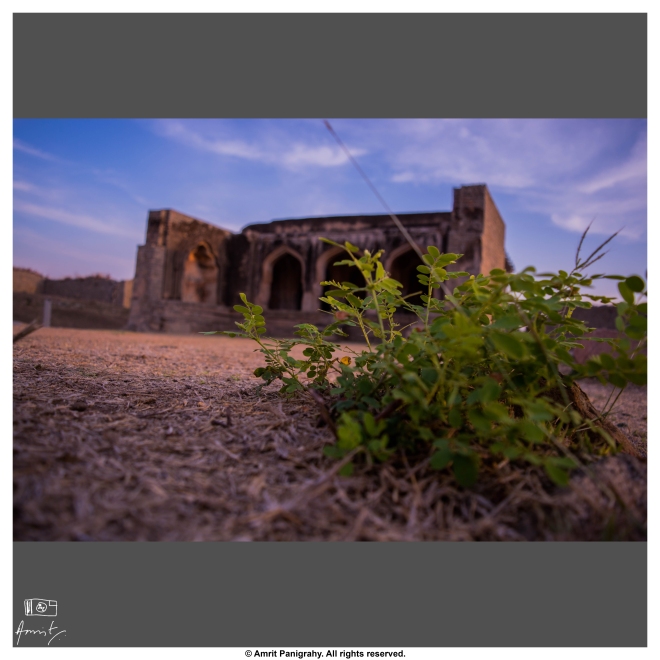
In frame: A low angle of the mosque inside the palace complex, in Hampi, Karnataka, India.

VERY IMPORTANT TO NOTE: Yes, you can share this work with proper attribution. But, please seek permission before using this work (not including the photo), partially or fully. YOU CAN NOT USE THE PHOTO. Believe me, asking is better than ending up in court or facing public shaming on social media. Thanks for understanding.

© Amrit Panigrahy. All rights reserved.

I was there…. Waiting for you!

I waited there, under our pine tree,
And I went there for many more days,
Hoping you would come one day.

It was futile, I was told,
And that you would never be back.
But, I wanted to give it a try.

I wanted to give it a try,
Just so when my time comes,
I won’t feel that I did not wait enough.

And when I realized many springs later,
That you would never come,
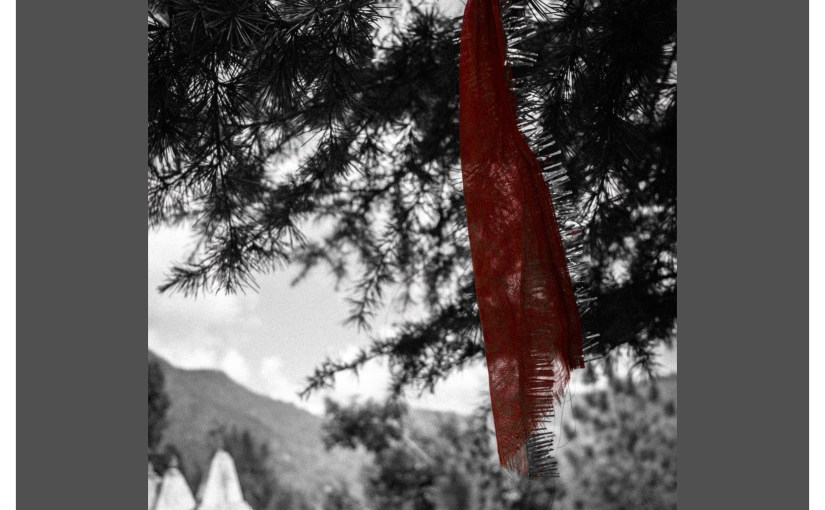
I left there the scarf you had given me.

The scarf, my only piece of memory of you,
For it had your scent, as fresh as dew,
It was the only thing that I had of you.

As I wanted to let you know,
Just in case you showed up..
….That…

I was there…. Waiting for you!

————————————————

DISCLAIMER: Penned by yours truly, this poem is a work of fiction. Any resemblance to any person living or dead is purely coincidental.

In frame: A ritualistic scarf tied to a pine tree in the Himalayas, on the way from Naitala to Guptakashi, in Uttarakhand, India. I found small temples dedicated to local Gods as well as such ritualistic things, common place in the Himalayas.

VERY IMPORTANT TO NOTE: Yes, you can share this work with proper attribution. But, please seek permission before using this work (not including the photo), partially or fully. YOU CAN NOT USE THE PHOTO. Believe me, asking is better than ending up in court or facing public shaming on social media. Thanks for understanding.

© Amrit Panigrahy. All rights reserved.
A wait too long!

It was a mad rush inside the temple. And owing to my short height, it was impossible for me to have a glance at the deities, let alone having a good look. So, I tugged at my father’s shirt and asked him to pick me up and hold me in his arms so that I could take a good look. I was curious to understand what was all the fuss about these three half-finished deities sitting on that raised platform. And he picked me up! I saw He had a pleasant smile on His face, His big round eyes seeing everything, and His arms extended to embrace everyone.

I was 9 when I last had the opportunity to go see Lord Jagannath and His siblings in His abode in Puri. Year 1991 was the year of Godavari Pushkaram, the most recent one being in 2015. Hindus consider it auspicious to take a dip in the waters of Godavari during that time. And it is considered to be even more auspicious if you visit Jagannath Puri after the holy dip in Godavari. So, we did! Needless to say, it was a road-trip – from my hometown in southern Odisha, to Rajahmundry on the banks of Godavari, in Andhra Pradesh, to Jagannath Puri in Odisha and back to my hometown.

We were staying in one of my uncle’s house in one of the narrow by lanes of Puri. Those were the days when there were no mobiles and no internet, and in the name of TV channels we had only Doordarshan. Unlike kids of today, we had no option but to have fun. So, my parents did not have to pester me and my brother to get ready to go out with them to explore Puri. I have only faint memories of Puri. What I strongly remember from that evening however, is the feeling of not feeling one’s legs from all the walking. The year was 1991!

Jagannath Temple, Puri
Street outside the Jagannath temple in Puri, Odisha, India. It is called Bada Danda in Odia, literally translating into Grand Road.

Then I “grew up”, and started having a “life”. I travelled the length of coastal Odisha many times, but never got a chance to revisit Puri. Then, like any other good Hindu, I blamed it on Him – “Jagannath hasn’t called me to visit him yet”. And in the meantime, 26 years went by.

Lord Jagannath and his siblings are as human as Gods can get. As human as visiting their aunt every year (Rathyatra) to getting ill after spending too much time in the water (Snana Yatra) to fighting with the spouse (Hera Panchami) to leaving the old body and consecrating into a new one (Nabakalebara).

While the previous deity of Lord Jagannath (which existed before the Nabakalebara of 2015) was considered to be very tolerant towards human behaviour, the current deity of Lord Jagannath is considered to be action-minded and an angrier one at that. It was only wise to stop blaming Him for not visiting and pay him a visit in his abode, I thought.

So, I visited Him after 26 years. And guess what! He looked all the same to me, like He did when I was 9 years of age. The same pleasant smile on His face, His big round eyes seeing everything, and His arms extended to embrace His whole creation. He is cool, I realised! May be a little but upset with me because I took 26 years to come back, but He was cool!

This being the month of May, it was very humid inside the temple. And because of the repair work going on in the Jagamohan (the assembly hall in front of the sanctum sanctorum), devotees are not allowed to have a closer look. Yes, His abode needs repairs too! That’s why I said He is as human as a God can get.

My visit to Puri lasted for only 90 minutes. Getting a glimpse of Him was my only purpose in Puri this time, and I was glad that I succeeded. And I realised that He calls us all the time, it is us who fail to comply and blame Him instead.

I plan to visit Puri again during Rathyatra this year, to relive my childhood memories, and after doing so bring you back the stories of Lord Jagannath and Puri.

Jai Jagannath!

In frame: Street outside the Jagannath temple in Puri, Odisha, India. It is called Bada Danda in Odia, literally translating into Grand Road. Kindly bear with lower quality of this photo. It was taken using my mobile and not my DSLR, as I am carrying only my 35mm film SLR this time as part of a challenge to myself.

VERY IMPORTANT TO NOTE: Yes, you can share this work with proper attribution. But, please seek permission before using this work (not including the photo), partially or fully. YOU CAN NOT USE THE PHOTO. Believe me, asking is better than ending up in court or facing public shaming on social media. Thanks for understanding.

© Amrit Panigrahy. All rights reserved.
Why travel?

//राही बन//

आराम और सुविधाओं से भरी बेरंग ज़िन्दगी जिएगा कब तक?
निकल बाहर और राही बन, रास्ते को बना अपना घर,
भाग उस मंज़िल की तरफ, जिसका पता ना मुझे है, ना तुझे
जा.. जी अपनी जिंदगी, क्यूँ की उम्र बाकी है बहुत कम..
ऐसी बेरंग ज़िन्दगी जिएगा कब तक?

One for the road
An empty stretch of road between Ujjain and Mandav, in Madhya Pradesh, India after almost 25-30 kms of non-existent roads.

I will admit! For me, travel had always something very tempting about it. My father, who is an avid traveller himself, sowed the seeds of love for travel. And when I was a kid, my mother (who is a History major) would tell me bed time stories about Xuanzang, Faxian, Ibn Battuta and Captain James Cook, and I would lie on the bed imagining myself as an explorer/traveller. Though I have not come too far from those bed-time-stories days, I think it has been good start, although late.

I have been able to cover only a small fraction of this magnificent land. For a starter, I have been breathless on Khardung La in the Himalayas, and have been dwarfed by the majestic mountains in Kedarnath, and have almost frozen in the waters of Gangotri, and have been mesmerised by the Ganga Aarti in Rishikesh. I have criss-crossed central India hopping from heritage sites to religious places, and have been wowed by Kailash temple in Ellora and paintings of Padmapani and Vajrapani in Ajanta, and have been transcended into another dimension while watching Bhashmaarti in Ujjain. I have been lazy in a Goan monsoon, and also have been awed by the magnificence of Hampi. I have crawled up and down in the coffee estates in the Western Ghats, and have also seen the calmness of the sea in Rameshwaram, and have been on the Vivekananda rock to see the three seas meet.

Wait! That’s not all. I have driven my beat Maruti 800 to places. I have ridden my Pulsar 200NS for thousands of kilometres. I have taken my Scorpio on multiple multi-thousand kilometre road trips, and have been on the roads for days together.

Ahaa… Wait! That’s not all, either. I have been stuck on the highway with a cyclone approaching. And as I spent my night in the car and the eye of the cylcone came really close, the howling gale almost blew the car away. And at least on two occasions I have been stranded on the road, surrounded by flood waters, and water levels slowly rising all around me. In such situations the natural choice boils down to either survival (an animal instinct) or humanity (that differentiates us from animals). In the small village I was stuck in on one occasion during the floods, there were at least two hundred more people stranded. And all of us were fed well by the villagers, without being charged a single penny. Without any idea how long the floods will last, wasn’t it brave of those villagers?

Had I been confined, I will not be having these wonderful experiences to share, correct? The travel experiences have shaped me into the kind of human I am at present.

Why I travel, explained in 3 P’s:

Places: Only words and pictures will not do justice to the places I have been to and the stories behind them. The befitting tribute to those places can only be paid by visiting and experiencing them first hand. How on earth can someone tell how it feels to be starved of oxygen at five and a half kilometres above mean sea level? Or, how it feels when water at sub-zero temperatures hits the calvaria? Or, how it feels being stranded in the eye of a cyclone and the gales are about to blow away your car?

People: The great explorers of the past were not dumb to have travelled the world and learn nothing. Humans learn best from experiences of other human beings. And what better way to meet new people other than travel? I have never seen more honest people than the Laddakhis. Being fed by villagers during the floods and for free was the best gesture any human to have ever showed me. I have had instances of total strangers coming and talking to me when I was on a ride to Odisha on my Pulsar 200NS and in the course of the conversation, telling me about places of interest nearby, or about the road that lay ahead. And, people are not always pleasant. I have also been conned many times during my travels. I call them “learning experiences”.

Passion: I am the happiest when I am on the roads, away from my desk, away from my flat. Only someone with love for travelling will understand this. Good news is, there is no way you will not fall in love with it after you start travelling. I mean, I wasn’t born with this love either. And those selfies at beautiful places are a bonus!

Few points of wisdom:

Something always goes wrong when one travels. It is the risks that make travelling even more enticing. Here are a few things that I keep in mind when I am travelling:

Time: When travelling, I always keep time in hand, and utilize it to the fullest extent. I divide my travelling days and set realistic targets for the same. Seeing places is a serious business, you see!

Lights (while self-driving): I have done a fair bit of driving/riding under the lights and have come to a conclusion that it is not worth it. It is a proven fact that human reflexes while driving are much less effective under artificial light. Then there is always the risk of unsocial elements, ghosts and unsocial-elements-dressed-as-ghosts at night. I hate ghosts and hence I try my best to avoid night driving. Pun intended!

Money: Not all places have ATMs. And post demonetisation, not all the ATMs dispense cash. I carry just enough to survive and overcome an eventuality and much less than an amount that will tempt someone to kill me. As a rule of thumb, I would start my day with Rs 5000, and replenish it back to that level at start of each day.

Maps and research: I carry a road atlas as a back up to the map on my phone. Most of the times, I do my route and stoppage planning beforehand. The most fun part of travel preparation is setting up an itinerary. I call it research!

When in doubt, I lie: If it is a self-driven road-trip, when asking for directions I always ask directions to the next big town on my route, and not to my destination. When the stranger I am speaking to does not seem right, or is too inquisitive, or both, I just cook up a story. Believe me, it is not a sin to lie when it comes down to safety. And I have a thing against serial killers!

Have fun: When something goes wrong, and something always goes wrong, I don’t get bogged down by the incident and look at the brighter side, instead. Remember, if you have no control on the outcome of a crisis, have a good time while having the crisis.

I also admit that I am yet to see the world, and have experienced just a fraction of what so many other people might have. Although late, I am glad to have started travelling. And travel I will!

Finally, let me repeat the wise words from John A. Shedd for you – “A ship in harbor is safe, but that is not what ships are built for.”

So, what are you waiting for? Pack your bags, and get out of the house. Go Now!

Credits: Poem at the top penned by your’s truly!

Note: Please get in touch if you have difficulty in reading Hindi, and would prefer an English translation of the poem instead.

In frame: A stretch of good road between Ujjain and Mandav. We stopped here to straighten our backs after 25-30kms on non-existent roads. Yes, that happens in a Scorpio too!

VERY IMPORTANT TO NOTE: Yes, you can share this work with proper attribution. But, please seek permission before using this work (not including the photo), partially or fully. YOU CAN NOT USE THE PHOTO. Believe me, asking is better than ending up in court or facing public shaming on social media. Thanks for understanding.

© Amrit Panigrahy. All rights reserved.
Could you repeat that, Mr Capa?

“If your pictures are not good enough, you are not close enough.” – Robert Capa

Well, that’s what Robert Capa said. But, who was Mr Capa?

Robert Capa was the “greatest combat and adventure photographer” in history. If you are not in the photography business or have got nothing to do with cameras, you would probably not know him. An accidental photographer like many of us, he becamse a legend because of the way he dealt with his profession – dedication and commitment.

The said quote was in the context of war photography. Robert Capa lived and died during an age when there were no fancy photographic equipment. And in that age, more often than not, one had to walk in to the thick of action to get that appealing frame. We are talking about bombs going off all around, bullets whizzing past ears. That thick of an action! And it was this “getting close” part which helped Capa in capturing some of the most dramatic photographs of the wars that he covered.

How is the quote relevant for me in this age, when we have all the fancy equipment we can think of: super-zoom telephoto lenses, the best sensors, and what not? How is it relevant for me when I have not seen a live combat in my entire life? Combat as in when people are trying to kill each other! And most importantly, how is it relevant in my life? Read on for the revelation!

Capa’s quote in the context of photography:

On a scale of one to telephoto lenses, how lazy are you? That’s a weird scale, isn’t it? Not when we are discussing photography.

First, let’s all agree that photography is all about interactions with subjects. Alright? The goodness of the photograph is directly proportional to how well the photographer has interacted with the subjects. If the broad genre is people, then it becomes interaction with people, and if the broad genre is wildlife and/or nature, then it becomes interaction with the nature (insects, trees, birds and animals included). Simply put, the photographer needs to get involved with her/his subjects. And one cannot get involved with the subjects without getting closer, can (s)he?

For me, capturing people was always difficult. I was shy by nature. I was not comfortable talking to strangers. For this reason, most of the times I came across as arrogant. When I say capturing people, I do not mean staying in my comfort zone, taking out that telephoto lens and start capturing people from far off. And then, out of those thousands of photos chose one that is reasonably good and call it “candid”. Well, nothing wrong in that! Nothing wrong other than the fact that I would be bull-shitting, if I say “I capture people”. So, to challenge myself, I took up making portraits.

The photographs where the subjects look right at the viewer, I find these photographs as most intriguing. I feel these are the photographs which connect with the viewer instantly. And to capture those, the subject must be aware, and one needs to abandon all the inhibitions and ask for permission from a total stranger. That is the thrill part!

And that is the level of involvement (“getting close” in Capa’s words) one needs, irrespective of the genre of photography. All or nothing, I tell you!

With time, as I develop my skills of making a portrait, I am also developing my people skills. Now, I do not mind approaching a total stranger and ask for permission to make a portrait. If it is a “yes”, you can see the result in the portrait above. And if is a “no”, I take it in the stride and keep working on my smile.

While making portraits, how do I know how close is close enough? Well, definitely not so annoyingly close that I am encroaching my subject’s personal space. But close enough to capture the right emotions.

Below is yours truly in action, while making the portrait above. That close is close enough, I think.

IMG_3305

I have never been caught in action, except for this one time, all thanks to my good friend Amit Kumar Singh.

Capa’s quote in the context of life:

I am going to tweak that original quote slightly.

“If your life is not interesting enough, then you are not living it from close enough.”

Well, you are alive, aren’t you? And what part of “being alive” do you find not interesting?

More about Robert Capa:

Capa lived and died in an age when there were no fancy photography equipment, in an age when photographers had to “make” photographs. Yes, he died at a young age of 40 back in 1954, when he stepped on a landmine while covering the French Indochina war. He had a love story too! He was engaged to Gerda Taro, another combat photographer, who was killed in the Spanish civil war in 1937. Capa contributed primarily to Life magazine. He clicked some of his most famous photos when he accompanied Allied troops during D-day invasion, in World War II. He was the co-founder of Magnum Photos. For all his association with war and death, here is his second most famous quote:

I hope to stay unemployed as a war photographer till the end of my life.” – Robert Capa

In frame: A flower seller in Gudimalkapur flower market, Hyderabad, Telangana, India. I initiated the talk by asking if I could take pictures of the marigold flowers she was selling, and she agreed. After the photographing the marigolds, I asked if I could make her portrait, and she agreed but said it is going to cost me. So, we bargained and settled for a “nominal” amount. So much for people skills.

Also, I have used a 3-step Brenizer technique here, for the first time. These are three photographs from top to bottom merged in to one.

VERY IMPORTANT TO NOTE: Yes, you can share this work with proper attribution. But, please seek permission before using this work (not including the photo), partially or fully. YOU CAN NOT USE THE PHOTO. Believe me, asking is better than ending up in court or facing public shaming on social media. Thanks for understanding.

© Amrit Panigrahy. All rights reserved.