In search of “Nothingness”

Bira (pronounced as Bee-raw, meaning brave in Odia) was born into a Brahmin family, in a Brahman Sasan. In Odisha, a Brahman Sasan is a village where every family is Brahmin. He grew up witnessing the monster called Brahmin supremacy and the twisted, distorted Hindu Sanatan religion. Tired of it, he and few of his friends went to Joranda and embraced Mahima Dharma. That was seven decades ago.

The allegation that was levelled against Bira was that he had converted and was no more a Hindu, so he and his family need to pay a fine to continue to stay in the village, to which Bira sternly refused. As a result, his family was banished from their ancestral village. One of main reasons was, even after being a Brahmin himself, Bira had challenged their supremacy. All other families of the village were asked to not keep any kind transaction with his family.

In the meantime, a letter was written to the high seat of Hindus in Jagannath temple, in Puri, asking them to advise a future course of action in Bira’s case. To which, they replied that it was settled long back and Mahima Dharma was very much a part of the Sanatan Hindu fold. After the ban on Bira’s family was lifted, having his point proven he chose to stay back in his ancestral village fighting further religious atrocities and intolerance, till he left for a city close by for his children’s education few decades later.

Bira Panigrahy was my grandfather. Of the group of people who embraced Mahima Dharma on that day, more than seven decades ago, only my grandfather continued to be a follower till his death. Any history of my association with Mahima Dharma would be incomplete without mentioning the brave man who was much ahead of his time. As I sat down to write this post, devotional songs written by the blind poet Bhim Bhoi and sang by Mahima devotees rang in the background. The devotees, even though having full time professions, accompany the monks  wherever they go. They were at our home as we were conducting something known as a “Balyaleela”, a yagna of sorts. The occasion this time was my grandfather’s death anniversary.

As per the teachings of Mahima Swamy (as the Master of Mahima Dharma is called), a human doesn’t need any intermediaries to reach the Supreme. All humans are born equals despite caste, creed, color, race, gender and religion. That there is only one God, the Supreme, who is shapeless and colorless, the nothingness in other words. The Supreme resides in every living and non-living being and everything resides in the Supreme. Mahima Dharma is a form of Vishisht Advaita, where every living being is respected equally. Followers of Mahima Dharma worship the nature and the universe, the nothingness within and without, and pray for well being of every living being of the universe.

The Offering
A Mahima monk accepting a coconut being offered by a follower of Mahima Dharma at “Dhuni Mandir”, the temple of fire in Mahimagadi, at Joranda, Dhenkanal, Odisha. The offered coconut will be burned in the holy fire.

The monks of Mahima Dharma as directed by Mahima Swamy himself follow an extremely ascetic lifestyle. For example, when they visit the houses of devotees, they not allowed to stay for more than a night, and are not supposed to go inside the house. They eat under the open skies, and are not allowed to sleep on beds for the rest of their lives. Giving up basically everything that would even remotely qualify as modern comfort. They have only one task at hand, spread the message of the Master, and in the process move ahead in their spiritual journey.

When I was on a road trip with parents in Odisha few months back, something strange had happened. After having spent few minutes in the Indralath temple, in Ranipur-Jharial, we came out and were getting ready to get inside the car. A drunk shepherd approached my father from nowhere, and told him “A Mahima monk had come here many many years ago when I was a kid. And he hosted a “Balyaleela” (a ritual done on special occasions), and there were lakhs of people.” There were no identifications either on my father or on our car which suggested that any of us were a follower of Mahima Dharma. The followers of Mahima Dharma are a very very small fraction of the total population.

Before that, when I had gone to see Puri during Rathyatra last year, I received a call from an unknown number. On the other side was a Mahima monk who visits our family very often. “Have you become a Jagannath devotee?”, he asked me, when on being asked I told him that I was in Puri. Worshiping deities, shapes or  forms is forbidden in Mahima Dharma.That the monk had called me for the first time ever, when I had come to see Lord Jagannath had to mean something; also, what the drunk shepherd was mumbling in front of the Indralath temple.

The celestial message was clear to me. I had to go visit the Mahimagadi, the seat of Mahima Dharma at Joranda, in Dhenkanal, Odisha. And what better time than the annual Maghmela, on the full moon day in the Hindu month of Magh.

On 31 January, 2018, Joranda was a mission accomplished!


VERY IMPORTANT TO NOTE: Yes, you can share this work with proper attribution. But, please seek permission before using this work (not including the photo), partially or fully. YOU CAN NOT USE THE PHOTO. Believe me, asking is better than ending up in court or facing public shaming on social media. Thanks for understanding.

© Amrit Panigrahy. All rights reserved.
The year song


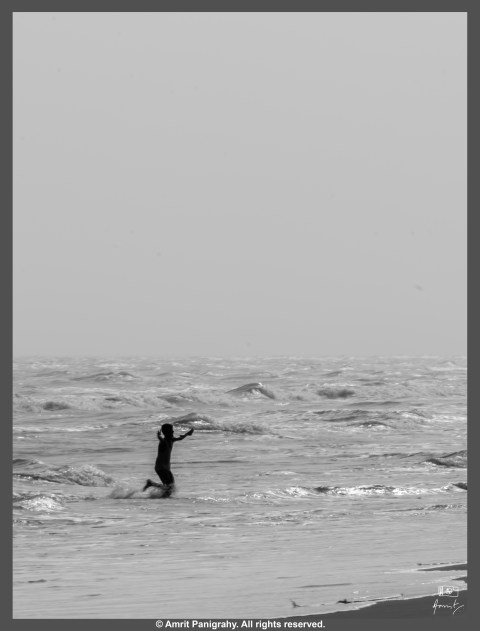
Riding the waves
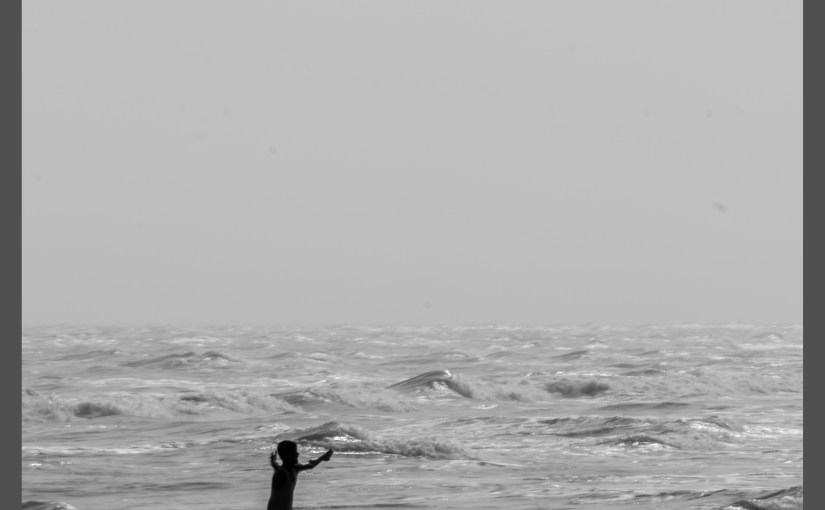
A young man running back to the shore from the sea

A song for the year, I had promised to write,
Taking time out in the middle of the night,
Thoughts rusty, and not organised so well,
But an year it was and many tales to tell.

So, here it is!

Before the year started, in hindsight it was like…

Retreating waves pulled me back to the sea,
Like vices in whose vice like grip I was in,
Vices I left behind on my way to the coast,
And to those no one would raise a toast.

With questions and no answers I started my year,
A start with much less joy and surely a lot of fear,
As if I stepped into the unknown blindfolded,
Fear of an uncertain future, and what lay ahead.

It was the best one ever. To sum it up…

I travelled ten thousand kilomeres on road,
To new places about which I had never heard,
Met people I would never see in my life again,
But memories of a lifetime, of joy and of pain.

I let go of the hands that I never thought I would,
Stopped missing people I never imagined I could,
Worked on myself and learned to be with me,
Had I felt bored with myself, I was in bad company.

Started to see every living being for what they were,
My lack of compassion, and it was totally unfair,
Biggest lesson was on empathy and to be able to relate,
Thank my stars I learned in time, and it wasn’t too late.

The universe has been very kind to me in return,
A lot of gifts and people with best intentions,
Gifts that will stay with me for my entire life,
People who will stay and will help me thrive.

When the waves pulled me, I came back riding them,
Stronger, wiser, calmer, compassionate and brave.

Now with 2017 behind me, here is my 2018 wish for you….

May you have my 2017, if not better than that,
I wish this for you from the bottom of my heart.

Call it a rhyme or a poem, this is my year song,
A song, I won’t mind humming whole life long.


2017 was a life changing year for me, with a lot a of changes for good. This is how good a year it was, in my own words, as a poem.

In frame: A young man running back to the shore from the sea, near Baruva, in Andhra Pradesh, India.

VERY IMPORTANT TO NOTE: Yes, you can share this work with proper attribution. But, please seek permission before using this work (not including the photo), partially or fully. YOU CAN NOT USE THE PHOTO. Believe me, asking is better than ending up in court or facing public shaming on social media. Thanks for understanding.

© Amrit Panigrahy. All rights reserved.
64 Yoginis – And a message to my father

The 64 Yogini Temple:

Ranipur Jharial was the first stop on the recent road-trip I did with my parents in Odisha. We reached here after a gruelling 6 hours drive from my home town. The 64 Yogini temple of Ranipur Jharial in Bolangir district in Odisha, is one of the only 4 such temples dedicated to 64 Yoginis that exist in the whole country. Two of them are in Odisha – the other one in Hirapur, near Bhubaneswar.

The 64 Yogini temple is located atop small hill, which is a single rock spread over many acres. On that rock there are also many small temples dedicated mainly to Lord Shiva. What would catch your eye however is the peculiar structure of the 64 Yogini temple.

64 Yogini Temple
The 64 Yogini Temple under the sun on a cloudy day, in Ranipur Jharial, Bolangir, Odisha, India.

It is a circular hypaethral temple. The deities of 64 Yoginis adorn the inner side of the circular temple. The centre of the temple is adorned by an image of three faced Lord Shiva, Adi Yogi himself, embracing his wife Goddess Parvati. This temple is believed to have been built by Somavamshi Keshari kings in 9th-10th century AD. All the deities are made of sandstone.

Lord Shiva
Three faced Lord Shiva at the center of 64 Yogini Temple, in Ranipur Jharial, Bolangir, Odisha, India. I shot this frame using my 35mm Canon FTb QL manual film SLR on an Ilford HP5 Plus 400.

The temple is designed in such a way that energy from all the 64 Yoginis would stay within the circular wall of the temple, and the yogis and sadhaks who did their sadhana here would benefit immensely from the concentrated energy from all Yoginis. The 64 Yoginis also represent 64 types of Siddhis a human can achieve.

The Indralath Temple:

Indralath Temple
The elevation of Indralath Temple from up close, in Ranipur Jharial, Bolangir, Odisha, India.

Another attraction in Ranipur Jharial is the 60ft tall Indralath temple, the oldest and tallest brick temple in Odisha. Also built during 9th/10th century AD by Somavamshi Keshari kings, it is believed that this temple was probably dedicated to Lord Shiva or Lord Vishnu. Interestingly however, the designs and statues on the outer wall of the temple suggest Buddhist influence on the architecture. The statues on the outer wall are made of clay and mud and are burnt to give them longevity, as it was done for the bricks.

The Experience:

Before I started the journey, I was told that it is not advisable and safe to go on top of the hill during the month of Ashadh, or the first month of monsoon, because of the numerous lightning strikes that have happened in the past. We were well past Ashadh, so that was a relief.

64 Yogini Temple
The 64 Yogini Temple, in Ranipur Jharial, Bolangir, Odisha, India. I shot this frame using my 35mm Canon FTb QL manual film SLR on an Ilford HP5 Plus 400.

When I went on top of the rock, near the temple, the first thing I noticed about the place was the calmness, even if it was windy. However, the calmness was only on the surface. The place was full of some mystic energy, as if all the yogis and sadhaks who did their sadhana here left their legacy behind for the later generations to experience. Although there were many things running through my mind, when I closed my eyes, it was as if I got teleported instantaneously into another realm. What happened with my father however, was interesting! And I was a witness.

My father, as were both my paternal grand parents, is a follower of Satya Mahima Dharma, and he has been practising meditation for many years now. One of the youngest sects of Hinduism, quite interestingly, this sect also had 64 Siddh Purush (64 men with Siddhis). Numbering just a tiny fraction of Odisha’s population the followers of this sect do not worship any deity. Very much a part of Hinduism, they believe that to reach the Supreme you do not need any mediums. One of my next projects is to highlight this sect to the mainstream, so look out for that.

Being himself, my father decided to check how it feels to sit in meditation near the 64 Yogini temple. So, he removed his shoes, sat on the platform and closed his eyes and went into a meditative state. And I got busy taking photos. Few minutes later, I got back to him, and by that time he was done. I asked him how was it, and he told me that he could feel some kind of energy. After that we decided to visit the nearby Indralath temple nearby, and it was all fine till then.

It got weird when after having spent few minutes in the Indralath temple, we came out and were getting ready to get inside the car. A drunk shepherd approached my father from nowhere, and said “A Mahima sadhu (a preacher of the sect of which my father is a follower) had come here many many years ago when I was a kid. And he hosted a Balyaleela (a ritual done only special occasions), and there were lakhs of people.”

There were no identifications either on my father or on our car which suggested that any of us were a follower of that particular sect. The practitioners of this sect are very very small fraction of  the total population. To give you all an idea, there are only 2/3 families of this sect in my hometown which a population of at least one lakh. Too much of a coincidence, right?

The only thing that could possibly explain this incident was probably the fact that there are strong energies still existent in the 64 Yogini temple and nearby, and after father meditated there, he “was sent a message” that the path he had chosen for himself (that of Satya Mahima Dharma) is right for him, and he does not need to divert now. We reached at this conclusion after discussing on this incident for some time.

And then we decided to move ahead with our journey, a 2,000km road-trip across Odisha, which turned out to be quite eventful in its own right. More on that later!

VERY IMPORTANT TO NOTE: Yes, you can share this work with proper attribution. But, please seek permission before using this work (not including the photo), partially or fully. YOU CAN NOT USE THE PHOTO. Believe me, asking is better than ending up in court or facing public shaming on social media. Thanks for understanding.

© Amrit Panigrahy. All rights reserved.


Mountain Song

I was unsure and had many questions when I started,
Unable to understand whether to hold on to those who departed.

I tried and any attempt to touch my past was futile,
As from behind the veil it waved at me with a “smile”.

In a failed attempt, I fought with my past in present,
An act that I would never consider to be decent.

I cried as I saw the past slip away, to which I was so attached,
It was a healing process and I thought I was being attacked.

I decided to quit the things that I was doing,
With tears in my eyes I tried a new beginning.

There was one more thing that I had still to let go,
The sense of I, me and mine, which they call the ego.

As I looked at the winding road up the hill,
Towards a destination I hadn’t started still.

It looked like I was a long long way away from my goal,
I decided to climb nonetheless and it started taking a toll.

Shivering while climbing as cold touched my bones,
On the roads I found freshly fallen pine cones.

The pine cones reminded something that I had chosen to forget,
That even those high up also fall and eventually turn to dust.

When hungry, I found fresh apples from a road side garden,
Tastier I am sure than the one had by Eve and Adam.

When I was thirsty I drank from a mountain spring,
A respite that only pure mountain water could bring.

It was the Almighty telling me to relax and not to worry,
And that I would be provided for and I need not be sorry.

The mountains and highlands that people called divine,
When I reached there, I was sure I would be fine.

The mountains were so big, and the snow so white,
And I told myself that the teachers were always right.

Mountains told me to accept that I was puny and the outcome I can’t influence,
I am not even a speck of dust, when it comes to the whole vast universe.

The snows told me that everything here is inherently pure,
And we pollute everything looking for useless cure.

When I came down from the mountains, I was not like when I went,
Left there many things I was attached to, for which I was sent.

I was questioned for the decisions I took and things I left behind,
I told them as long as this did good to me, I really didn’t mind.

Been a year since I came back from the mountains,
And the memory still as fresh as last night’s rains.

Looking back at last year, it all makes sense now,
The answers to my why, what, when and how.

In human terms, this journey has lasted only a year long,
Ode to the mountains and my evolution, this mountain song.

Mountain song
A temple by the mountain road, high in the Himalayas

The poem was penned by me, where I have tried to put in to words my evolution from what I was a year back when I went to the Himalayas.

In frame: A temple by the mountain road high in the Himalayas, on the way from Naitala to Guptakashi, in Uttarakhand, India. I found these small temples dedicated to local Gods as well as such ritualistic things, common place in the Himalayas.

VERY IMPORTANT TO NOTE: Yes, you can share this work with proper attribution. But, please seek permission before using this work (not including the photo), partially or fully. YOU CAN NOT USE THE PHOTO. Believe me, asking is better than ending up in court or facing public shaming on social media. Thanks for understanding.

© Amrit Panigrahy. All rights reserved.

Advertisements

As per the King’s order

“You are hereby commissioned, by the King’s order, to build the largest monolithic statue of our Lord, Shri Ganapati, from the large boulder that is marked by the royal flag, on top of the Hemakunta hill. On completion of this order, which can not exceed three years, you will receive a grant of five villages and the adjoining fertile land from the royal court.”, read the King’s messenger from the order signed by the King himself, as the master sculptor Narasimhulu listened in disbelief.

The messenger went on, “You can employ your own artisans for this order, and all such artisans will be on the payrolls of the royal court. Should you fail to execute this order, this same order will be passed on to your elder son, and you will be convicted of disobeying the King’s order and will be tried of high treason.” That was almost 3 years back, and he had gladly accepted the offer, not that he had too many choices at that time. In all these days, the statue of Lord Ganapati was only half done. With the King’s deadline expiring only a fortnight later, there was no way the order could be executed now. The King had already gotten a temple built around the half-finished statue. And Narasimhulu could not afford even a minute mistake, by increasing the pace of the work.

Knowing he could never complete the order in time, Narasimhulu asked all the artisans to leave. He locked himself inside the temple with the half finsihed statue and decided to starve himself to death.

He prayed to Lord Ganapati, asked for His forgiveness as he was leaving the statue unfinished. In a day or two he fell down in the corner, weakened by lack of food. He thought his end was near and he was hallucinating, as he saw a figure, much bigger than a normal human being, working on the unfinished statue with a chisel and a hammer. Other than his size, all Narasimhulu could notice was his larger than usual ears. He couldn’t see the face of the unknown sculptor, as he had his back to Narasimhulu at all times, and he was himself very weak to walk up and find out.

Meanwhile, in the outer world it was the day when the King’s deadline ended. The King came with all his courtesans and the royal family and found the temple doors locked from inside. He ordered the doors to be broken.

Narasimhulu, very weak from starvation for days, could faintly hear the sounds of heavy objects hitting the temple door from outside. When he heard the door open, he gathered all his energy and opened hi eyes. As light entered the temple, he could see the faces of the statue of Lord Ganapati.

Narasimhulu could see that the statue was complete, as per the King’s order.

Ganesha
Kadalekalu Ganesha, in Hampi, Karnataka, India.

DISCLAIMER: This is a work of fiction. Any resemblance to any person living or dead is purely coincidental.

In frame: Kadalekalu Ganesha, a 4.5 meters tall monolithic statue, located in a temple on the Hemakunta hill, in Hampi, Karnataka, India.

VERY IMPORTANT TO NOTE: Yes, you can share this work with proper attribution. But, please seek permission before using this work (not including the photo), partially or fully. YOU CAN NOT USE THE PHOTO. Believe me, asking is better than ending up in court or facing public shaming on social media. Thanks for understanding.

© Amrit Panigrahy. All rights reserved.


Jagannath Series – Part II: The Krishna Connection

Today is Niladri Bije, the last day of the Rathjatra festival when the three siblings – Lord Jagannath, Devi Subhadra and Lord Balabhadra enter the temple after coming back from their annual outing to their aunt’s place. No one stops the other two siblings from entering the temple, but when Lord Jagannath approaches the temple gates, his wife Devi Lakshmi closes the gates and does not allow him to enter. She is angry with Him, as He didn’t take Her along when He went out nine days earlier. Like any other husband, Lord Jagannath has to pacify Her with gifts. And He gifts her Kheermohan, a sweet made of chhena, that somewhat looks like His eyes. The modern name of Kheermohan is Rasagola (or like Bengalis would prefer calling it, Rosogulla). Now, that I have put down facts which prove that Rasagola is infact an Odia delicacy, let us move to a rather more serious topic, that of Lord Jagannath’s origins.

“Niladri” means blue mountain in Sanskrit, and “Bije” means climbing. It is believed that the original Jagannath temple was built on a blue mountain. The current Jagannath temple was built on the same site as the original one.

After the Mahabharata, the Yadavs went extinct after killing each other in a fratricidal war. Lord Krishna had one last “leela” to take care of, before the end of the Avatar. The last “leela” had one more character – Jara, reincarnation of Angad, son of Bali from Ramayan, and a tribal hunter in his current life. Angad was given a boon in the previous life by Lord Ram, who had killed his father Bali, that he would get his chance to avenge his father’s death.

One hot afternoon, Lord Krishna was resting under the shade of a tree. Jara, who was out hunting, from behind the bushes mistook Lord Krishna’s toe for the ear of a deer, and shot an arrow. The arrow proved fatal for Lord Krishna, and the Avatar came to an end. Thus, Jara avenged his father’s death.

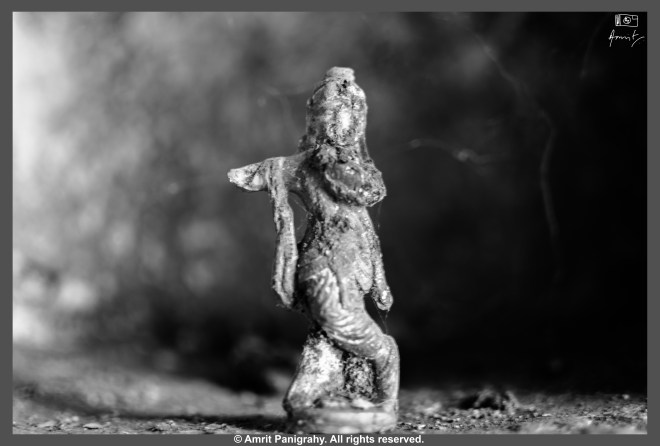
Krishna Connection

Image: Remains of a statue of Lord Krishna in a dilapidated building near the Ananta Padmanabha Sway temple, in Ananthagiri, Telangana, India. 

Lord Krishna’s dear friend Arjun was called for His cremation. At the end of it, everything else except Lord Krishna’s heart had turned into ash. Arjun then picked up his dear friend’s heart, put it inside a neem log with Shankh (conch), Chakra (disk), Gada (mace) and Padma (lotus) symbols on it (the four symbols of Lord Vishnu, of whom boh Sri Ram and Sri Krishna were avatars), and floated it in the sea.

That piece of log with Sri Krishan’s heart in it voyaged through the sea, from Dwarka on the west coast to Puri on the east, and eventually took the form of the first Lord Jagannath. How it took the form of Lord Jagannath is a tale for another time. Wait! Did I say “first” Lord Jagannath? Does it mean that there were many Lord Jagannaths? Much to your astonishment, the answer is yes!

Every twelve to nineteen years Lord Jagannath reincarnates into a new body, in an event called Nabakalebara. During Nabakalebara, the “brahma” or the “tattva”, the life of Lord Jagannath, which is said to be the heart of Lord Krishna, is placed in a new body, and the old body is cremated. Him going through the cycles of life and death highlights the fact that everything that is here on Martyalok (as Earth is also called in Sanskrit, where death is inevitable) has to function by the rule of the land. More on Nabakalebara is also a tale for another time.

/Disclaimer: Based on legends, folklores and part fiction/

In frame: Remains of a statue of Lord Krishna in a dilapidated building near the Ananta Padmanabha Swamy temple, in Ananthagiri, Telengana, India.

VERY IMPORTANT TO NOTE: Yes, you can share this work with proper attribution. But, please seek permission before using this work (not including the photo), partially or fully. YOU CAN NOT USE THE PHOTO. Believe me, asking is better than ending up in court or facing public shaming on social media. Thanks for understanding.

© Amrit Panigrahy. All rights reserved.


Jagannath Series – Part I: Master of the Universe

There is hardly any lingusitic tribe in India, which relates to any particular God like Odias relate to Lord Jagannath. Being an Odia myself, I grew up in the midst of Jagannath culture. Most part of a religious Odia’s life (and majority of us are quite religious) revolves around Lord Jagannath, to the extent that the first invitation card of any auspicious occasion from an Odia household goes to Him. In even the smallest villages of Odisha, you will find a Jagannath temple, and all the rituals/festivals being observed as it happens in the Jagannath temple of Puri. Oh, and yes! For those of you unaware, it is said Odias observe thirteen festivals in a year i.e. in twelve months, and almost all of them are someway or the other related to Lord Jagannath.

Jagannath FB

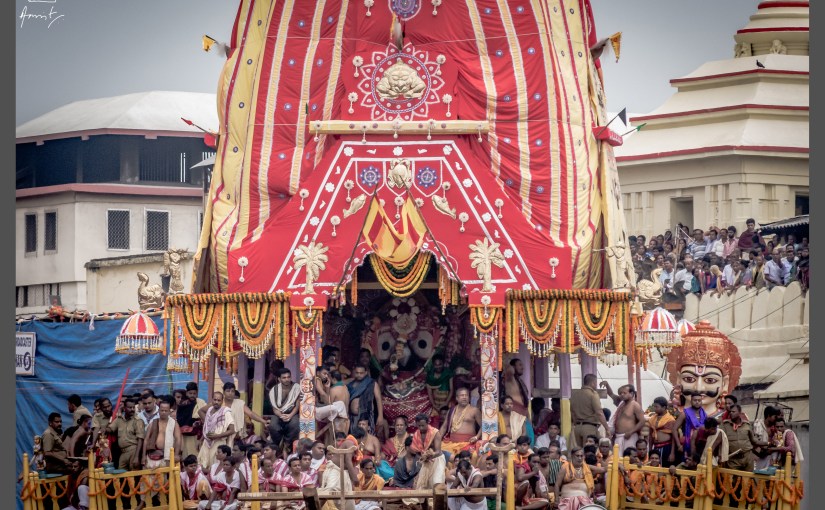
Image: Lord Jagannath on his chariot Nandighosh, on His way to His aunt’s place during Rathyatra. 

So, what is it with the Odias and this seemingly “physically incomplete” deity? Wait! Did I just call a God “physically incomplete”? Well, I am allowed to. Because, although his name translates to “Master of the Universe” and Kings sweep his chariot, Lord Jagannath is as much a friend to all Odias, as he is God. He inspires as a friend, philosopher and guide to every Odia in true sense, to the extent that He lives like a human, His wife fights with Him like any other man’s wife, and He also dies like a human to take birth again. And He is also known as “Patitpavan”, which translates to “He who lifts the downtrodden”.

Among all the things that Lord Jagannath is to Odias, most importantly He is the pride, He is The Odia identity. And He is the ultimate symbol of valiant resistance by this tribe against attacks and oppression by foreign invaders – from Turks to Afghans to Mughals. The Jagannath temple in Puri has been attacked twenty times, over the centuries. And the tremendous belief that Odias put on Him can not be described in simple words. Why not! I mean, no other God is accessible, like Lord Jagannath is.

When a King was marching on a mighty kingdom to the south, He answered the King’s prayers, came out and marched ahead of the King’s army, and fought on the King’s side. When a low caste devotee was not allowed inside the temple to offer his prayers, Lord Jagannath himself walked down from his temple to accept his devotee’s offering. When his favorite devotee was not allowed inside the temple because he was a Muslim, Lord Jagannath made sure that His chariot stops in front of His favorite devotee’s tomb every year during Rathyatra.

Today happens to be “Bahuda”, the day of homecoming from His annual outing to his Aunt’s place. Well, that is what Rathyatra is all about! Didn’t I tell you in the beginning that He is more human than any God can be? At the same time, Rathyatra is also about meeting all those who could not pay Him a visit at His abode. And it is said, if you see Lord Jagannath on his chariot only once, you are free from the cycle of life and death and will attain Moksh.

True Master of the Universe, don’t you think?

And what better day to start a series on Him and related tales, legends and history (which also includes that of Konark, by the way), than on the day of His homecoming. Get ready for the “Jagannath series”, all of you!

Jai Jagannath!

In frame: Lord Jagannath on His chariot Nandighosh, on the way to His aunt’s place during Rathyatra 2017. Rathyatra is also one of the largest congregation of humans in the world.

VERY IMPORTANT TO NOTE: Yes, you can share this work with proper attribution. But, please seek permission before using this work (not including the photo), partially or fully. YOU CAN NOT USE THE PHOTO. Believe me, asking is better than ending up in court or facing public shaming on social media. Thanks for understanding.

© Amrit Panigrahy. All rights reserved.

Dome Diaries – Epilogue

Dome Diaries Navigator – Prologue  ||  Part I  ||  Part II  ||  Part III  ||  Epilogue

When I first thought of visiting Bijapur and started doing my “research”, I was fascinated to find out how the Adil Shahis of Bijapur stayed sovereign for the two centuries, during which a great churning of power was happening across our counry. It was the same two centuries when Vijayanagara to the south, the Marathas to the west and the Mughals to the north were vying for control of the same piece of land.

Part 3-6 FB

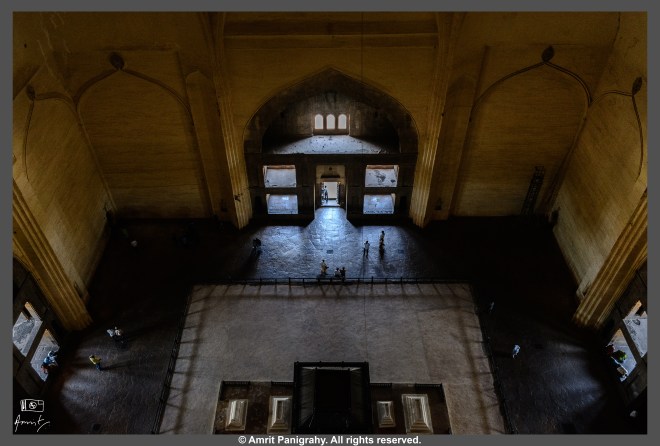
Image: Epitaph of Mohammed Adil Shah, as seen from the balcony seven storeys high, inside the Gol Gumbaz

The things that the Adil Shahi dynasty got right, the things that they got wrong, some pure chance and some meticulous planning. Through this series, I have tried to cover everything that I thought mattered, as far as history of India is concerned. This visit opened up more questions than it actually answered, mostly pertaining to the Marathas. This will mean travelling to the Maratha land, which makes me excited. In due course, I will plan and visit, and whatever happens thereafter, rest assured you will read them here.

Also, customary vote-of-thanks time now! I stayed in “Maurya Adil Shahi” during my visit to Bijapur, a property owned and operated by Karnataka State Tourism Development Corporation (KSTDC). This place had a cordial and helping staff, food was okayish. I was not in Bijapur for food, anyways. KSTDC gives guided tour of Bijapur, for a price. However, I chose to pick a guide on my own. And this is where comes Jehangir, my guide in Bijapur, a learned chap and a patient guide, who answered almost all my questions. And given his hold over Indian history, I had a good time discussing history with him. If you are planning a visit to Bijapur, and looking for a guide, do get in touch with me for his number.

That’s it! Hope you enjoyed the series. And as I plan and cover more of this land, you will get to hear from me, ermmm.. read from me.. Whatever! You got what I wanted to say.

Ciao!

Dome Diaries Navigator – Prologue  ||  Part I  ||  Part II  ||  Part III  ||  Epilogue

In frame: Epitaph of Mohammed Adil Shah, as seen from the balcony seven storeys high, inside the Gol Gumbaz, in Bijapur, Karnataka, India.

VERY IMPORTANT TO NOTE: Yes, you can share this work with proper attribution. But, please seek permission before using this work (not including the photo), partially or fully. YOU CAN NOT USE THE PHOTO. Believe me, asking is better than ending up in court or facing public shaming on social media. Thanks for understanding.

Dome Diaries – Part III: Two and a half tombs, and other things

Dome Diaries Navigator – Prologue  ||  Part I  ||  Part II  ||  Part III  ||  Epilogue

Introduction:

With more than hundred domes of all sizes (the largest of them is 44 mts in diameter, you read that right!), Bijapur is called the “City of Domes”. Of all the structures, the most imposing, intriguing and fascinating are the mausoleums of Ibrahim Adil Shah II and Mohammed Adil Shah, namely Ibrahim Rouza and Gol Gumbaz, respectively. Looks like these Sultans who reigned over Bijapur during its most prosperous period had their mortal life sorted, so they focused more on making their permanent resting places (read tombs) worth staying for a really long long time.

Why tombs-4 FB

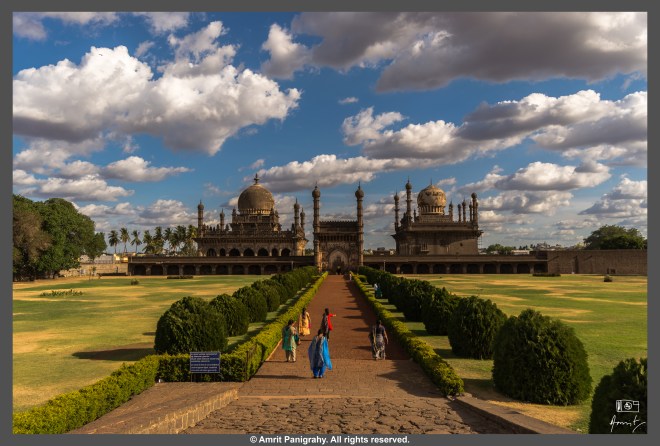
Image: Ibrahim Rouza and the mosque in Bijapur, Karnataka, India under the pre-monsoon cotton candies, as seen from the entrance

Wait! That’s just two tombs. What is half a tomb? Read on, and you will find out.

TOMB I: Ibrahim Rouza

Ibrahim Rouza was originally commissioned by Ibrahim Adil Shah II as a mausoleum for his beloved queen consort, Taj Sultana, at least half a century before the “monument of love”. That’s right! The Sultan probably laid the foundation of the idea to dedicate grand mausoleums to consorts, which culminated in the grandest of them all, the Taj Mahal in Agra. Although he commissioned the mausoleum for his queen, it was Ibrahim Adil Shah II who died first, and was eventually buried there. Hence, it is named after him, Ibrahim Rouza. It is widely believed that Ibrahim Rouza was the inspiration behind Taj Mahal.

Part 3 FB

Image: Ibrahim Rouza in Bijapur, Karnataka, India, as seen up close 

Designed by Persian architect Malik Sandal, this magnificently ornate structure is built of dark grey basalt till the base of the dome. The dome is made of brick and mortar. What makes Ibrahim Rouza stunning is not what is visible from far away, but what is visible from up close. Its walls are filled with fine calligraphy in Arabic, mainly religious. The top portions of the windows also have religious calligraphy in Arabic, but in the form of lattice work on stone. The workers who created these masterpieces would have to be expert craftsmen in lattice work, as well as well-versed with religious scriptures and Arabic.

TOMB II: Gol Gumbaz

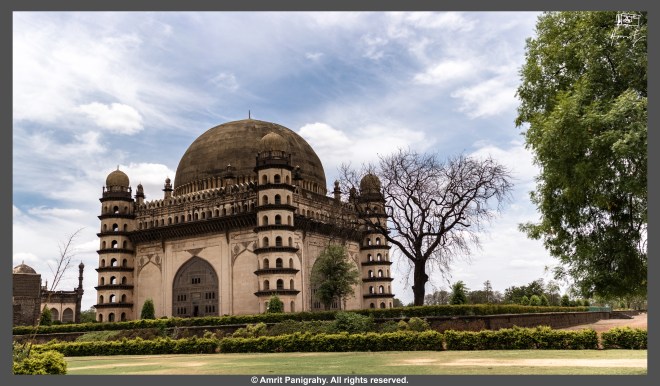
Also designed as a mausoleum by Malik Sandal for Mohammed Adil Shah, son of Ibrahim Adil Shah II, at more than seven storeys high Gol Gambuz is the most iconic structure of Bijapur, and the second largest freestanding dome in the world, measuring 44 meters in diameter. The location was chosen for this grand structure because the builders could use a very large basalt as a foundation for this imposing structure. It is said that it took 20,000 men, 23 years to build Gol Gumbaz.

Part 3-3 FB

Image: Gol Gumbaz, the most iconic structure in Bijapur, Karnataka, India

The technique they used here is interesting – perpendicularly overlapping squares as the base, intersecting arches using interlocking stones till the base of the dome, brick mortar on an wooden false structure for the dome, and the wooden structure was removed once the dome was complete. The thickness of the walls on the ground level is about 15 feets, at the base of the dome it is 10 feets, and the width of the dome itself is 9 feets.

HALF A TOMB: Barakamaan

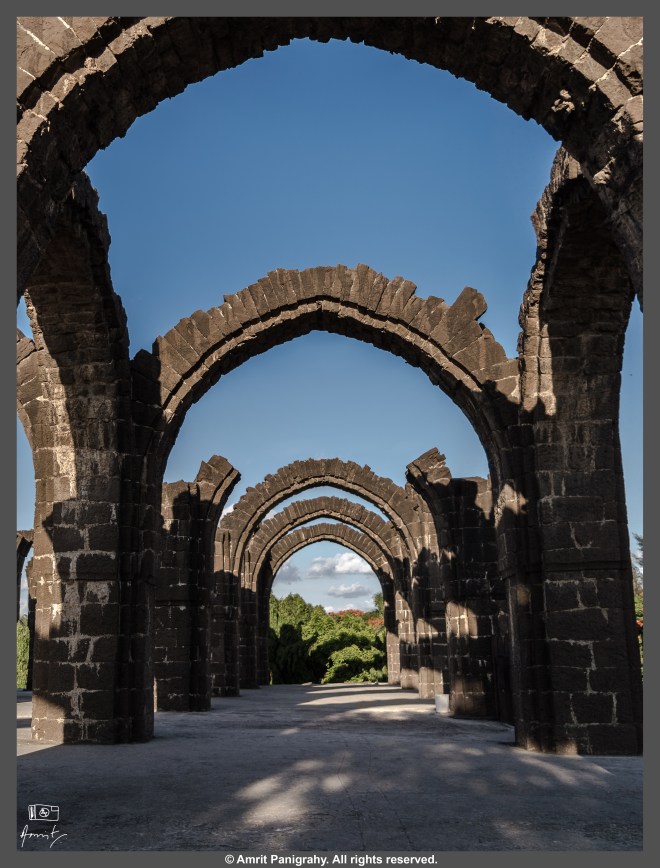
Inspired by his grandfather and father’s mausoleums, Ali Adil Shah II went about starting the work on his mausoleum. Actually planned to be more than twelve storeys high (and hence the name Barakamaan – Bara means twelve and Kamaan means arch) when complete, this structure would have dwarfed the Gol Gumbaz, and could have claimed to be the largest freestanding dome in the world.

Why tombs-2 FB

Image: The arches of Barakamaan in Bijapur, Karnataka, India

Constant power struggle with the Marathas and pressure from the Mughals meant Ali Adil Shah II could not make available all the resources that this mega structure would need to be completed. And as luck would have it, he would die with his mausoleum still unfinished and would be buried there. As he was the last Sultan of Bijapur to die independent, he would continue to lay under the open skies for eternity.

And other things..

Apart from the two and a half tombs, Bijapur also has two palaces – Gagan Mahal and Asar Mahal built by Ali Adil Shah I and Mohammed Adil Shah, respectively. Built in Persian style, these palaces are much less ornamental than the Adil Shahi mausoleums. Usually two stories high, the roofs were supported by wooden beams, made of teak wood. One such beam can be seen lying beside the Asar Mahal. It is said that the last Adil Shahi Sultan, Sikander Adil Shah surrendered in front of Aurangzeb in Gagan Mahal.

Part 3-8 FB

Image: Asar Mahal in Bijapur, Karnataka, India

The initial Adil Shahi rulers mostly followed Shia Islam, until Ibrahim Adil Shah II converted to Sunni Islam in 1552. His father Ali Adil Shah I had built the Jama Masjid, the Mehraab of which was redecorated with gold paintings by his son Mohammed Adil Shah, and is still one of the most decorated Mehraabs in India. The mosque was built to be used for prayers on special occasions. Given that Adil Shah I was born a Sunni but converted to Shia during later years, the Jama mosque did not have an eastern gate, as is the Sunni practice. The eastern gate was a later addition.

Part 3-10 For FB

Image: A guide explains its history to visitors in front of the beautiful Mehraab of Jama Masjid in Bijapur, Karnataka, India

Ali Adil Shah I is also credited with building the citadel and the fort, among other things, especially in the post Talikota period. It was during his reign, and reigns of his adopted son Ibrahim Adil Shah II and Mohammed Adil Shah, Bijapur got its iconic buildings. It was a period when Bijapur bloomed, before fading away in the pages of history.

END OF PART III

Dome Diaries Navigator – Prologue  ||  Part I  ||  Part II  ||  Part III  ||  Epilogue

In frame (in order of appearance): 1)  Ibrahim Rouza and the mosque in Bijapur, Karnataka, India under the pre-monsoon cotton candies, as seen from the entrance.

2) Ibrahim Rouza in Bijapur, Karnataka, India, as seen up close. It is also called the “Black Taj” or the “Taj of Deccan”.

3) Gol Gumbaz, the most iconic structure in Bijapur, Karnataka, India. It is the second largest freestanding dome in the world, measuring 44 meters at diameter.

4) The arches of Barakamaan in Bijapur, Karnataka, India. It was planned to be the much bigger than Gol Gumbaz, and could have claimed the distinction of being the largest freestanding dome in the world. But fate had other plans.

5) Asar Mahal in Bijapur, Karnataka, India. Unlike their mausoleums, the Sultans’ palaces were very simple two storeyed structures.

6) A guide explains its history to visitors in front of the beautiful Mehraab of Jama Masjid in Bijapur, Karnataka, India, which was redecorated in its current golden paint on orders of Mohammed Adil Shah.

VERY IMPORTANT TO NOTE: Yes, you can share this work with proper attribution. But, please seek permission before using this work (not including the photo), partially or fully. YOU CAN NOT USE THE PHOTO. Believe me, asking is better than ending up in court or facing public shaming on social media. Thanks for understanding.

© Amrit Panigrahy. All rights reserved.

Sees it all!

“Chaka aakhi sabu dekhuchi”, is a popular saying in Odia. Which translates to “Lord Jagannath sees it all”. Chaka in Odia means round, Aakhi in Odia means eyes. Notice His round eyes.

When I was in Puri last month, I had mentioned that I was planning to visit Puri during Rathyatra. Well, here is a secret! I was not planning, I had actually promised Him. 26 years were too long a gap, you see. You can read about my last month’s visit here.

Reached here in Puri, just in time to see the annual outing of the Gods, the Rathyatra of 2017. Saw Him gracefully moving towards his chariot (we call it Pahandi in Odia), with his crown (called Tahia in Odia) moving back and forth as He moved. I was quite far off when this was happening, at least couple of hundred meters, may be more. But as He appeared out of the temple main gates, the atmosphere was filled with cries of His name all around. And guess what, I am the first person from my whole family to witness it happening in front of my eyes (as confirmed by my father).

He sees it all!!
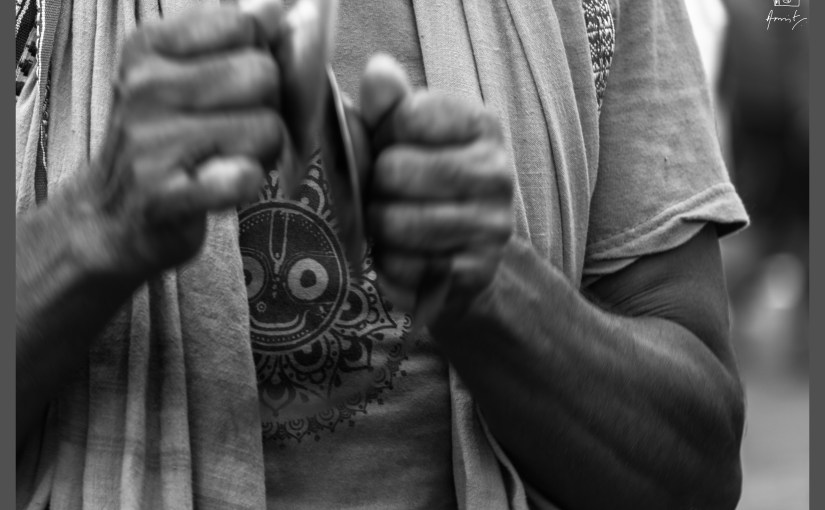
Lord Jagannath on a devotee’s t-shirt as he plays his Gini (a traditional Odia music instrument).

The energy on the Grand road (called Bada Danda in Odia) was so much, I saw people dancing for hours (you read that right!) to folk songs from all over Odisha, as well as to the tune of drums (dhol and mridang) and khanjanis (see picture to know what it is). It was like a rave party from another age. And it was as if they were drawing their energy from an eternal source, may be it was Him as He smilingly moved towards them on top his chariot. Because, what I saw there today is not humanely possible. You got to see it to believe it. And boy, was it overwhelming for me. Add to it all the people around (my estimate is half a million, at least), a perfect recipe to get disoriented (in a good way), call it trance!

There were a lot of traffic restrictions all around the town, so I walked all the way, and the last few kilometers were barefoot on the beach as the waves played hide and seek. By the time I reached back at my hotel, I must have clocked 15 kilometres, all in a days walk.

Now, as I sit in my hotel room and write this, I was thinking. How about I bring to you all the tales, legends, facts and stories about Lord Jagannath, that I know? Also, how about stories of Konark? You know that the construction of the Sun temple in Konark was related to events that unfolded in Puri, right?

So, let’s call them “Jagannath series”.

Signing off from Puri, land of Lord Jagannath!

In frame: Lord Jagannath on a devotee’s t-shirt as he plays his khanjani (a traditional Odia music instrument). You can see Him anywhere you want. You just need to look harder. And He sees you, all the time.

VERY IMPORTANT TO NOTE: Yes, you can share this work with proper attribution. But, please seek permission before using this work (not including the photo), partially or fully. YOU CAN NOT USE THE PHOTO. Believe me, asking is better than ending up in court or facing public shaming on social media. Thanks for understanding.

© Amrit Panigrahy. All rights reserved.