दरवाज़े, जिनकी चाबी उसी के पास ही थी,
कुछ एक मेरे लफ्ज़, जो वो ही थी समझती,
समझ जाती थी ज़ुबान खामोशियों की भी,
सांसे उसके लिए जैसे सरगम किसी गाने की।
एक दिन ऐसा आया, वो बोली में चली जाउंगी,
तुम्हारी कुछ आदते हैं जो मैं कभी सह ना पाउंगी,
क्या पता उसको के सबसे बड़ी आदत वो खुद थी,
मेरे दरवाज़े की चाबी,
मेरे अनसुलझे लफ्ज़,
मेरी सांसे,
और मैं….
वो खुद थी…….
हां, वो उसकी आदत थी ।। Yes, she was his habit
A Hindi poem, this one talks about the closeness and the “used to” kind of bond the lovers share, so much so that when the lady decides to leave citing few of the man’s habits that she can’t tolerate anymore, it turns out that the man considers her his biggest habit, as his key to happiness, as his unspoken words, even as his breath and he himself.
I have to admit that owing to time constraints and many ongoing projects, I am unable to give time to creative writing as much as I should. So, after a long time, here it is.
VERY IMPORTANT TO NOTE: Yes, you can share this work with proper attribution. But, please seek permission before using this work (not including the photo), partially or fully. YOU CAN NOT USE THE PHOTO. Believe me, asking is better than ending up in court or facing public shaming on social media. Thanks for understanding.
“Dear Sons of the Sages! Lord Shiva has come and granted you boons. Give up everything else and do this service. If you do this service, you can make the impossible possible, parboiled rice and fried green gram will sprout, dried wood becomes a living tree, childless mothers bear children, blinds get vision and old people become young again.”
It was the Hindu month of Chaitra and I was driving by a village in southern Odisha. While passing, by I heard the sound of the drums and the grave tune was potent enough to teleport you into another dimension. It had to be, for it was meant to please the fiercest forms of Shakti and Shiva – Goddess Dandakaali and Lord Rudra, respectively. As I grew curious and stopped the car, my father told me it was Danda Jatra, pronounced as thuh (as in “the”)-wn-daw zaat-ra, literally meaning the festival of punishment.
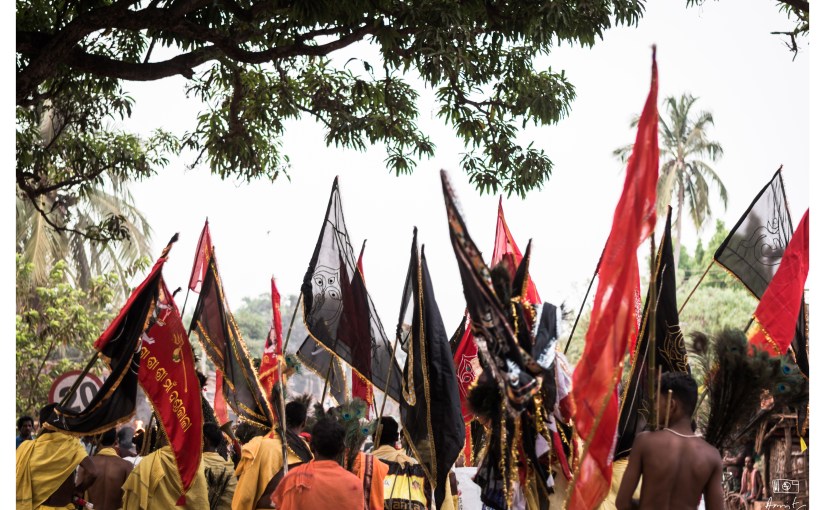
Drummers beating a very grave tone, announcing the arrival of Danduas to villages from far off.
Danda Jatra traces back its origins to more than a millennium ago, when it found importance in the Tantrik practices of a predominantly Shakta (worshippers of Shakti) Kalinga of 10th century AD, or thereabouts. Danda Jatra is by the farming community and for the farming community, cutting across all castes, and revolves around the daily life of a farmer. In simple words, the practice revolves around the age old tradition of “barter”, wherein in this case the Dandua (as the people who take part in this festival are called) asks for a few wishes to be fulfilled by Goddess Dandakaali and Lord Rudra and in return promises to spend 13, 18 or 21 days in penance and abstinence (the punishment), spreading the message of Shiva and Shakti.
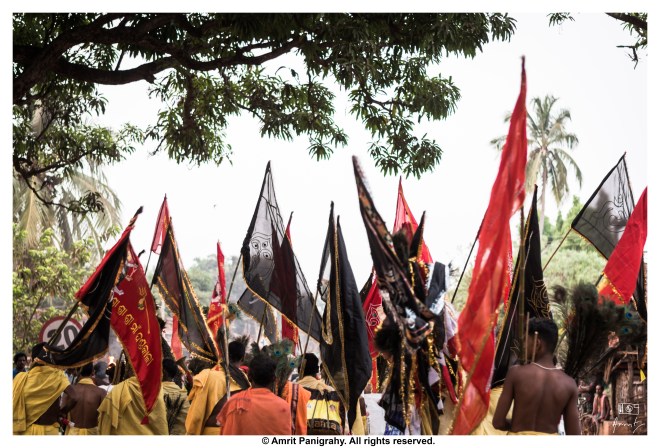
Danduas walking past a village in a procession holding these flags, to the beat of drums, and spreading the message of Shiva and Shakti.
Every team comprises of 13 Danduas and there are more than 300 teams in existence today. From the start, for 21 days the Danduas abstain from any kind of indulgence like meat (of all kinds), liqour and physical intimacy with their partners. On the strike of midnight of the first day, they take bath in the village pond, wear saffron colored clothes and congregate near the village temple. After a few rituals Hara-Gouri (basically Shiva and Shakti) are consecrated as two holy sticks (also called Danda in Odia). Then they light the holy fire by (you guessed it right!) rubbing two bamboo sticks against each other, and this holy fire remains lit till the end of the festival. I saw them roaming around in villages with the holy fire and the consecrated sticks, and blessing households and shops as the walked along.
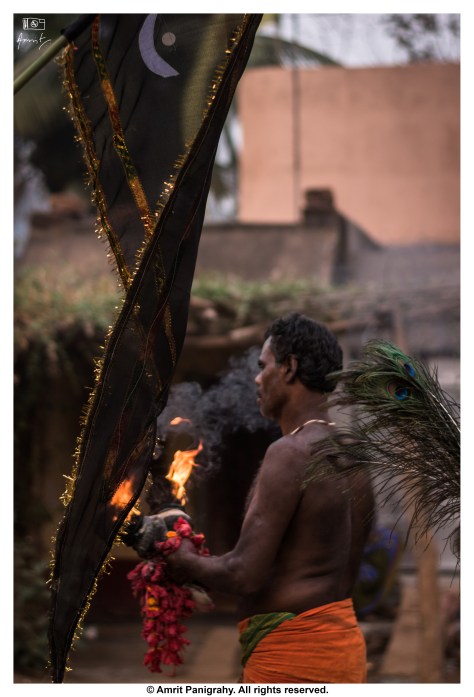
A Dandua carrying the holy fire around the village, to bless the households and shops. The holy fire is kept lit for whole 21 days.
They go around giving performances in villages upon invitation, and through the use of comedy and light-heartedness (sometimes vulgar), they spread serious messages from the scriptures, about ways of life and righeousness. When they perform on the dirt, it is called Dhuli Danda (Dhuli in Odia means dust), and when it is in the water, it is called Pani Danda (Pani in Odia means water). And then there is something known as Danda Suanga, which usually starts around midnight and continues well into the morning next day.
I had heard about it as a kid and had seen it a couple of times when I went to the villages with my father. I had the opportunity of watching Dhuli Danda this time. The Danduas had made square shaped farmlands on the ground, by lying down on the dirt, and one of them acted as a farmer, who used two of them as oxen to cultivate the farmland and then planted seeds. And so the daily life of a farmer continued.
The Danduas on the dirt are mimicking farmlands, and two running towards the camera are acting like oxen cultivating the farmlands. The Dandua behind them acting as the farmer.
Danda Jatra is one of the toughest festivals to take part in for the Danduas, high summer temperatures, lack of sleep, off-schedule and mainly midnight rituals, and just one full meal take a toll even on the most seasoned of them. The meal that is prepared is neither grinded nor boiled, and is offered to Goddess Dandakaali and Lord Rudra first. The Danduas have the food after that in the dead of the night, outside the village and amidst the deafening sound of the drums. They are not supposed to hear any sound while eating, not even that of a bird chirping. If they hear any such sound, or find any impurity in their food, they won’t take that food and stay hungry that night.
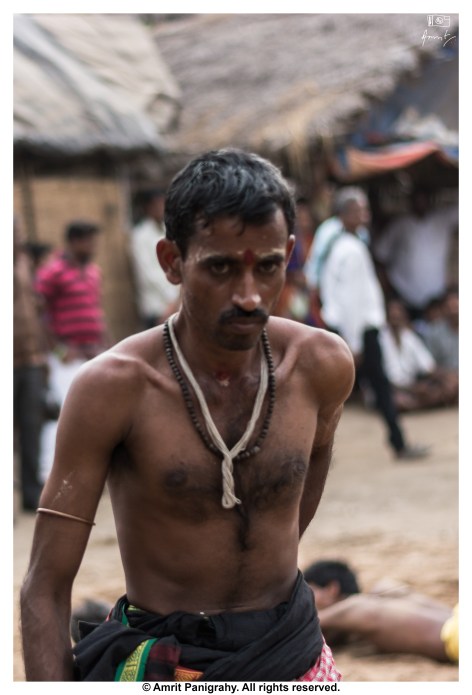
A Dandua sitting on the road exhausted. High summer temperatures, lack of sleep, off-schedule and mainly midnight rituals, and just one full meal take a toll even on the most seasoned of them.
On the day of Vishubh Sankrati (the day when Sun crosses the equator and moves into the northern hemisphere), also the last day of the Danda Jatra, the Pata (Paa-taw) Dandua, the leader of the team who wears only black, plays an important role. It is said that Goddess Dandakaali herself possesses him, and then he is tied upside down with holy fire lit right below his head. Sal tree resin (locally called Jhuna) is thrown into the fire repeatedly and it creates a lot of smoke. Amidst loud chantings, it is repeated till the Pata Dandua bleeds from the nose and exactly three drops of blood fall in the holy fire right below. This signifies Goddess Dandakaali having accepted the offerings, and the Danda Jatra culminates.
The Pata Dandua plays a very important role in the Danda Jatra, and acts as the medium of communication between Goddess Dandakaali, the Danduas and the villagers.
Danda Jatra is a religio-spiritual practice, and is held with reverence and much fanfare in rural southern Odisha, even after a millennium since it started. Modernity has influenced it in many ways. And, my quest for knowing the practices around Danda Jatra more intimately, and bringing them out to the larger audience, remains a medium-term project.
Jai Dandakaali!
VERY IMPORTANT TO NOTE: Yes, you can share this work with proper attribution. But, please seek permission before using this work (not including the photo), partially or fully. YOU CAN NOT USE THE PHOTO. Believe me, asking is better than ending up in court or facing public shaming on social media. Thanks for understanding.
Dear Lord of the blue mountain, trample and subjugate my restless mind, like a mighty elephant destroys a lotus pond. Thus save me!
– Bhakta Salabega
Salabega (pronounced Saa-law-be-gaw), one of the greatest devotee of Lord Jagannath was a Muslim by birth. He wrote very beautiful devotional songs dedicated to the Lord. Bhakta Salbeg’s era dates back to about half a century after Kalapahad (yes, I will tell his story too, but that’s for a different time!) had wreaked havoc on Odias, in the early 1600s. Odisha was reeling under Mughal rule. Lalbeg was the Mughal subedar of the Odisha province at that time.
While returning from a conquest, Lalbeg fell for the beauty of a bathing Brahmin widow near a place called Dandamukundapur (which is near present day Sakhigopal between Bhubaneshwar and Puri). Lalbeg forcefully took away the Brahmin widow to his harem and married her. Bhakta Salabega born in 1607/08 AD was their only child. After growing up, Salabega accompanied his father to many military conquests. In one such battles Salabega was grievously injured.
On his death bed, Salabega listened to his mother who was still a Jagannath devotee and started praying to the Lord. By the grace of the Lord and under his mother’s care Salabega had a miraculous recovery and became Lord’s devotee for life. After recovery from his injuries Salabega went to Puri for Lord’s darshan but was turned away from the temple for his religion of birth. Heartbroken Salabega left for Vrindavan hoping that he would have the Lord’s darshan around a year later during Rathyatra.
When Salabega was returning to Puri during Rathyatra a year later, he fell ill midway. He was very disappointed, as now he would have to wait for another year to be able to see Lord Jagannath. So he started praying, and Lord Jagannath being how He is, obliged and His chariot Nandighosh didn’t move even an inch from where it was, till Salabega didn’t reach Puri, and was able to see Him in his own eyes.
After his death, Salabega was cremated at the same spot on Puri Badadand (grand road) where Nandighosh had stopped. His samadhi still stands there, and it is customary for Nandighosh, Lord’s chariot to stop in front of Salabega’s samadhi during Rathayatra.
Bhakta Salabega wrote many beautiful devotional songs dedicated to Lord Jagannath, each of those equally expressive of a devotee’s devotion and His greatness. “Ahe nila shaila”, pronounced “Aa-he nee-law shai-law” (the same one from where the opening lines of this post are taken) is the most well known. You can watch a much shorter and slightly modernised version of the original here.
For those of you interested in the original lyrics of “Ahe nila shaila”, below are the stanzas in Odia and their English translation.
A Russian devotee of Lord Jagannath singing His praise right outside the Singhadwar (Lion gate) of the temple in Puri, Odisha.
“ଆହେ ନୀଳ ଶୈଳ”
ଆହେ ନୀଳ ଶୈଳ ପ୍ରବଳ ମତ୍ତ ବାରଣ,
ମୋ ଆରତ ନଳିନୀ ବନକୁ କର ଦଳନ।
“Dear Lord of the blue mountain, trample and subjugate my restless mind, like a mighty elephant destroys a lotus pond. Thus save me!”
ଗଜରାଜ ଡାକ ଦେଲା ଥାଇ ଘୋର ଜଳେଣ,
ଚକ୍ର ପେଶି ନକ୍ର ନାଶି କୃପା କଲ ଆପଣ।
“When the King of elephants cried out your name in pain when his foot was caught by a crocodile, you sent your disc to kill the crocodile and rescue the elephant. Thus save me!”
କୁରୁସଭା ସ୍ଥଳେ ଶୁଣି ଦ୍ରୌପଦୀର ଜଣାଣ,
କୋଟି ବସ୍ତ୍ର ଦେଇ ହେଳେ ଲଜ୍ଜା କଲ ବାରଣ।
“After hearing Draupadi’s cries for help from the Kuru court, you saved her from being ashamed in front of the court full of men by providing her with a million yards of clothes. Thus save me!”
ଘୋର ବନେ ମୃଗୁଣିକୁ ପଡିଥିଲା କଷଣ,
କେତେ ବଡ଼ ବିପତ୍ତିରୁ କରି ଅଛ ତାରଣ।
“When the deer was in excruciating pain in the dense forest, you saved her from a grave danger. Thus save me!”
ରାବଣର ଭାଇ ବିଭୀଷଣ ଗଲା ଶରଣ,
ଶରଣ ସମ୍ଭାଳି ତାଙ୍କୁ ଲଙ୍କେ କଲ ରାଜନ।
“When the Raavan’s younger brother Vibhishan came to take refuge under you, you gave him refuge and made him the King of Lanka. Thus save me!”
ଅଜାମିଳ ଡାକ ଦେଲା ଜୀବ ଯିବା ବେଳେଣ,
ତେଡ଼େ ବଡ଼ ପାପୀ ଗଲା ବଇକୁଣ୍ଠ ଭୁବନ।
“When a grave sinner like Brahmin Ajamik called out your name while dying, you liberated him. Thus save me!”
ପ୍ରହଲ୍ଲାଦ ପିତା ସେ ଯେ ବଡ଼ ଦୁଷ୍ଟ ଦାରୁଣ,
ସ୍ତମ୍ଭରୁ ବାହାରି ତାକୁ ବିଦାରିଲ ତକ୍ଷଣ।
“Prahalad’s father (a demon named Hiranyakashipu) was terrible and atrocious, and you came out of the pillar to tear him apart. Thus save me!”
ନୀଳାଚଳେ ବିଜେ କରି ବୌଦ୍ଧ ଅଵତାରେଣ,
ବେନି ଭୁଜ ଟେକି ପ୍ରଭୁ ଯାଚୁଅଛ ଶରଣ।
“You have chosen Neelachal (another name of Puri) as your abode, residing there as the Buddha incarnation of Lord Vishnu, and are offering shelter to everyone by lifting your hands.”
କହେ ସାଲବେଗ ହୀନ ଜାତିରେ ମୁଁ ଯବନ,
ଶ୍ରୀରଙ୍ଗା ଚରଣ ତଳେ କରୁଛି ମୁଁ ଜଣାଣ।
“Thus speaks the insignificant Salabega, who is a Muslim by birth, and I am appealing under your lotus feet, please save me!”
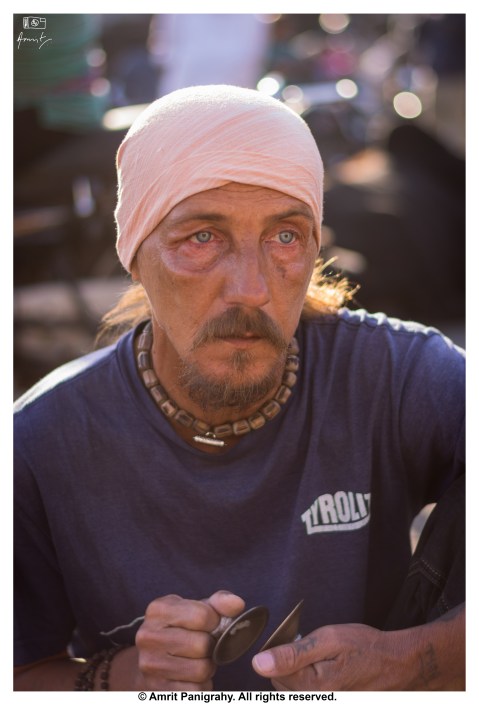
In frame: A Russian devotee of Lord Jagannath singing His praise right outside the Singhadwar (Lion gate) of the temple in Puri, Odisha. As was for Bhakta Salbeg, it is forbidden for this devotee also to enter the temple, because of his religion of birth and foreign origin.
VERY IMPORTANT TO NOTE: Yes, you can share this work with proper attribution. But, please seek permission before using this work (not including the photo), partially or fully. YOU CAN NOT USE THE PHOTO. Believe me, asking is better than ending up in court or facing public shaming on social media. Thanks for understanding.
The roar of the river, and so close,
Drowned everything including sound,
Couldn’t even hear my mind’s prose,
Beneath, the slippery shaky ground.
The whirlpool right in front of me,
Couldn’t fathom how deep it could go,
To be locked in it, and lose the key,
Forever, with no more despair to grow.
My mind’s whirlpool was getting bigger,
Consuming everything, from inside out,
Event that led to this, and the rigour,
Everything that I thought I knew about.
Stood there thinking, on the bank of the river,
Cold wind touched my skin and I began to shiver.
Lot of rejections, a failed life I thought,
People who once “adored” had started to hate,
This agony and pain, on myself I had brought,
There won’t be any if they left at this rate.
The image of a life I had in my mind,
Things that I had started to believe,
In last few days all of it came unwind,
It started to question my love to live.
It was the river I had followed,
All the way up, and on way back,
And saw everything it had mowed,
The mountains it made to crack.
I walked a few steps on the bank, and now closer,
Thought it was okay if the world called me a loser.
Everything started to become hazy,
Was getting ready to make the jump,
Thoughts in my head were going crazy,
Clearly heard my heart’s frantic pump.
Everything fell silent all around, including the river’s roar.
I clearly heard but turned to find no one, and it shook my core.
I had clearly heard my Mom’s calling,
But I couldn’t see her anywhere near,
Didn’t know what kept me from falling,
And the whole event too much to bear.
More than a year later, when I think of it,
Perilously close I actually was to commit.
Cannot thank enough the divine intervention,
A blunder it would have been, for any reason.
All these days, this past in me had dormantly lied,
Nothing remained same, that was the day “I” died.
The “I” that was meek, and fragile..
The “I” that was weak and easily broke….
Lot of things were unfolding in my life during that time, and the mountains had turned my life upside down. People had changed, definitions had changed, and outlook had changed, or so I thought. I was finding it really hard to cope with all of it at once. And it is that moment of weakness I have portrayed in my poem above. Depression is a killer. You might not be as lucky as I am to have a divine intervention. So, please talk it out.
Remember, suicide is a crime against your loved ones!
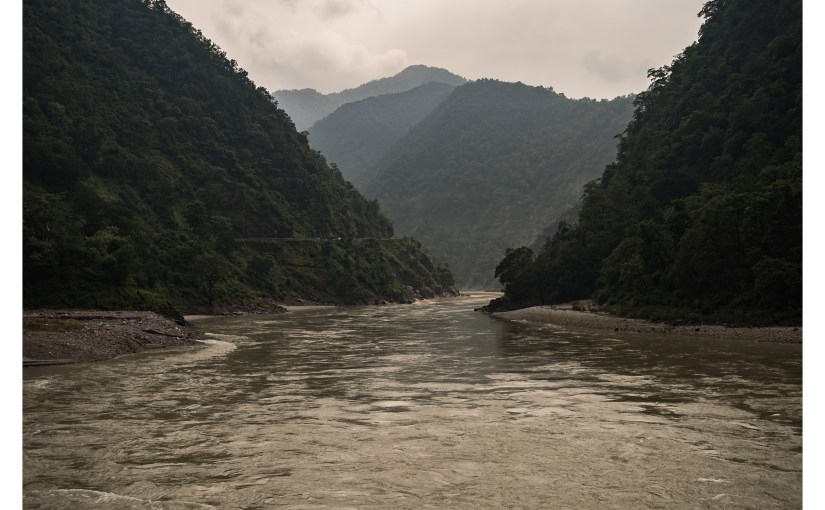
River Ganga flowing through a valley, under an overcast sky, downhill from Devprayag, in Uttarakhand, India.
In frame: River Ganga flowing through a valley, under an overcast sky, downhill from Devprayag, in Uttarakhand, India. It was here we had stopped for lunch on our last day in the mountains more than a year ago.
VERY IMPORTANT TO NOTE: Yes, you can share this work with proper attribution. But, please seek permission before using this work (not including the photo), partially or fully. YOU CAN NOT USE THE PHOTO. Believe me, asking is better than ending up in court or facing public shaming on social media. Thanks for understanding.
“The divine are extremely happy where women are respected; where they are not, all actions are fruitless.” – Manusmriti
All the women who are reading this, I beg for your forgiveness. I hope this International Women’s Day brings about a change, not just in words, but in actions too.
It was on the morning of 17th December 2012, I trembled as I read the gory details of what was done to Nirbhaya the previous night. How could men do those things to a woman? Were they men, after all? And weren’t they born to women? And Aruna Shanbaug, ever heard of her? Before dying, she spent forty three years in a vegetative state in Bombay hospital. Her only fault was she was alone in the basement of the hospital where she used to work as a junior nurse.
In India, five women get raped every hour, seven get assaulted every ten minutes. From worshiping the feminine form as the source of creation to committing unfathomable crimes against her, we as a society have deteriorated a long way. From revered Goddesses to not even as equals and objects of pleasure, how did this fall happen? This calls for some soul-searching as a civilization.
In 9,000BC, some eleven thousand years ago, emerge the first evidences of humans doing agriculture for the first time in the Indian subcontinent. Till then, humans had been hunter-gatherers, leading a primarily nomadic lifestyle. They would seasonally move up and down the subcontinent in search of food. Agriculture was a serious affair, the fields needed to be tended to, and the crops needed to be watered. And in this transitory phase, just when they were starting to hone their skills in agriculture, the humans of the subcontinent faced a new challenge. How to be hunter-gatherers and farmers at the same time?
Because the women were not as strongly built as their male counterparts, given their existence by nature was for a different purpose, the answer was obvious. The women stayed back and started to tend to the agricultural fields, while the men ventured out, at first to hunt/gather, and later in history to explore and conquer. There was the foundation of our civilization as a matriarchal one. And it functioned with women at the center, everything else revolving around them. Given the large role women played at that time in procreation and keeping the household sorted, they began to be revered as Goddesses. Progressively, women took over all the intellectual jobs/vocations, those which weren’t physically as demanding and did not include much travelling, and allowed them to act as the foundation of a household.
The early invaders of this civilization did not have much success, not because of the lack of their military prowess, but because the foundation of this civilization, its smallest unit, the household remained intact, thanks to the above design. Over the period, they changed their tactics and went after the very foundation itself. When the women were attacked, the men didn’t have a choice but to protect them, and hence they kept them inside the houses. After a few generations, the act of protection became “traditions”, and then followed the ill-practices of purdah and sati. As time passed women lost their rightful place in our societies, a seat above rest of us all, earned by them for being creators themselves.
We as a civilization failed them, and continue to do so even today!
First of all, women don’t need equal rights as men. Because, equal right would be equal in true sense if men too are capable doing things that women do, including managing a household, taking care of everyone’s needs and child birth. As a man myself, I am incapable. So, when feminists shout for equal rights, I cringe and rightly so!
Secondly, women were created better than men, and any objectification or anything considered demeaning in the household and outside needs to be dealt with sternly. The mindset that women as someone inferior needs to be shunned.
And lastly, just let her be. Stop ogling!
Remember, we can’t be the Vishwaguru if we keep ill-treating the source of creation itself.
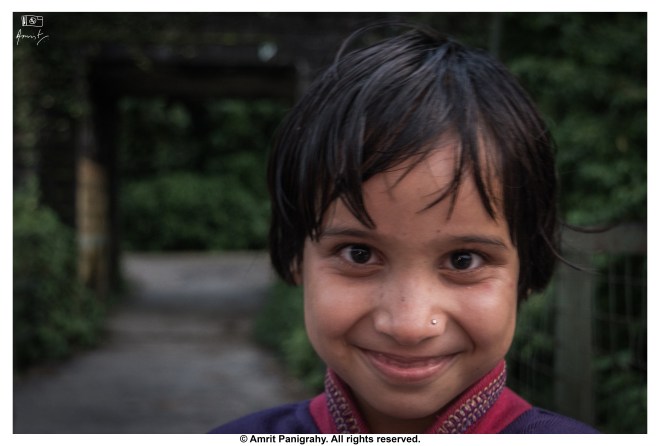
A small girl smiling for the camera on the hanging bridge across the Bhagirathi river, in Nautela, Uttarakhand.
In frame: A small girl smiling for the camera. Her smile could qualify for borderline grinning. I was busy taking photographs on the hanging bridge across the Bhagirathi river, in Nautela, Uttarakhand when I saw her and her tiny tot friends crossing. They were really fascinated by the camera in my hand.
VERY IMPORTANT TO NOTE: Yes, you can share this work with proper attribution. But, please seek permission before using this work (not including the photo), partially or fully. YOU CAN NOT USE THE PHOTO. Believe me, asking is better than ending up in court or facing public shaming on social media. Thanks for understanding.
हर एक आशियाने पे जैसे वो चला देती थी अपनी जादू की छड़ी,
सुला के सबको, सपनों की रखवाली करती हुई रात भर रहती थी खड़ी |
सुबह की पहली रोशनी के साये में जैसे वो लड़खड़ाती हुई चल रही थी,
सपनों से भरी रात के नशे से लगभग बेहोश, अपने कदमों को संभालती।
उसकी अपनी कदमों की आहट जैसे उसी के जादू को थी तोड़ रही,
मुस्कुराती, और एक रूहानी रात का वादा करके चली गयी, रूही।
The setting moon over Hyderabad’s skyline, as seen from Moula Ali, in Hyderabad, India.
As if she ran her magic wand over all the dwellings during the night, and after having made everyone fall asleep, she stood guard to their dreams. Under the shade of the first light of the morning (poetic expression), she unsteadily walked, still drunk on the dreams from the night, she tried keep herself steady. It was as if her own footsteps were undoing her magic spell, and with a smile on her face, Ruhi walked away promising another intriguing night.
It was magical indeed, my first ever photowalk, and first ever trip to Moula Ali, on the other side of Hyderabad. The moon was setting over the sleepy Hyderabadi skyline, and the dawn was breaking in the opposite direction.
These were my very early days in photography, when I was using a Sony HX100V (with a sensor that was 1/4th of what my current DSLR has). And I didn’t know RAW even existed (yes, perils of being self taught!), so bear with me for the resolution of the image.
In frame: The setting moon over Hyderabad’s skyline, as seen from Moula Ali, in Hyderabad, India. It was magical indeed, just being there at that moment, with the moon setting in front of me, and behind me, the dawn breaking.
VERY IMPORTANT TO NOTE: Yes, you can share this work with proper attribution. But, please seek permission before using this work (not including the photo), partially or fully. YOU CAN NOT USE THE PHOTO. Believe me, asking is better than ending up in court or facing public shaming on social media. Thanks for understanding.
King Indradyumna, who previously worshiped Lord Jagannath and built His temple in Puri, was born as Prataprudra, with the same opulences as Indra himself.(Gauro Ganoddesha Dipika)
When the reigns of Gajapati kingdom were handed over to Gajapati Prataprudra Deva, borders of Kalinga extended from river Ganga in Bengal in the north to Kaveri in the south and bordered the Bahamani in the west. His title read Gaudeshwara – Lord of Gaudadesh (present day Bengal), Nava Koti – King of nine crore subjects, Karnata Kalabargeshwara – Lord of Karnataka and Gulbarga (Bahamanis ruled from Gulbarga, or Kalaburgi as it is known today). Undoubtedly the most illustrious King of Kalinga, he was the longest serving monarch of the Gajapati kingdom and ruled for forty-three years (1497-1540 AD), and he was also the last. In 16th century AD the Indian subcontinent was going through unprecedented churning and the Gajapati empire of Kalinga was not untouched.
The last King to have ruled when Kalinga at its greatest extent also happened to rule during the time when Sri Chaitanya Mahaprabhu was spreading the message of Bhakti (devotion) through out the Indian subcontinent. Sri Chaitanya Mahaprabhu was believed to be an incarnation of Lord Vishnu himself. Such was his appeal among everyone that once when the fierce armies of Gajapati Prataprudra Deva and that of the Sultan of Bengal were fighting a battle with each other, He and His devotees crossed unharmed right across the battleground into Kalinga.
Gajapati Prataprudra Deva was a devout Vaishnava. Prataprudra Deva had always wished to meet Sri Chaitanya Mahaprabhu, but was denied audience, because Mahaprabhu was an ascetic, and having renounced material life He did not want to have anything to do with women and Kings. Till the time He had only heard that Prataprudra Deva led a very simple life, unlike that of any other King, having utmost respect for scholars and learned men. To test Prataprudra Deva further, He even likened Prataprudra Deva to a black snake obsessed with power. The King was disheartened and even went to the extent of abdicating the throne, so that he would be able to meet with Mahaprabhu. Prataprudra Deva was advised against it.
The King of Kalinga is not the King, but merely a servitor of Lord Jagannath, and rules the land in His name and only as His representative. Lord Jagannath is the true King. As a normal servitor, the King with a broom in his hands, sweeps the three chariots of the siblings – Lord Jagannath, Goddess Subhadra and Lord Balabhadra, during the annual Rathyatra festival, during which they embark on their annual visit to their aunt. And this has been the practice from millenia.
And it was during Rathyatra, that Mahaprabhu saw Prataprudra Deva sweeping the chariot like a common man. Impressed with Prataprudra Deva’s humility and piety, Mahaprabhu granted him a special power through which he could see miracle that was about to unfold. Prataprudra Deva saw there were seven groups of devotees dancing in front of the chariots, and each of the groups had Sri Chaitanya Mahaprabhu dancing with them. He was there with all seven groups, at the same time. Seeing the miracle Prataprudra Deva’s beliefs became stronger about Mahaprabhu being an incarnation of Lord Vishnu, and hence Lord Jagannath himself.
Devotees of Lord Jagannath praying when he appears on his chariot, during Rathyatra.
In the meantime, Prataprudra Deva saw that Mahaprabhu took a break from dancing and went to a nearby garden. He followed Him, changed his clothes from that of a King to that of a commoner, and started recited verses from Mahaprabhu’s favorite chapter from the Bhagavatam. Moved by the way the King recited the verses, Mahaprabhu told him, “I have nothing material with me to give you, however I can embrace you.” And then He embraced the King.
It is believed that the mythical King Indradyumna had built the Jagannath temple in Satyayug. Gundicha Devi, the aunt to whose place Lord Jagannath travels every year during Rathyatra was the queen of King Indradyumna. As events turned out, King Indradyumna could not meet his Lord for the last time before dying, and hence took birth as Gajapati Prataprudra Deva during the time of Sri Chaitanya Mahaprabhu so that he could meet his Lord in flesh and blood.
More about Gajapati Prataprudra Deva:
Gajapati Prataprudra Deva did not have a smooth sailing as the King. He was only seventeen years old when he faced his first challenge, an invasion from the north, by the Sultan of Bengal (1497-1500 AD). He had just finished defending the north of his empire, when he was challenged from the south, this time by the Vijayanagara empire (you can read more about the Vijayanagara empire in my earlier post called “The Torchbearer” by clicking here). His Vijayanagara campaign was about to end after eight years (1500-08 AD), when the Sultan of Bengal again sent his general, who taking advantage of the absence of Gajapati, was able to march all the way till Puri. Prataprudra Deva hurried back and in 1509 AD drove out the invading army of Sultan of Bengal.
In 1509 AD, the most illustrious emperor of Vijayanagara, Krishnadevaraya ascended the throne (you can read about Krishnadevaraya in one of my earlier posts by clicking here). He challenged the Gajapati’s supremacy, and Kalinga and Vijayanagara were locked in battle that lasted for seven years (1512-19 AD). The battle ended when Prataprudra Deva conceded defeat after the capture and death of his son and crown prince Virabhadra. The Gajapati had to retreat to the north of river Krishna as per the treaty. A few years later, the Gajapati supremacy was challenged by Quli Qutub Shah, of Qutub Shahi dynasty of Golconda, and remained greatly intact with only minor losses of territory.
Apart from defending the borders of Gajapati kingdom to a very large extent during a largely tumultuous period in the Indian subcontinent, Prataprudra Deva also patronized art and literature, himself having authored nine literary pieces in Sanskrit. It was during his time that the Panchasakha (five poets and friends Balarama Dasa, Jagannatha Dasa, Ananta Dasa, Achyutananda Dasa and Jasobanta Dasa) produced their best work and flourished despite being openly opposed to few of Prataprudra Deva’s actions. This proves that the King was very tolerant and lenient towards his dissenting subjects too.
With the Gajapati kingdom ended the military hegemony that Kalinga held in the Indian subcontinent, which had so far helped Kalinga sway history in its favor, right from the time of Emperor Kharavela in 2nd century BC.
You can read my other works related Lord Jagannath here:
1. A wait too long – Click here
2. Sees it all – Click here
3. Master of the Universe – Click here
4. The Krishna Connection – Click here
In frame: Devotees of Lord Jagannath praying when he appears on his chariot, during Rathyatra. This unique way of praying, extending two arms in the air with open palms symbolizes the devotees urging to Lord Jagannath to rescue them from the figurative mortal sea. Interestingly, the followers of Mahima Dharma also pray in a similar fashion.
VERY IMPORTANT TO NOTE: Yes, you can share this work with proper attribution. But, please seek permission before using this work (not including the photo), partially or fully. YOU CAN NOT USE THE PHOTO. Believe me, asking is better than ending up in court or facing public shaming on social media. Thanks for understanding.
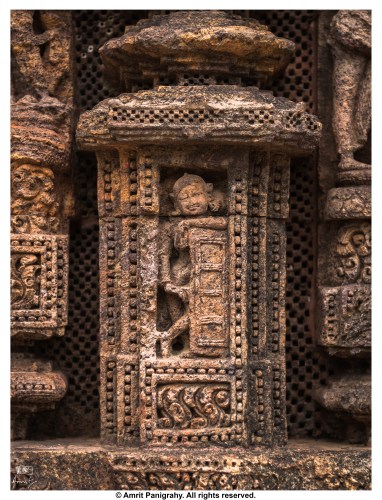
A sculpture of a lady waiting with half the door open, with a smile on her face. You can see this on the south side of Konark temple, in Odisha, India.
The Odia poem I wrote above is called “ଘରବାହୁଡା”, (pronounced as ghaw-raw-baa(as in baba)-hu(as in who)-da(as in dark), which means homecoming. A fiction based poem, the central character is a woman, who has been separated from his male consort or husband for twelve long years, because he is a sculptor by profession, and has been summoned by the King of the land, for construction of the Sun temple at Konark. She narrates how she dresses up every evening and stands near the door smiling, hoping against hope that he would come back, even though she had returned inside disappointed the previous evening. It has been twelve years and even her mom has now lost hope that he would ever return, but she stands and waits every evening, no matter how late. Even the pearl necklace that he had gifted her has become pale, as if tired of waiting for him and asking her whether he would ever return. Looking at her standing at the door every evening, people around her have starting thinking of her a dance girl, or a whore, in search of patrons. Then she goes on to urge him to come back home as soon as possible, regardless of the temple completion.
This sculpture, might be a figment of imagination of the sculptor, shows how his consort or wife might be waiting for him to return. By the time he must have finished this sculpture, he must have been away from home for twelve long years, or slightly more. Did you notice the smile on the figurine’s face? This was how the sculptor must have imagined to see her upon his return home, with a smile on her face.
1200 architects and sculptors took twelve years to build the Sun temple at Konark and it was finished in 1256 AD. King Narasimha Deva III spent 40cr gold coins to build this architectural marvel, the cost also included that of land reclamation from the sea (you heard that right!), as it is believed that the temple was built in the sea. There are many legends and stories associated with Konark, which I am saving for some other time, with your permission of course!
In frame: A sculpture of a lady waiting with half the door open, with a smile on her face. You can see this on the south side of Konark temple, in Odisha, India. Konark temple is full of sculptures which showcase every human emotion, and not only erotica as is popularly believed. In the words of Ravindranath Tagore, “Here the language of stone surpasses the language of human.”
VERY IMPORTANT TO NOTE: Yes, you can share this work with proper attribution. But, please seek permission before using this work (not including the photo), partially or fully. YOU CAN NOT USE THE PHOTO. Believe me, asking is better than ending up in court or facing public shaming on social media. Thanks for understanding.
Bira (pronounced as Bee-raw, meaning brave in Odia) was born into a Brahmin family, in a Brahman Sasan. In Odisha, a Brahman Sasan is a village where every family is Brahmin. He grew up witnessing the monster called Brahmin supremacy and the twisted, distorted Hindu Sanatan religion. Tired of it, he and few of his friends went to Joranda and embraced Mahima Dharma. That was seven decades ago.
The allegation that was levelled against Bira was that he had converted and was no more a Hindu, so he and his family need to pay a fine to continue to stay in the village, to which Bira sternly refused. As a result, his family was banished from their ancestral village. One of main reasons was, even after being a Brahmin himself, Bira had challenged their supremacy. All other families of the village were asked to not keep any kind transaction with his family.
In the meantime, a letter was written to the high seat of Hindus in Jagannath temple, in Puri, asking them to advise a future course of action in Bira’s case. To which, they replied that it was settled long back and Mahima Dharma was very much a part of the Sanatan Hindu fold. After the ban on Bira’s family was lifted, having his point proven he chose to stay back in his ancestral village fighting further religious atrocities and intolerance, till he left for a city close by for his children’s education few decades later.
Bira Panigrahy was my grandfather. Of the group of people who embraced Mahima Dharma on that day, more than seven decades ago, only my grandfather continued to be a follower till his death. Any history of my association with Mahima Dharma would be incomplete without mentioning the brave man who was much ahead of his time. As I sat down to write this post, devotional songs written by the blind poet Bhim Bhoi and sang by Mahima devotees rang in the background. The devotees, even though having full time professions, accompany the monks wherever they go. They were at our home as we were conducting something known as a “Balyaleela”, a yagna of sorts. The occasion this time was my grandfather’s death anniversary.
As per the teachings of Mahima Swamy (as the Master of Mahima Dharma is called), a human doesn’t need any intermediaries to reach the Supreme. All humans are born equals despite caste, creed, color, race, gender and religion. That there is only one God, the Supreme, who is shapeless and colorless, the nothingness in other words. The Supreme resides in every living and non-living being and everything resides in the Supreme. Mahima Dharma is a form of Vishisht Advaita, where every living being is respected equally. Followers of Mahima Dharma worship the nature and the universe, the nothingness within and without, and pray for well being of every living being of the universe.
A Mahima monk accepting a coconut being offered by a follower of Mahima Dharma at “Dhuni Mandir”, the temple of fire in Mahimagadi, at Joranda, Dhenkanal, Odisha. The offered coconut will be burned in the holy fire.
The monks of Mahima Dharma as directed by Mahima Swamy himself follow an extremely ascetic lifestyle. For example, when they visit the houses of devotees, they not allowed to stay for more than a night, and are not supposed to go inside the house. They eat under the open skies, and are not allowed to sleep on beds for the rest of their lives. Giving up basically everything that would even remotely qualify as modern comfort. They have only one task at hand, spread the message of the Master, and in the process move ahead in their spiritual journey.
When I was on a road trip with parents in Odisha few months back, something strange had happened. After having spent few minutes in the Indralath temple, in Ranipur-Jharial, we came out and were getting ready to get inside the car. A drunk shepherd approached my father from nowhere, and told him “A Mahima monk had come here many many years ago when I was a kid. And he hosted a “Balyaleela” (a ritual done on special occasions), and there were lakhs of people.” There were no identifications either on my father or on our car which suggested that any of us were a follower of Mahima Dharma. The followers of Mahima Dharma are a very very small fraction of the total population.
Before that, when I had gone to see Puri during Rathyatra last year, I received a call from an unknown number. On the other side was a Mahima monk who visits our family very often. “Have you become a Jagannath devotee?”, he asked me, when on being asked I told him that I was in Puri. Worshiping deities, shapes or forms is forbidden in Mahima Dharma.That the monk had called me for the first time ever, when I had come to see Lord Jagannath had to mean something; also, what the drunk shepherd was mumbling in front of the Indralath temple.
The celestial message was clear to me. I had to go visit the Mahimagadi, the seat of Mahima Dharma at Joranda, in Dhenkanal, Odisha. And what better time than the annual Maghmela, on the full moon day in the Hindu month of Magh.
On 31 January, 2018, Joranda was a mission accomplished!
VERY IMPORTANT TO NOTE: Yes, you can share this work with proper attribution. But, please seek permission before using this work (not including the photo), partially or fully. YOU CAN NOT USE THE PHOTO. Believe me, asking is better than ending up in court or facing public shaming on social media. Thanks for understanding.
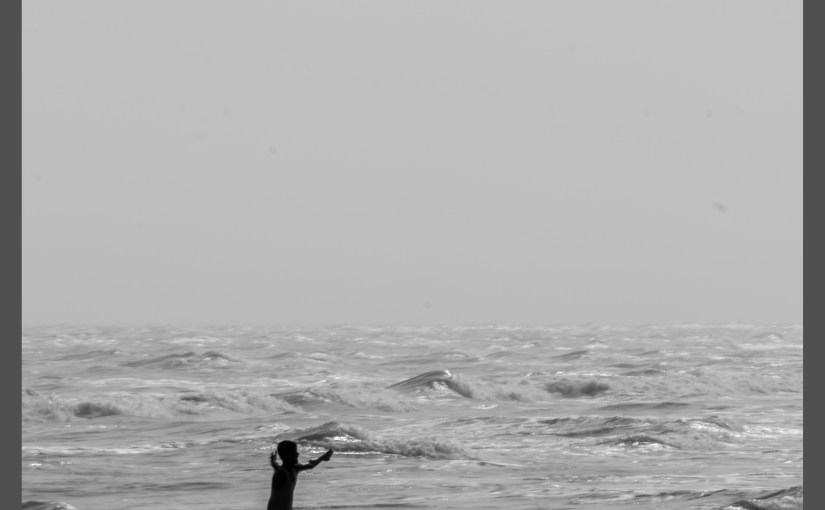
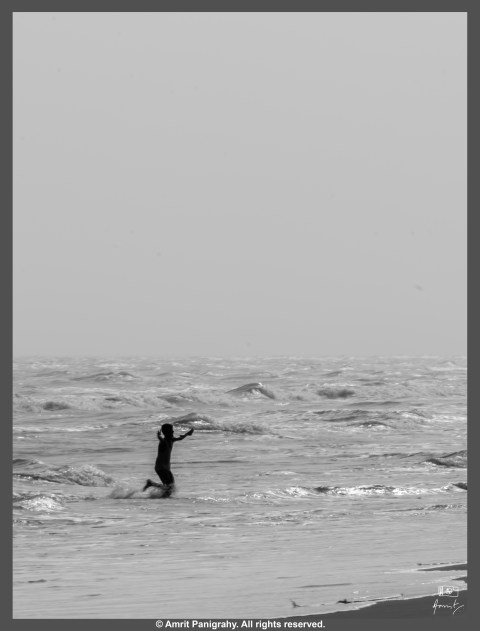
A young man running back to the shore from the sea
A song for the year, I had promised to write,
Taking time out in the middle of the night,
Thoughts rusty, and not organised so well,
But an year it was and many tales to tell.
So, here it is!
Before the year started, in hindsight it was like…
Retreating waves pulled me back to the sea,
Like vices in whose vice like grip I was in,
Vices I left behind on my way to the coast,
And to those no one would raise a toast.
With questions and no answers I started my year,
A start with much less joy and surely a lot of fear,
As if I stepped into the unknown blindfolded,
Fear of an uncertain future, and what lay ahead.
It was the best one ever. To sum it up…
I travelled ten thousand kilomeres on road,
To new places about which I had never heard,
Met people I would never see in my life again,
But memories of a lifetime, of joy and of pain.
I let go of the hands that I never thought I would,
Stopped missing people I never imagined I could,
Worked on myself and learned to be with me,
Had I felt bored with myself, I was in bad company.
Started to see every living being for what they were,
My lack of compassion, and it was totally unfair,
Biggest lesson was on empathy and to be able to relate,
Thank my stars I learned in time, and it wasn’t too late.
The universe has been very kind to me in return,
A lot of gifts and people with best intentions,
Gifts that will stay with me for my entire life,
People who will stay and will help me thrive.
When the waves pulled me, I came back riding them,
Stronger, wiser, calmer, compassionate and brave.
Now with 2017 behind me, here is my 2018 wish for you….
May you have my 2017, if not better than that,
I wish this for you from the bottom of my heart.
Call it a rhyme or a poem, this is my year song,
A song, I won’t mind humming whole life long.
2017 was a life changing year for me, with a lot a of changes for good. This is how good a year it was, in my own words, as a poem.
In frame: A young man running back to the shore from the sea, near Baruva, in Andhra Pradesh, India.
VERY IMPORTANT TO NOTE: Yes, you can share this work with proper attribution. But, please seek permission before using this work (not including the photo), partially or fully. YOU CAN NOT USE THE PHOTO. Believe me, asking is better than ending up in court or facing public shaming on social media. Thanks for understanding.












 Amrit Panigrahy